
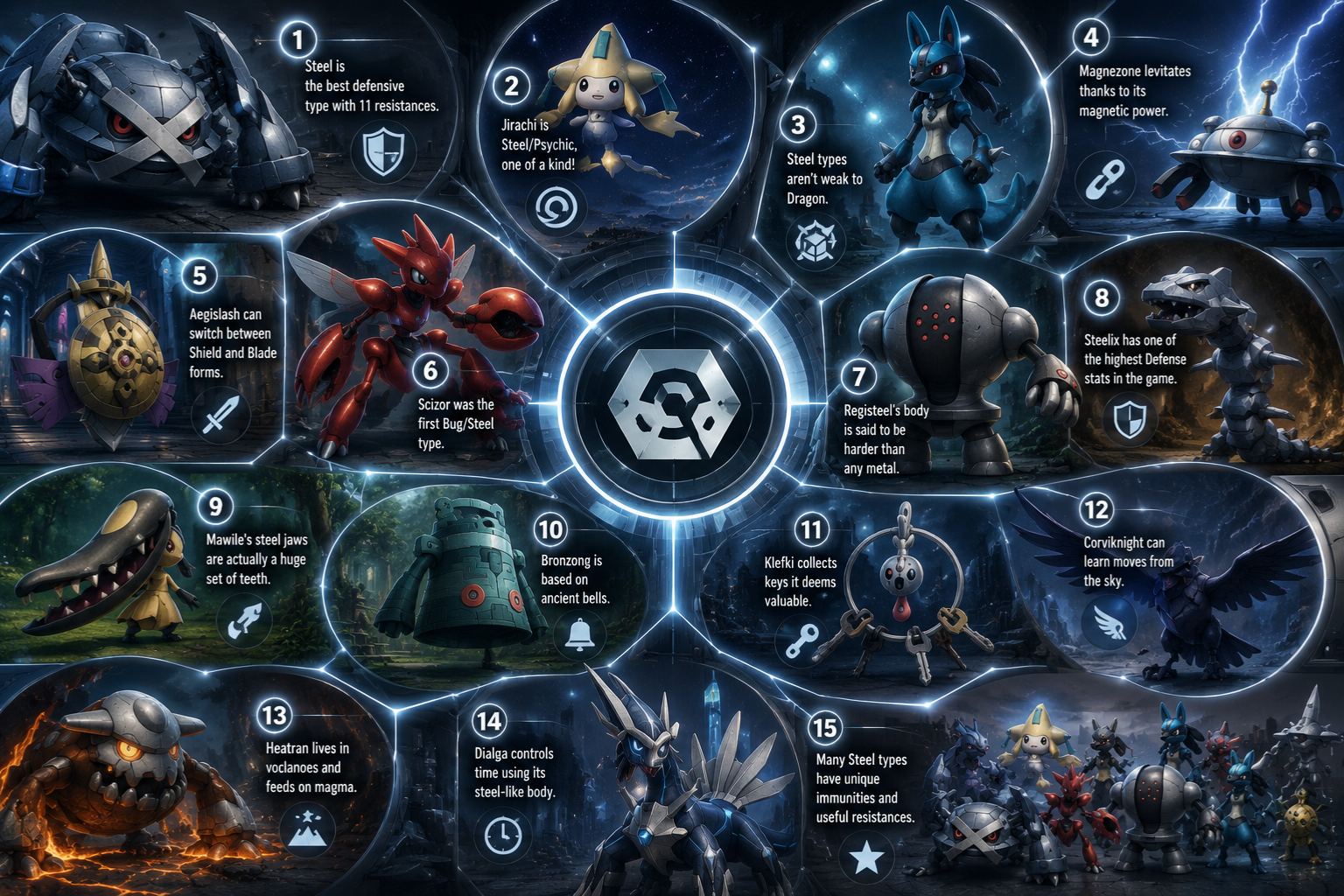
Steel type Pokemon are one of the most defensively dominant types in the entire franchise. Introduced in Generation II alongside Dark types, they were specifically added to balance the game — and they’ve been doing that job ever since. With resistances to 10 different types and immunity to Poison, no other type in the game comes close to that level of defensive coverage.
What’s interesting is that steel types weren’t always beloved. When Gold and Silver dropped, many casual players overlooked them entirely. Competitive players, though, figured out pretty quickly that slapping a steel type on your team meant your opponent had to work twice as hard to get through your defensive core.
History Behind Steel Pokemon
The decision to add steel type Pokemon to Generation II was directly tied to the developers wanting to nerf Psychic types, which had dominated Generation I almost completely. Psychic Pokemon like Alakazam and Gengar were nearly unbeatable in the original Red and Blue, so Game Freak introduced types that could resist or challenge them. Steel became that immovable wall — slow, tanky, and frustrating to face.
You can learn more about game design strategy and how it applies to franchise balancing in ways that mirror how Pokemon’s type chart evolved over decades of development.
Back in the Johto days, there were only a handful of steel types. Steelix, Scizor, Magnemite’s evolutionary line, Skarmory — that was basically it. The scarcity made them feel special, like you’d found something rare and powerful.
Most Iconic Steel Type Pokemon
Scizor has to be at the top of this list. With a base stat total of 500 and a moveset that includes Bullet Punch — one of the fastest priority moves in the game — Scizor has been a staple in competitive play for over 20 years. That’s an insane run for any Pokemon to stay relevant.
Metagross is another name that every serious trainer knows. Pseudo-legendary status, 600 base stat total, and the ability to hit like a truck while barely taking any damage in return. Steven Stone, the Champion of Hoenn, uses Metagross as his signature Pokemon for good reason. It looks cool, hits hard, and takes hits like nothing happened.
Aegislash deserves a mention specifically because it plays completely unlike any other steel type Pokemon. Its stance-change ability means it switches between a defensive form and an offensive form based on the move you use. That kind of mechanical uniqueness is rare in the franchise.
Steel Type Weaknesses Explained
For all their defensive strengths, steel type Pokemon do have vulnerabilities. Three types can hit steel for super effective damage: Fire, Fighting, and Ground. That’s it. Three. Compared to most types which have five or more weaknesses, steel types sit in an incredibly comfortable position.
Fire is probably the most common threat you’ll encounter. Many competitive teams carry a fire type specifically as a counter to steel, and moves like Flamethrower, Fire Blast, and the particularly scary Magma Storm from Heatran can punish steel types hard. If your steel type lacks a good Fire resistance or a way to pivot out, you’ll feel it.
Ground is sneaky because many steel types are also part Poison — wait, that’s not right. What makes Ground dangerous is that most steel types are grounded, meaning they can’t avoid Earthquake unless they have Levitate or an Air Balloon. Running an Air Balloon on Excadrill is actually a common tech in lower ladder play for this exact reason.
Steel Type Moves Worth Learning
Iron Head, Flash Cannon, and Meteor Mash are the three big moves that define the steel type Pokemon offensive toolkit. Iron Head has 80 base power with a 30% flinch rate — that’s honestly a little broken when you have a fast attacker using it repeatedly. Steel Beam is a newer addition with 140 base power, but it cuts your HP in half after use, so it’s more of a desperation option.
Gyro Ball is one of the more creative moves in the franchise. Its power scales with how much slower the user is compared to the target. Steelix, which has one of the lowest speed stats in the game, can hit absurdly hard with Gyro Ball against speedy opponents. It rewards building slow, bulky steel types in a way that other moves don’t.
Don’t overlook Smart Strike either. It never misses, which matters more than people realize in competitive play. When your opponent has raised their evasiveness or you’re dealing with accuracy-dropping weather or abilities, having a reliable steel move that always connects is genuinely valuable.
Best Steel Types Competitively
According to Smogon’s usage statistics, Corviknight, Heatran, and Ferrothorn have consistently ranked among the most-used steel type Pokemon in the OU (OverUsed) tier over the past several generations. That consistency tells you something — these aren’t just popular, they’re structurally excellent.
Heatran is particularly interesting because it’s a dual Fire and Steel type, which gives it a unique set of resistances and an immunity to Fire moves through its Flash Fire ability. Normally Fire is steel’s biggest weakness, so Heatran essentially patches that hole by itself.
Ferrothorn is the ultimate passive wall. Iron Barbs punishes physical attackers every time they hit it, and combined with Leech Seed and Spikes, it turns every turn into slow, grinding attrition. If you’ve ever lost to a stall team, Ferrothorn was probably involved.
Steel Pokemon in Early Games
Steel type Pokemon in Generations I and II were deliberately limited in number. Game Freak introduced just 9 steel type Pokemon across those first two generations, keeping them rare and special. By the time Generation VI rolled around, the steel type had the highest number of resistances of any type — 11, including an immunity to Poison.
In Generation VI, the Fairy type was introduced and steel lost its resistance to Ghost and Dark moves. This was actually a significant nerf that changed how steel types were used in competitive play. Many players were frustrated, but it made the metagame more interesting by giving Fairy types a reliable partner in steel that checked Dragon types, while steel no longer walled Ghost types indefinitely.
The Gen II games also introduced the physical/special split differently than later games. All steel moves were physical by default in those early games, which made some steel type Pokemon much harder to use effectively until Generation IV changed everything.
Steel and Fairy Type Combo
The steel and Fairy dual typing is widely considered the best defensive combination in the entire Pokemon franchise. Together, they cover each other’s weaknesses almost completely — Fairy resists Fighting and Dark (two of steel’s problem types), while steel resists Poison and Steel moves that would otherwise threaten Fairy types.
Magearna and Klefki are two steel/Fairy type Pokemon that exemplify this combo, but the biggest name is obviously Togekiss — wait, Togekiss is Normal/Fairy. The real queen of this typing is Magearna, a mythical Pokemon with a soul-heart ability that boosts Special Attack every time an ally faints. That’s creepy and also very powerful.
Zacian in its Crowned Sword form is currently the most dominant steel/Fairy type in existence. Banned from standard play entirely, it’s the kind of Pokemon that warps entire formats around itself. Its Intrepid Sword ability raises Attack by one stage on entry, and it already has 170 base Attack before that bonus.
Legendary Steel Type Pokemon
Steel type Pokemon appear frequently in the legendary category, and it makes thematic sense. Steel represents endurance, permanence, and power — qualities you’d naturally associate with legendary creatures.
Dialga, the temporal legendary from Generation IV, is a Steel/Dragon type that controls time itself. Mechanically, the steel typing makes it significantly bulkier than most Dragon types, giving it a distinctive defensive profile that sets it apart from Palkia and Giratina.
Solgaleo from Generation VII is a Psychic/Steel type that serves as one of the box legendaries for Sun and Moon. Its Sunsteel Strike move is a signature attack that ignores the target’s ability — meaning abilities like Sturdy or Multiscale don’t protect against it. That’s a genuinely scary attack to face.
Steel Type in Gym Battles
Gym leaders and Elite Four members who specialize in steel type Pokemon are consistently among the hardest battles in their respective games. Jasmine in Johto with her Steelix, Byron in Sinnoh with his Bastiodon and Bronzor — these fights forced players to think differently about their teams.
Steven Stone in Hoenn takes it further by being the actual Champion with a full steel-heavy team. His Metagross, Skarmory, Aggron, and Armaldo present a genuine challenge even to players who think they’ve got the steel type figured out.
Wikstrom of the Kalos Elite Four is another steel specialist worth mentioning. His Probopass, Klefki, Scizor, and Aegislash team in Pokemon X and Y represents one of the more well-rounded steel type Pokemon lineups any NPC trainer has ever fielded.
How Steel Types Evolved
The design philosophy behind steel type Pokemon has shifted dramatically over the years. Early steel types looked like robotic or metallic versions of existing creatures — Steelix is literally a metal Onix, Scizor is a metal Scyther. Simple, clean transformations.
By Generation V, designers started getting more creative. Klinklang is literally spinning gears. Ferrothorn looks like a spiked metal plant crossed with a sea mine. These weren’t just metallic animals — they were industrial concepts brought to life as creatures.
Generation VIII pushed this even further with Copperajah, Perrserker, and the Galarian forms of existing Pokemon. Galarian Meowth became a steel type after spending so long on ships that its coin hardened into iron. That’s a genuinely creative piece of in-universe worldbuilding that rewards paying attention to the Pokedex entries.
Rare Steel Type Paradox Forms
Scarlet and Violet introduced Paradox Pokemon, and some of the most interesting ones are steel type Pokemon from ancient or future timelines. Iron Treads, Iron Hands, and Iron Valiant are future forms of Donphan, Hariyama, and Gardevoir respectively — all carrying the steel type as part of their futuristic robotic design.
Iron Valiant in particular became a competitive powerhouse almost immediately after release. With access to Close Combat, Moonblast, and a blazing base 116 Speed, it combined the offensive power of both Gallade and Gardevoir into one package with a steel typing that added bulk.
Ancient Paradox forms like Great Tusk took a different direction — going back to prehistoric roots rather than futuristic steel. But the future Paradox forms show that steel type Pokemon will likely remain relevant as long as the franchise continues to evolve.
Steel Type Team Building Tips
When you’re building a team around steel type Pokemon, the first thing to solve is your Fire weakness. You need either a water type to absorb fire moves, a dedicated switch-in for fire attackers, or a steel type like Heatran that already patches the Fire vulnerability on its own.
Volt Switch and U-turn synergize brilliantly with steel type Pokemon as defensive pivots. You bring in your Corviknight or Scizor, force your opponent to react, then use a momentum move to bring in something more offensive. This kind of pivot-based play is fundamental to how good teams operate in the current metagame.
Entry hazards love steel types and vice versa. Ferrothorn sets Spikes and Stealth Rock, Klefki sets Spikes and dual screens — many steel type Pokemon are specifically designed to set up the board for the rest of your team. If you enjoy hazard-based play, building around a steel type setter is a great starting point.
Steel Pokemon Pokedex Entries
Pokedex entries for steel type Pokemon are consistently some of the most dramatic in the franchise. Aegislash’s entries describe it as capable of influencing the hearts of kings and guiding the fate of kingdoms. Metagross’s entry states it has four brains linked together and is smarter than a supercomputer.
Corviknight’s entry notes that it is so powerful that it serves as a taxi service in the Galar region, flying trainers across the map. That’s less dramatic but honestly more charming — a terrifying iron crow that moonlights as public transportation.
Steelix’s entry claims its body has been compressed under incredible pressure underground for so long that it’s harder than any metal on Earth. That’s a cool concept, and it explains mechanically why Steelix has such absurd physical Defense despite not being particularly fast or offensively impressive.
FAQ: Steel Type Pokemon
Q: What are steel type Pokemon weak to?
Steel type Pokemon are weak to Fire, Fighting, and Ground type moves. These three types deal double damage to steel types, and they’re the primary things you need to watch out for when using steel on your team. Fire is typically the most common threat in competitive play.
Q: How many steel type Pokemon exist in total?
As of Generation IX (Scarlet and Violet), there are over 80 Pokemon with the steel type either as a primary or secondary typing. The number grows with each new generation, and steel remains one of the most consistently expanded types in the franchise.
Q: Which steel type pokemon is best for competitive play?
It depends on the format, but Heatran, Corviknight, and Ferrothorn are consistently strong choices in standard formats. Zacian (Crowned) is the strongest steel type Pokemon in existence but is banned from most play. Metagross and Scizor are also perennial favorites.
Q: Can steel type Pokemon learn non-steel moves effectively?
Yes — most steel type Pokemon have broad movepools that let them run Fire, Ice, or Fighting coverage moves to handle their own checks. Metagross famously runs Ice Punch and Thunder Punch alongside its steel moves, while Scizor uses Bug Bite and Superpower for coverage.
Conclusion
After everything we’ve covered, the conclusion is pretty clear: steel type Pokemon are not just good — they’re structurally essential to how the Pokemon franchise balances itself. Whether you’re building a competitive team or just trying to get through the story with a reliable partner, a steel type Pokemon almost always earns its place.
The sheer defensive utility they bring — 10 resistances, one immunity, and the ability to check Dragon and Fairy types simultaneously — makes them the Swiss Army knife of competitive team building. Steel type Pokemon have been relevant since Generation II and show no signs of losing that relevance.
What makes steel types genuinely interesting isn’t just the numbers. It’s the variety. From the sluggish, immovable Steelix to the blazing-fast Scizor, from the passive Ferrothorn to the stance-shifting Aegislash, steel type Pokemon cover an enormous range of playstyles. There’s a steel type for every kind of trainer.
If you haven’t seriously used a steel type Pokemon on your team before, this is the encouragement you need to try. Build around Corviknight for defensive utility, pick up Scizor for offensive pressure, or give Metagross a shot if you want a straightforward powerhouse that rarely lets you down. The steel type has been tested across 25+ years of competitive play, and it keeps passing every test.