


Maryland business entity search is one of those free government tools that most business owners discover either too late or by accident. Someone’s already filed under the name you wanted. A vendor you were about to pay a deposit to turns out to be administratively dissolved. A competitor you assumed was legitimate hasn’t filed an annual report in three years. All of that information was sitting in a public database the whole time. Free. Searchable. Two minutes away.
That’s the thing about Maryland business entity search that doesn’t get said enough. It’s not just a name availability checker. It’s a business intelligence tool that most entrepreneurs treat like a phone book when it’s actually closer to a background check. And in a business environment where mistakes cost real money and real time, knowing how to use this tool properly is not optional anymore. It’s foundational.
This guide covers everything. What the database actually contains, how to search it without losing your mind, what the results mean, where the tool hits its limits, and how smart Maryland business owners are using it in ways most people never think to try.
Maryland Business Entity Search Is Maintained by SDAT and That Context Changes Everything
The Maryland business entity search database lives on the portal of the State Department of Assessments and Taxation, universally known as SDAT. This is the Maryland agency responsible for chartering new business entities, processing annual report filings, maintaining public records on registered businesses, and handling personal property assessments for business assets.
Knowing SDAT runs this system is not just administrative trivia. It tells you precisely what the database tracks and what it doesn’t. SDAT records cover state registration status, annual filing compliance, registered agent information, entity type, date of formation, and charter document history. That’s a specific and genuinely useful body of information once you understand what you’re looking at and stop expecting it to answer questions it was never designed to address.
The database does not track federal tax compliance. It does not show court judgments, active litigation, UCC filings, or financial health in any form. SDAT shows whether a business is properly registered and compliant with Maryland state filing requirements. That’s the lane. Stay in it and the tool is powerful. Expect it to do something outside that lane and you’ll make decisions based on incomplete information.
How to Actually Run a Maryland Business Entity Search Without Getting Frustrated
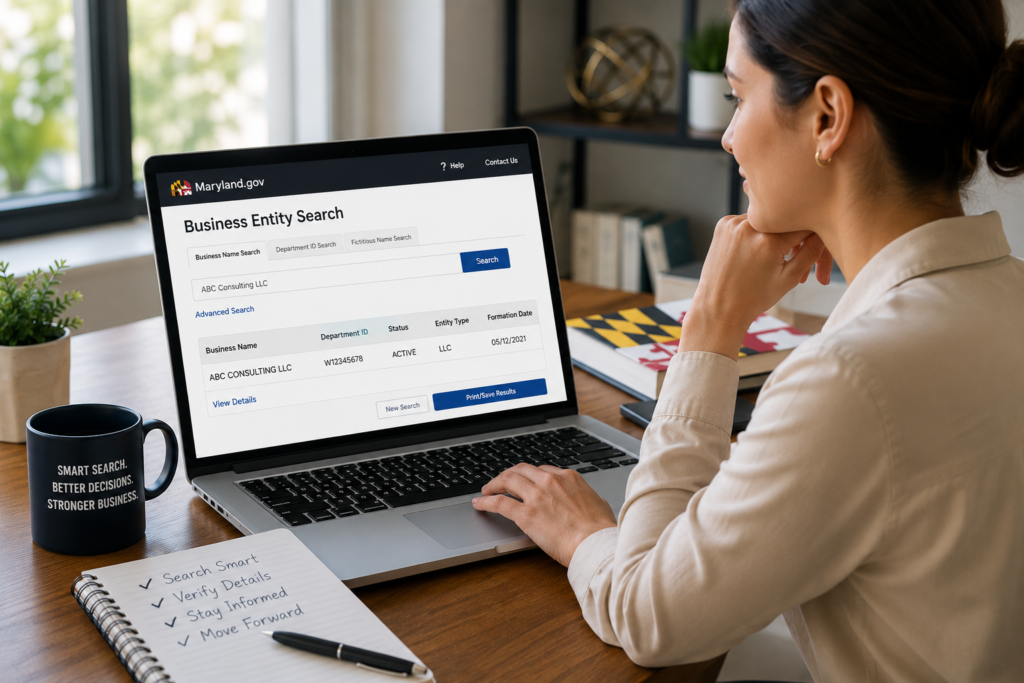
The SDAT search portal is functional but it has specific quirks that trip up first-time users more than they should. The most common approach is searching by business name and the most common outcome for first-time users is confusion when the entity they’re looking for doesn’t appear.
The database is sensitive to how a name was originally registered. Punctuation matters. Spacing matters. Entity suffixes like LLC, Inc, Corp, and LP affect search results differently depending on how the original registration was filed. Searching “Blue Harbor Consulting” might return nothing while “Blue Harbor Consulting LLC” returns the exact entity you needed.
The smarter approach for most searches is partial name search. Type only the most distinctive word or short phrase from the business name rather than the full registered name. Let the results populate and then scan the list. This approach catches more entities and avoids the frustration of exact-match failures. The portal also has separate search fields for entity ID number and resident agent name — two search paths most users never discover because nobody points them there. For a useful comparison of how neighboring state business search databases handle similar queries differently, this walkthrough on sos nc business search shows how search logic varies between state systems in ways that matter practically.
The Deadly Name Availability Mistake That Ruins New Businesses Before They Start
Here is the single most expensive mistake entrepreneurs make with Maryland business entity search and it happens constantly. A founder searches for their desired business name, finds it isn’t registered in the SDAT database, and concludes they’re clear to use it. They spend money on logo design. They build a website. They print business cards. They file their formation documents. And then months later they receive a cease and desist letter from a business operating under a federally trademarked name that happens to be very similar to theirs.
Maryland business entity search tells you whether a name is registered with Maryland SDAT. It does not tell you whether that name is available for use in commerce. Those are two genuinely different questions with two genuinely different answers in many cases.
Federal trademark protection operates through the USPTO as a completely separate system from any state business database. A business operating nationally or in another state may hold federal trademark rights that extend into Maryland regardless of what the SDAT database shows. Before committing to any business name based on a Maryland business entity search result alone, running a trademark search through the USPTO database is not optional. It’s a basic due diligence step that takes twenty minutes and can prevent a rebranding situation that costs thousands. The United States Patent and Trademark Office provides a free trademark search tool that every new business owner should use as a standard part of the name clearance process before spending a single dollar on branding.
Reading Entity Status Fields Correctly Protects You From Costly Mistakes

The status field in a Maryland business entity search result is one of the most practically important pieces of information the database provides and most people glance at it without understanding what they’re actually reading. Let’s fix that.
Active or good standing means the entity is current on its annual report filings and fees and is legally authorized to conduct business in Maryland. This is the status you want to see on your own entity and the status you want to confirm when dealing with vendors, partners, or contractors.
Forfeited means the entity has lost its good standing with the state due to missed annual report filings or unpaid fees. A forfeited entity cannot legally enter into contracts in Maryland. This matters enormously when you’re about to sign a service agreement, hand over a deposit, or enter a joint venture with another business. Checking their status takes three minutes. Discovering after the fact that your contract partner was forfeited when you signed creates legal complications that take significantly longer to untangle.
Dissolved means the business was formally closed. Voluntary dissolution means the owners chose to close the entity through proper legal process. Administrative dissolution means the state dissolved it for noncompliance. Either way a dissolved entity is no longer a legally operating business in Maryland regardless of whether it still has a website or answers a phone.
Revived or reinstated means a previously forfeited or dissolved entity was restored to good standing after correcting its compliance issues. This status is worth noting because it tells you the entity had a compliance problem at some point. Not automatically disqualifying but worth asking about if you’re considering a significant business relationship.
Resident Agent Information and the Practical Uses Most People Never Consider
Every entity registered in Maryland is required to maintain a resident agent — a designated person or professional service authorized to receive official legal and government correspondence on behalf of the business. Maryland business entity search displays the resident agent name and address for every registered entity and this information has several practical applications that most users never think to use.
If you need to serve legal notice on a Maryland business the resident agent address is the legally recognized delivery point for that notice. If you’re researching who actually controls a business that presents itself without obvious ownership information the resident agent record sometimes provides a useful starting point for further investigation. Large businesses frequently use professional registered agent services which limits how much individual owner information appears but smaller businesses often list a principal or attorney directly.
If you’re managing your own Maryland business registration confirming your resident agent information is current and accurate in the SDAT database deserves attention at least once per year. An outdated address means official correspondence from the state goes somewhere other than where you actually are. Annual report reminders, tax notices, and legal service documents all route through the resident agent. Letting that information go stale creates problems that are entirely preventable with a five-minute check.
Annual Report Filing History Tells the Real Story Behind Any Business

The Maryland business entity search database shows annual report filing history for registered entities going back through the life of the business and this history is more revealing than most people realize when they’re evaluating someone to do business with.
A business that has filed its annual report consistently every year since formation without gaps or reinstatements is a different kind of operation than one that has missed filings, lost good standing, been administratively dissolved, paid reinstatement fees, missed again, and repeated that pattern across several years. Both businesses might show an active status today. Their filing histories tell very different stories about operational discipline and management attention to basic compliance requirements.
This filing history matters most in three specific situations. First when you’re evaluating a potential long-term vendor or supplier and want to understand how seriously they manage basic business obligations. Second when you’re considering a business partnership or joint venture and want a picture of how the other entity has been managed. Third when you’re thinking about acquiring an existing Maryland business and need to understand the compliance history as part of due diligence. For anyone going through a business acquisition process, this comprehensive guide on business for sale covers the full due diligence framework that should accompany any acquisition with entity history verification as a standard early step in that process.
Using Maryland Business Entity Search to Research Competitors Intelligently
Most entrepreneurs think of Maryland business entity search purely as a compliance and verification tool. Smart business owners use it as a competitive research resource and the difference in how much useful information they extract is significant.
When you look up a competitor in the SDAT database you learn when they incorporated or formed their LLC. That tells you how long they’ve actually been operating as a formal entity regardless of how established they present themselves as being. You learn their entity type which tells you something about how they’ve structured their business legally. You learn who their resident agent is which sometimes reveals attorneys or professional service providers they work with. You learn their principal office address which tells you where they’re actually based if they present an ambiguous geographic identity.
None of this is private information. It’s public record specifically because the state requires transparency in business registration. Using public records to understand your competitive landscape is not only legitimate it’s basic market intelligence that costs nothing and takes minutes. Most of your competitors are not doing this. That gap is an advantage worth using. For a broader look at how market intelligence fits into business strategy, this overview of market research covers the frameworks that turn raw public data into actionable competitive insight.
What Happens When You Find the Business You’re Looking for Is Forfeited
This scenario comes up more often than people expect. You run a Maryland business entity search on a vendor you’ve been working with or are about to work with and their status comes back forfeited. What do you do with that information?
First don’t panic and don’t immediately assume fraud. Many businesses go forfeited simply because an annual report slipped through the cracks during a busy period. The owner may not even know it happened. Forfeiture in Maryland can occur surprisingly quickly after a missed filing deadline and small business owners operating without dedicated administrative support miss these deadlines more often than anyone would like to admit.
What you do with a forfeited status finding depends entirely on context. If you’re about to sign a significant contract with this entity that discovery should pause the process until they demonstrate reinstated good standing. A business can reinstate in Maryland by filing the overdue annual reports and paying the associated fees. If they’re a legitimate operating business they can resolve a forfeiture situation relatively quickly. If the discovery of forfeited status is met with evasion or dismissal rather than a straightforward plan to correct it that response tells you something worth knowing before you commit.
How Local Business Owners Are Using This Tool Before Signing Any Agreement
Here’s a practical habit that more Maryland business owners should develop. Before signing any service agreement, vendor contract, partnership document, or significant purchase order with another business entity, run a Maryland business entity search on that entity first. Make it a standard step in your business process the same way you’d verify a contractor’s license or check a reference.
The search takes three minutes. It confirms the entity is legally registered and in good standing. It confirms the resident agent information matches what the business has represented to you. It gives you the filing history that tells you how the business has been managed over time. And it costs nothing. For small businesses that operate with thin margins and limited resources to absorb the consequences of a bad business relationship, three minutes of verification before signing is one of the highest-return habits available. For context on how local business owners are approaching vendor relationships and due diligence in practical terms, this piece on local businesses near me captures how community-level business relationships are being approached more carefully as verification tools become more accessible.
The Limitations of Maryland Business Entity Search Every Owner Must Understand

Knowing what the tool cannot do is as important as knowing what it can. Maryland business entity search shows state registration records maintained by SDAT. It does not show and was never designed to show federal tax compliance status, pending or active civil litigation, criminal investigations involving business principals, outstanding judgment liens filed through courts, UCC financing statements, or whether a business is genuinely operational versus simply registered and dormant.
A business can carry a perfectly clean active status in the SDAT database while simultaneously facing serious financial distress, active lawsuits, regulatory investigations, or being completely non-operational in any practical sense. The database confirms legal registration compliance. It confirms nothing about business health, financial stability, customer satisfaction, or operational reality.
For a genuinely complete picture of any business you’re evaluating seriously, Maryland business entity search is the starting point in a due diligence process not the conclusion of one. Pair the SDAT search with court record searches through Maryland judiciary case search, Better Business Bureau profile review, Google review history, direct conversations with business principals, and for significant transactions professional reference checks or background verification services. The Maryland SDAT official portal also provides additional tools beyond basic entity search including personal property tax records and charter document retrieval that add useful layers to any serious business research effort.
Keeping Your Own Maryland Business Registration in Perfect Standing
Everything covered so far applies equally to your own Maryland business registration. The same database that lets you research vendors and competitors is the same database that shows your entity to everyone researching you. What does your record look like to someone running a Maryland business entity search on your business right now?
Your status should show active or good standing. Your resident agent information should be current and accurate. Your annual report filing history should show consistent on-time filings without gaps. Your principal office address should reflect where your business actually operates.
If any of those elements are out of order the time to fix it is now, before 2026 ends, before a potential client or partner runs your entity and finds something that raises questions you’d rather not have to answer. Maintaining clean registration standing is not complicated. It requires filing one annual report per year by the April 15th deadline and keeping your registered agent information current. That’s the entire compliance picture for most Maryland entities. The cost of missing it is administrative dissolution and the reputational question mark that comes with a forfeited status showing up in a public database search.
FAQ
What is Maryland business entity search used for?
It verifies business registration status, checks name availability, locates resident agent information, and reviews annual report filing history for entities registered in Maryland through the SDAT portal.
Does an available name in Maryland business entity search mean I can legally use it?
No. State database availability only confirms no Maryland entity holds that exact registered name. A separate USPTO trademark search is still necessary before committing to any business name for commercial use.
What does forfeited status mean in Maryland business entity search?
It means the entity lost its good standing due to missed annual report filings or unpaid fees and is no longer legally authorized to conduct business in Maryland until reinstated.
How often should I check my own Maryland business entity search record?
At minimum once per year before your annual report deadline. Any time you change your business address, resident agent, or principal officers an immediate update to the SDAT record is worth confirming.
Is Maryland business entity search completely free to use?
Yes. The SDAT public business search database is completely free through the official Maryland state portal with no account registration required to run searches on any registered entity.
Conclusion
Maryland business entity search is more powerful than most entrepreneurs ever realize and more underused than any free business intelligence tool has any right to be. The mistakes this guide covers — missing the trademark clearance step, misreading entity status, ignoring filing history, overlooking resident agent information, treating the tool as a conclusion rather than a starting point — these are not obscure errors made by careless people. They’re common errors made by busy people who didn’t have someone explain the tool properly before they needed it.
Before 2026 ends, build the Maryland business entity search habit into how you operate. Run it before you sign. Run it before you partner. Run it before you name your business. Run it on yourself every year before your annual report deadline. The database is always open, always free, and always three minutes away. The entrepreneurs who use it consistently make fewer expensive mistakes than those who don’t. That gap compounds over time in ways that matter enormously to a growing business. Start using it properly now.