

Nobody warned me about this. Not a mentor, not a business coach, not a single article I read during those early career years. The advice was always about the card itself. Good paper stock, clean design, include your LinkedIn. Nobody ever mentioned how you actually present that card when the moment arrives.
I figured it out the hard way. Three client relationships. Promising meetings. Then silence. No follow-up emails, no returned calls, just that particular professional quiet that means someone chose a different direction.
It took a fourth meeting and a candid colleague who watched one of those introductions happen. The problem wasn’t my pitch. Wasn’t my pricing. It was the moment I reached into my jacket pocket and produced a slightly bent card from a loose stack held together by friction and optimism.
That moment. That one small moment. Was doing damage I couldn’t see.
What a Business Card Holder Actually Signals Before You Say a Word
The business card holder conversation sounds trivial until you understand what’s actually happening in those first few seconds. People aren’t consciously thinking about your holder. But they’re absorbing impressions faster than conscious thought can track.
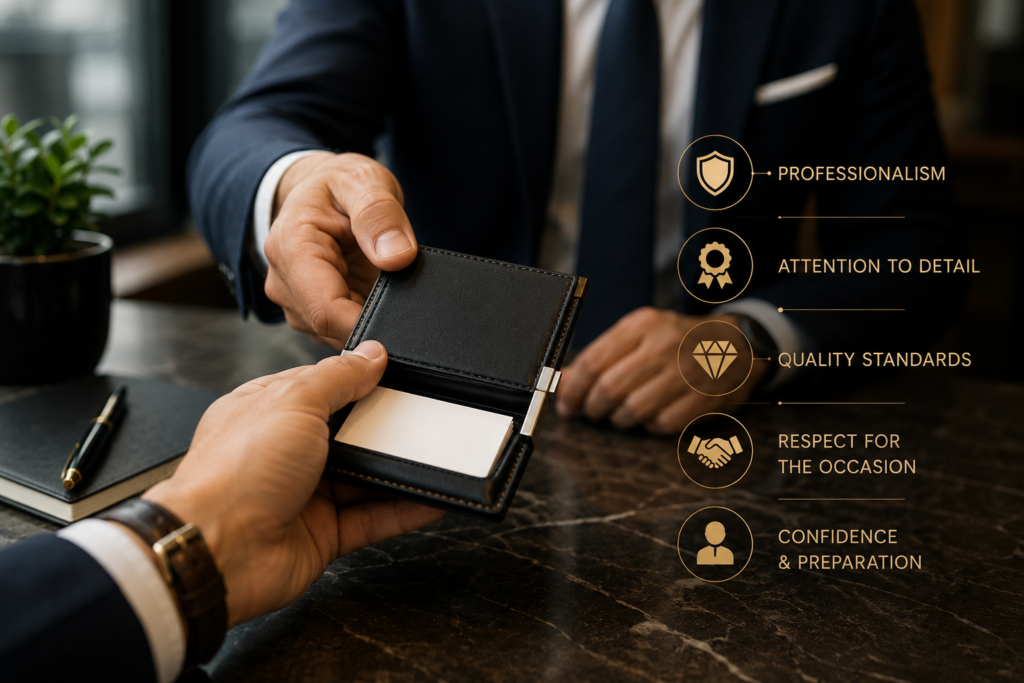
Preparation. Attention to detail. Respect for the exchange. These are the things a proper business card holder communicates without a single word spoken.
Think about it from the other side of the table. You’re forming a judgment about whether this person is organized and worth your continued attention. They reach for their card. Clean retrieval from a well-chosen holder registers positively. Excavating it from a wallet stuffed with receipts registers differently. Neither reaction is fully conscious. Both are real.
This is why professionals who understand personal brand treat their business card holder as seriously as any other visible professional tool. It’s not about status. It’s signal management. According to Forbes, business card etiquette remains a critical part of professional networking even in the digital age — and how you present your card matters as much as what’s printed on it. For context on how professional tools fit into broader presentation, this overview of business professional attire explains how every visible element communicates whether you intend it to or not.
The Different Types of Business Card Holders and What Each One Says
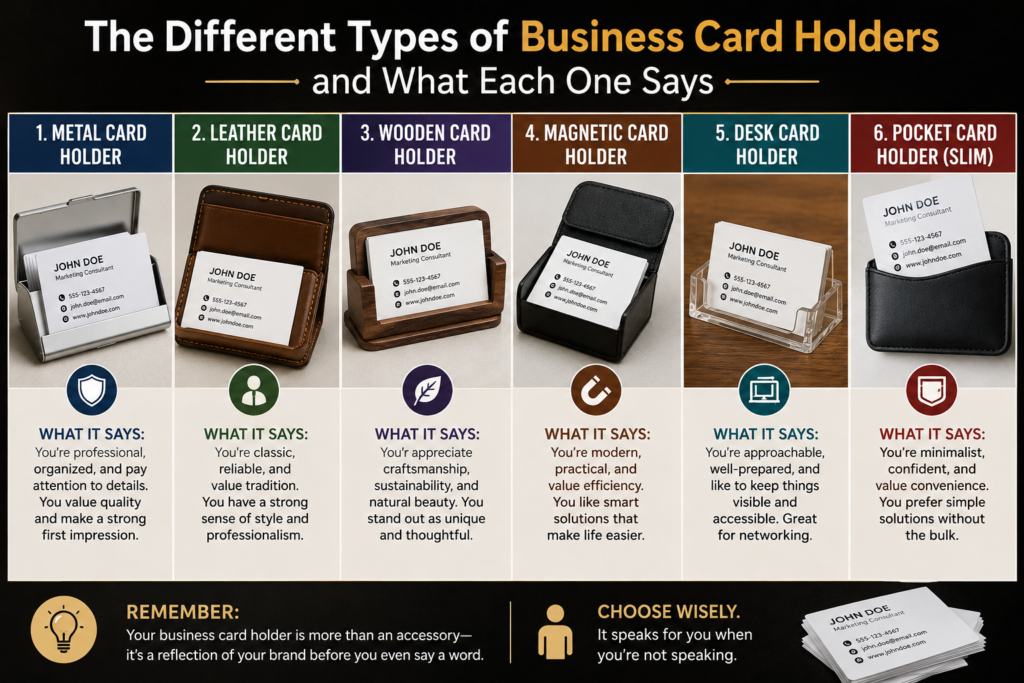
Not all business card holders serve the same purpose. Understanding the categories helps you choose the right tool for your actual environment rather than the most expensive option or the first search result.
Personal business card holders carry your own cards for distribution. Slim, pocket-sized, available in metal, leather, carbon fiber, and wood. The material choice communicates something about your professional context before anyone reads a word on the card.
Desk business card holders sit on a surface and present cards to visitors approaching your workspace. Less about portability, more about organized professional presentation in a fixed location.
Combination holders carry both your cards and received cards simultaneously. Particularly useful for active networkers attending events where exchanges go both directions rapidly.
Wall-mounted and countertop display holders serve retail and hospitality environments where passive distribution matters more than personal handoff.
Metal Business Card Holders: Who They Work For and Who They Don’t
Metal business card holders are the most common premium choice. Stainless steel, aluminum, brass, and titanium holders are durable, slim, and carry a clean aesthetic that works across most business environments.
They protect cards extremely well against bending, moisture, and daily pocket abuse. The tactile impression of a metal holder communicates precision and seriousness. In finance, law, consulting, and corporate environments that aesthetic lands exactly right.
Where metal misses is in creative or informal professional environments. A graphic designer presenting cards from a brushed aluminum holder might find it slightly at odds with the personal brand they’re projecting. Context always matters more than material prestige.
Leather Business Card Holders: The Classic Choice With Real Staying Power
Leather business card holders have been a professional staple for decades because the material genuinely works. Good leather ages well, develops character, and carries warmth that metal holders don’t offer.
In relationship-focused professional environments — consulting, sales, client services, executive leadership — leather communicates approachability alongside professionalism. That combination is harder to achieve than it sounds.
The quality range is enormous. Full-grain leather at the top end looks and feels completely different from bonded or synthetic leather at the budget end. The difference is visible and tactile in exactly the high-attention moments when the holder gets handled. A quality leather holder developing patina over years tells a story. A cheap one scuffing and peeling after three months tells a different one.
For international professionals, leather navigates cultural contexts more neutrally than other materials. In Japanese business culture the card exchange carries ceremonial significance. A quality holder communicates appropriate respect in ways a loose stack simply cannot.
Carbon Fiber and Modern Materials: Built for Tech and Innovation Spaces
Carbon fiber business card holders emerged as a serious category when the material moved from aerospace into consumer products. For professionals in technology, engineering, and startups, carbon fiber communicates something specifically aligned with those spaces.
Advanced materials. Precision manufacturing. Forward-thinking aesthetic. It reads exactly right in innovation environments.
The practical properties back it up too. Carbon fiber is extremely light, very strong, and resists the wear that degrades other materials over time. Minimal maintenance beyond occasional wiping.
The limitation is context. Carbon fiber reads brilliantly in tech environments. In traditional finance or established corporate settings it can feel like trying too hard. Know your room before you choose your material.
The Desk Business Card Holder and What It Does for Your Professional Space
The desk business card holder gets less attention than its portable counterpart but operates in a context where it matters considerably. A visitor approaching your workspace takes in the entire environment in seconds.
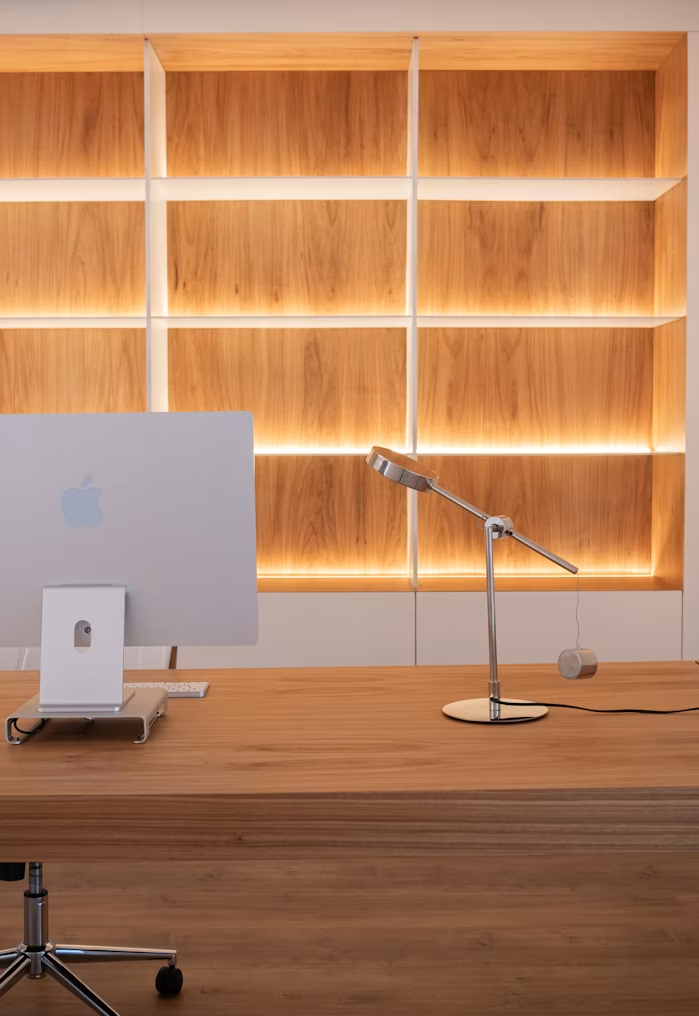
An organized desk with a clean card holder communicates orderliness and professional intention. Cards scattered across a desk surface communicate the opposite. The signal is instant and it happens before anyone sits down.
For client-facing professionals who host visitors, the desk holder is part of the environmental impression supporting or undermining the relationship you’re building. It should match your overall workspace aesthetic. A sleek modern office with a worn plastic card stand is a mismatch that registers even when visitors can’t articulate why.
Consistency across your professional environment communicates attention to detail. Clients notice it. For a broader look at how workspace presentation fits professional identity, this piece on business casual women explains how every element of professional presentation operates as a unified system rather than isolated choices.
How to Choose the Right Business Card Holder for Your Context
The right business card holder is not the most expensive one. It’s the one that fits your professional environment, personal brand, daily carrying habits, and the impression you need to make in moments that matter.
Start with your environment. Corporate, finance, and legal settings favor metal or quality leather. Creative environments reward individual aesthetic choices. Tech environments welcome carbon fiber. Client-service environments where warmth matters favor leather.
Consider your carrying situation honestly. Cards living in a jacket pocket work well with slim metal or carbon fiber. Cards living in a bag benefit from a more substantial leather holder. High-volume networking events call for combination holders that keep your cards separate from received ones.
Think about capacity. Most slim holders carry ten to twenty cards. That covers most individual professional encounters comfortably. Running out of cards because your holder only fits twelve is the same problem as producing a crumpled card. Both communicate unpreparedness for the moment.
The Maintenance Habits That Keep Everything Working
A quality business card holder needs minimal maintenance but it does need some. Metal holders benefit from occasional soft cloth cleaning to remove fingerprints and surface oils. Leather holders need periodic conditioning to prevent drying and cracking. Carbon fiber just needs occasional wiping.
More important than holder maintenance is card maintenance inside it. Check periodically and replace cards showing edge wear, slight bending, or surface marks. A pristine holder presenting worn cards is nearly as problematic as no holder at all.
The entire system needs to work together. Holder in perfect condition. Cards inside equally well-maintained. Retrieval smooth and practiced.
Also stay current on what your cards say. A holder full of cards with an outdated number or previous company name actively communicates disorganization. Refresh your supply whenever information changes.
Common Business Card Holder Mistakes Professionals Make Without Realizing
The overfull holder is the most common mistake. Thirty cards in a fifteen-card holder creates a bulging, difficult-to-open case that produces bent cards and a fumbling presentation. Keep capacity comfortable, not maximum.
The wrong-pocket habit is second. Keeping your holder with your phone, keys, or coins exposes it to scratches and pressure that degrades both the holder and the cards inside. Give it its own dedicated space.
Mixing your cards with received cards creates confusion. Handing someone else’s card to a new contact is an awkward moment entirely avoidable with a combination holder or simple secondary case.
Forgetting to refill before important meetings costs real opportunities. Make refilling a standard preparation step for any professional engagement where cards might be exchanged. For professionals building reliable preparation systems, this guide on project planning templates covers how consistent preparation habits prevent small failures that create large impressions.
What the Business Card Exchange Still Means in a Digital World

People ask whether business card holders still matter when LinkedIn exists and contacts live in phones. The answer is yes and the reason is more interesting than tradition.
Physical card exchange does something digital sharing cannot. It creates a moment. A pause where two people focus on the same small ritual. That moment generates memory in a way a LinkedIn tap simply doesn’t.
The person who handed you a physical card from a well-chosen holder during a meaningful conversation is more memorable than the person whose profile you tapped while half-listening to something else.
The business card holder makes that moment feel intentional rather than perfunctory. Research from Harvard Business Review confirms that tangible memorable moments in professional networking create stronger relationship foundations than purely digital interactions. The physical card exchange remains one of the most reliable ways to create exactly that kind of moment.
FAQ
What is the best material for a business card holder?
It depends on your environment. Metal suits corporate and legal settings. Leather fits relationship-focused contexts. Carbon fiber works best in tech and innovation spaces.
How many cards should a business card holder hold?
Ten to twenty cards covers most professional situations. Avoid overfilling which causes bending and difficult retrieval at the worst possible moment.
Should I use separate holders for my cards and received cards?
Yes. Mixing causes confusion and risks handing someone else’s card by mistake. Use a combination holder or carry two separate cases.
Are business card holders still relevant in a digital world?
Absolutely. Physical exchanges create memorable moments digital sharing cannot replicate. A smooth card exchange with a quality holder leaves a stronger impression than a LinkedIn tap in most professional contexts.
How do I maintain a leather business card holder?
Clean periodically with a soft cloth and apply leather conditioner every few months. Avoid overfilling which stresses the seams over time.
Conclusion
I lost three clients before I understood the business card holder was part of the message. Not the whole message. But part of it in a way I hadn’t accounted for and couldn’t see until someone honest enough to say so pointed it out directly.
The fix was not expensive. Not complicated. It was one intentional choice about a small object that comes out of a pocket for thirty seconds in a professional meeting.
Those thirty seconds matter. The business card holder is what makes them go smoothly.
Choose one that fits your environment and personal brand. Keep it in good condition. Keep the cards inside it equally well-maintained. Refill it before meetings that matter.
Then let that small intentional choice do the quiet work that good professional tools always do — communicating something real about how you operate before you’ve said a single word about it.