

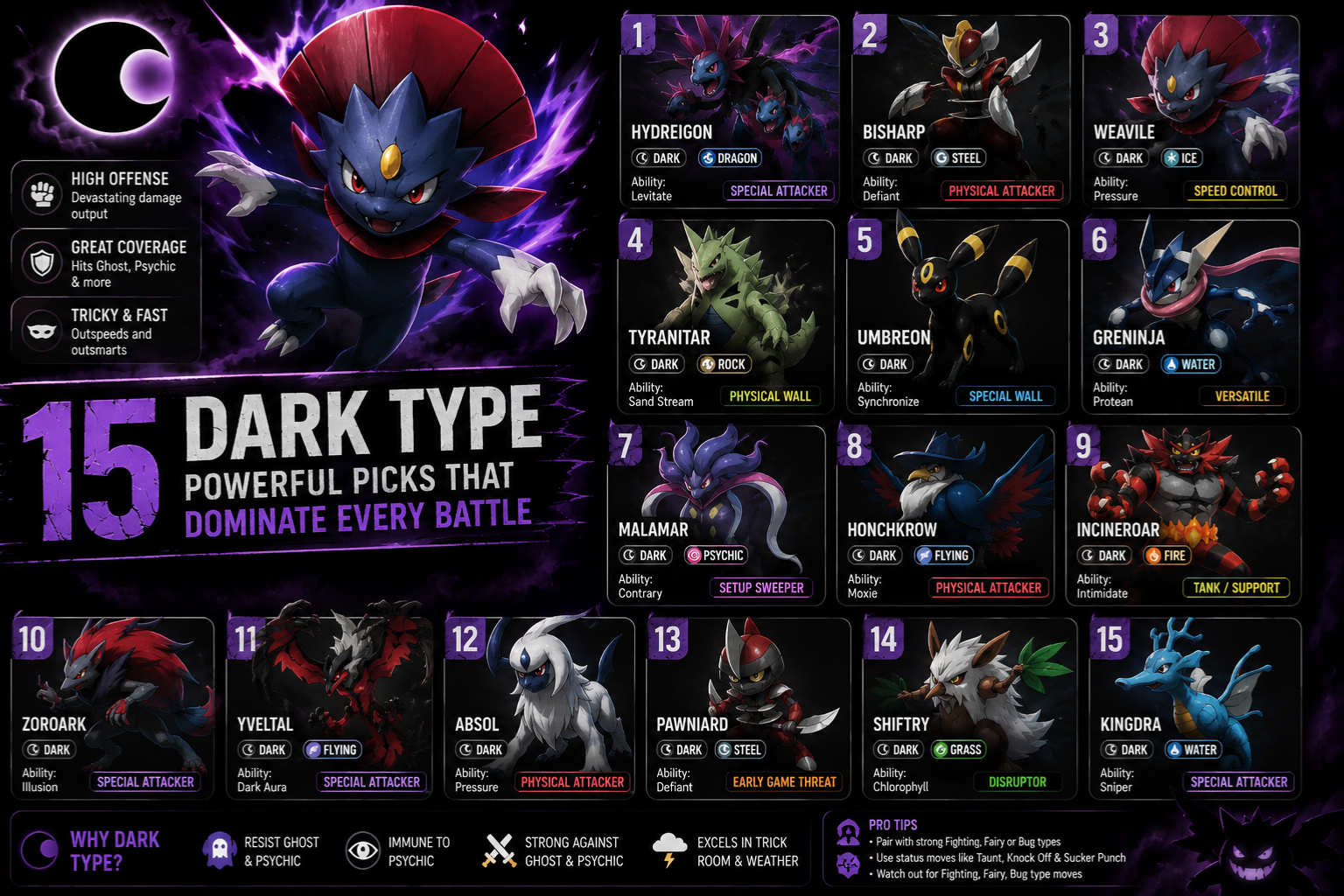
If you ask any serious Pokemon trainer which typing feels the most satisfying to use, dark-type Pokémon come up almost every single time. There’s something about the combination of raw power, tricky movesets, and psychological pressure that makes this typing uniquely fun to play with. Dark types were introduced in Generation 2 specifically to counter the Psychic type, which had been borderline broken in Gen 1. That design decision created one of the most interesting and strategically rich typings in the entire game. Whether you’re playing through the main story, grinding ranked battles online, or building a team for competitive tournaments, dark-type pokemon offer tools that almost no other typing can match.
What Dark Type Means
The dark type in Pokemon is built around a specific gameplay philosophy — pressure, trickery, and power. Dark type moves are super effective against Psychic and Ghost types, which gives Dark-type pokemon a huge advantage against some of the most commonly used defensive and special attackers in competitive play. They’re immune to Psychic moves entirely, which is a massive deal when you consider how many powerful Psychic attackers exist across every generation of the game.
Dark types have weaknesses too, and knowing them is just as important as knowing the advantages. They take super effective damage from Fighting, Bug, and Fairy type moves. Fighting and Fairy are both extremely common in competitive Pokemon, so dark-type pokemon need solid coverage moves or team support to handle those threats. The immunity to Psychic and resistance to Ghost and Dark moves themselves make this typing defensively interesting despite those weaknesses. Building around dark types means accepting the trade-offs and designing your team to cover the gaps.
Dark Type Pokemon Origins
The history of dark-type pokemon is genuinely interesting, and it shapes why the typing feels the way it does today. When Game Freak introduced Gold and Silver in 1999, Psychic types had dominated competitive play so completely that the metagame felt broken. Alakazam, Gengar, and Starmie were everywhere. The solution was a new type that could shut Psychic down hard. Dark type was that answer — immune to Psychic, super effective against it, and loaded with moves that felt thematically dark and unpredictable.
You can check out steel type Pokémon guide for comparison on how other defensive typings were designed around similar balancing goals. The dark type’s move pool reflects its thematic roots too. Moves like Foul Play, Sucker Punch, Knock Off, and Crunch all carry that flavor of underhanded tactics and raw aggression. Knock Off in particular has become one of the most valuable moves in competitive Pokemon — removing an opponent’s held item is often more impactful than dealing damage. That’s dark type philosophy in a single move.
Top 15 Dark Type Picks
Starting with the absolute best, Tyranitar sits at the top of almost every serious ranking of dark-type pokemon. It’s a Rock and Dark dual type with a massive base stat total of 600, incredible physical Attack, and access to Sand Stream which automatically summons a sandstorm when it enters battle. Tyranitar has been a competitive staple since Generation 2 and shows up in serious teams across almost every format. Its move pool is enormous — Stone Edge, Crunch, Ice Punch, Fire Punch, Earthquake — and it can function as a physical sweeper, a bulky attacker, or even a support pivot depending on how you build it.
Hydreigon is the other pokemon that serious players consistently bring up when discussing dark-type pokemon worth building around. It’s a Dragon and Dark dual type with 600 base stats, excellent Special Attack, and a fantastic move pool including Draco Meteor, Dark Pulse, Flamethrower, Flash Cannon, and Focus Blast. The Fairy type weakness hurts it in modern competitive play, but Hydreigon’s raw power and coverage options make it a legitimate threat in almost any format. It takes time to evolve — Deino doesn’t evolve into Hydreigon until level 64 — but the payoff is one of the best dark type attackers in the game.
Umbreon for Defensive Play
Not every great dark-type pokemon needs to hit hard. Umbreon is the proof that dark types can be just as dominant on the defensive side of the game. It’s an Eeveelution with exceptional special defense and solid defense, and its role is to sit on the field, tank hits, and slowly chip away at the opponent with moves like Foul Play, which uses the opponent’s own Attack stat to deal damage. Against physical attackers, Foul Play hits harder the more the opponent has invested in attack—which is a beautifully cruel design choice.
Umbreon’s access to Wish and Heal Bell makes it a legitimate support wall in competitive play. It can pass large Wishes to teammates, cure status conditions with Heal Bell, and use Yawn to force switches or put threats to sleep. In Double battles, Umbreon pairs well with almost any powerful attacker because it buys turns through recovery and disruption. It’s not a flashy pick, but experienced players respect what Umbreon does because they’ve felt how annoying it is to deal with when it’s played well.
Weavile and Speed Control
Speed is one of the most important stats in Pokemon battles, and Weavile is one of the fastest dark-type pokemon in the entire game. It has 125 base Speed, which puts it ahead of most common threats, and 120 base Attack, which means it hits genuinely hard. Weavile is an Ice and Dark dual type, and while Ice is one of the worst defensive typings in the game, Weavile doesn’t care because it moves first and hits hard enough to knock out threats before they can respond.
Icicle Crash and Triple Axel are Weavile’s best Ice type options, and they hit Dragon and Ground types that otherwise wall dark-type pokemon. Knock Off is basically mandatory on every Weavile set because removing held items is so impactful. Pursuit used to be a defining move for Weavile, trapping Psychic and Ghost types trying to switch out, but Pursuit was removed from the game in Generation 8. Even without it, Weavile remains one of the most effective revenge killers and priority attackers among dark-type pokemon because of its raw Speed and Attack combination.
Darkrai and Legendary Status
Darkrai is the mythical dark type pokemon that every player wants on their team but can only access through special events or trading. Its base stat total of 600 is distributed perfectly for a special attacker — 135 Special Attack and 125 Speed make it one of the most threatening offensive threats in the game. Dark Void, its signature move, used to be able to put both opponents to sleep in Double battles before it was nerfed to accuracy 50% and limited to Darkrai only. Even with that nerf, Darkrai remains a serious threat in formats where it’s legal.
According to Bulbapedia’s Pokemon database, the dark type currently has 91 fully evolved Pokemon across all generations, making it one of the larger typings in the game. Darkrai’s role in competitive play is straightforward — get it in safely, use Nasty Plot to double Special Attack, and sweep. Dark Pulse, Shadow Ball, Focus Blast, and Nasty Plot give it everything it needs. The challenge is keeping it healthy long enough to set up, which is why team support like screens, entry hazard removal, and speed control are so important when building around Darkrai.
Dark Type Dual Typings
One of the things that makes dark-type pokemon so varied and interesting is the range of dual typings the type appears in. Dark and Fighting gives you Pangoro, which hits nearly everything in the game for neutral or super effective damage. Dark and Steel gives you Bisharp and its evolution Kingambit, which have become serious competitive threats because Steel covers Fairy weakness and Dark covers Psychic and Ghost. Dark and Ghost gives you Spiritomb and Sableye, both of which had zero weaknesses before Fairy type was introduced in Generation 6.
Incineroar is Dark and Fire, which is a combination that offers solid offensive coverage and one of the best abilities in Double battles — Intimidate. Incineroar became the single most used Pokemon in VGC (Video Game Championships) formats for multiple years running because Intimidate, combined with Parting Shot and Fake Out support, makes it an unmatched utility piece. It’s not the most powerful dark-type pokemon offensively, but its support value in doubles is almost unmatched by any other Pokemon in the game.
Moves Every Dark Team Needs
Building a team around dark-type pokemon means knowing which moves are non-negotiable. Knock Off is the first one — it’s the most impactful utility move in the game, dealing decent damage while removing the opponent’s held item permanently for the rest of the battle. Losing a Choice item, Life Orb, or Leftovers can completely change how a battle plays out. Every physical dark-type Pokémon that can learn Knock Off should run it.
Sucker Punch is the second essential move for dark type pokemon. It’s a priority Dark type move that deals 70 base power but only works if the opponent is about to use an attacking move. The mind game element is real — if your opponent predicts Sucker Punch and uses a status move or switches instead, Sucker Punch fails completely. That back-and-forth is part of what makes dark type pokemon psychologically interesting to play. Foul Play rounds out the essential dark type moves for defensive or utility pokemon — it’s a 95 base power move that deals damage based on the target’s Attack, which means it punishes every setup sweeper that tries to boost in front of a dark type.
Countering Dark Type Pokemon
If you’re on the other side of the matchup, knowing how to counter dark type pokemon is equally valuable. Fighting type moves are the most reliable answer — they hit dark types for 2x damage, and Fighting is one of the most widely distributed offensive types in the game. Pokemon like Conkeldurr, Urshifu, and Lucario can threaten dark-type Pokémon hard with Close Combat, Mach Punch, and other Fighting moves.
Fairy types are the second major counter, and they’re particularly relevant in modern competitive play because Fairy is so widely distributed across popular Pokemon. Togekiss, Sylveon, Clefable, and Gardevoir all threaten dark-type Pokémon with their Fairy moves, and several of them have enough bulk to take a hit first. Bug type moves are the third counter, but Bug is generally a weaker offensive type, so it shows up less in competitive builds. The combination of Fighting plus Fairy coverage on a single team creates enormous pressure on any dark type heavy team composition.
Dark Types in VGC Format
The Video Game Championships format has been the most watched competitive Pokemon scene for years, and dark-type Pokémon have had a significant presence throughout its history. Incineroar’s dominance was mentioned earlier, but the broader picture is interesting. Dark types tend to perform well in VGC because Fake Out, Sucker Punch, and Knock Off are all exceptionally valuable in double battles, where tempo and disruption matter even more than in Singles.
Urshifu-Single Strike, the Fighting and Dark type Legendary introduced in the Isle of Armor DLC, became one of the most dominant VGC Pokemon shortly after its release. Its signature move Wicked Blow always lands a critical hit, which bypasses defensive boosts and damage reduction moves entirely. That made it a specific counter to strategies built around Dynamax and stat boosts, and it reshaped how teams were built during that competitive season. When a dark type Pokémon can specifically dismantle a meta strategy, it shows how much design depth this typing carries.
Dark Type Pokemon in Story Mode
Competitive play gets a lot of attention, but dark-type Pokémon are just as valuable for players going through the main story. Houndoom is often available relatively early in games where it appears, and its Fire and Dark typing gives it fantastic coverage against a huge range of gym leaders and story bosses. Absol is a fan favorite that hits hard from the start with its high Attack stat, even if its defenses make it fragile.
For players going through Sword and Shield, Grimmsnarl is a fantastic dark-type pokemon that doubles as a screen setter. It can set Light Screen and Reflect, protect teammates from special and physical damage, and still hit reasonably hard with its own moves. In story mode where the AI doesn’t punish setup turns the same way human opponents do, Grimmsnarl makes the late game significantly easier. The dark type’s mix of offensive power and utility options means there’s almost always a dark type pokemon that fits whatever playstyle you prefer for story mode.
Mega Evolutions and Dark Types
Mega Evolution, introduced in Generation 6 and later discontinued, gave some dark-type pokemon transformations that made them genuinely broken in competitive play. Mega Gyarados changed from Water and Flying to Water and Dark, gaining a massive Attack boost and the Mold Breaker ability. Mega Tyranitar gained even more physical bulk and power on top of an already imposing base stat spread. Mega Absol gained Magic Bounce, which reflected status moves back at opponents — a completely different utility profile that made it surprisingly annoying to deal with.
Even though Mega Evolution isn’t available in current generation games, it defined a competitive era and showed how dark-type Pokémon could be pushed to genuinely dominant levels with the right boost. Many players who started competitive Pokémon during the X and Y or ORAS era have strong memories tied to mega dark types. The period also produced some of the most creative team building the game has seen, with players building entire strategies around protecting and powering up their mega evolution.
Dark Type Pokemon Weaknesses
Every type has a ceiling, and understanding where dark-type Pokémon struggle is important for honest team building. The Fairy weakness is the biggest one in modern competitive play. Fairy was added specifically to counter Dragon types, but it also hits Dark super effectively, and Fairy type moves are all over the place in competitive teams. Misty Terrain, which powers up Fairy moves and prevents status conditions on grounded Pokemon, can make entire dark type teams struggle.
The Fighting weakness is equally significant because Fighting type coverage is so common as a secondary type move on physical attackers. Many Pokemon that aren’t primary Fighting types still carry Close Combat or Superpower for coverage, and those moves slam dark-type pokemon hard. Bug is less threatening competitively but still worth tracking. The practical implication is that dark type teams need at least one Pokemon that can absorb Fighting hits—something with a resistance or immunity to Fighting moves — and at least one answer to Fairy types, ideally a Steel or Poison type attacker.
Best Dark Type Abilities
Abilities can completely transform how a dark type Pokémon performs in battle, and the dark type has access to some genuinely excellent ones. Moxie is one of the most exciting — every time the Pokemon knocks out an opponent, its Attack rises by one stage. On a fast, hard-hitting dark type like Krookodile or Salamence, a single knockout can start a chain that clears an entire team. It’s the snowball ability, and when it works, it feels amazing.
Prankster is the other game-defining ability among dark type pokemon, and it belongs to Grimmsnarl and Sableye. Prankster gives priority to status moves, so moves like Thunder Wave, Will-O-Wisp, Taunt, and screens go first regardless of Speed. The catch is that Prankster-boosted moves don’t work on dark type pokemon themselves — an intentional design decision that gives dark types a specific immunity to this strategy. Intimidate on Incineroar was already mentioned, but it’s worth repeating how much that ability defines the dark type’s role in doubles formats.
Training Dark Type Pokemon
Getting dark type pokemon battle-ready requires the same EV training process as any other type, but there are some specific considerations worth knowing. Physical dark type attackers almost always want 252 EVs in Attack and 252 in Speed, with the remaining 4 EVs going into HP. This spread maximizes the two stats that matter most for pokemon like Weavile, Bisharp, and Tyranitar in physical attacker roles.
Special dark type attackers like Hydreigon and Darkrai want 252 Special Attack and 252 Speed with 4 HP. Defensive dark type pokemon like Umbreon take a completely different approach — 252 HP, 252 Special Defense, and 4 Defense is the most common spread, turning it into the special tank it’s designed to be. Nature matters too. Adamant boosts Attack at the cost of Special Attack for physical attackers. Timid boosts Speed at the cost of Attack for special attackers. Calm or Careful natures work well on defensive dark type pokemon that don’t need offensive stats.
FAQ
Q: What are dark type pokemon weak against?
Dark type pokemon are weak to Fighting, Bug, and Fairy type moves. All three deal 2x damage to dark types. Fighting and Fairy are the most common threats in competitive play, so team building around dark types usually involves covering these weaknesses with teammates that resist or are immune to those move types.
Q: Which dark type pokemon is best for competitive battles?
It depends on the format, but Incineroar, Tyranitar, Hydreigon, Weavile, and Urshifu-Single Strike are consistently among the top dark type pokemon in competitive play. Incineroar is the most universally useful in VGC doubles because of Intimidate and Fake Out support value.
Q: Are dark type pokemon immune to any moves?
Yes. Dark type pokemon are completely immune to Psychic type moves. They also can’t be affected by moves boosted by the Prankster ability when those moves target dark types directly, which is a unique secondary immunity that makes dark types specifically resistant to one of the most annoying strategies in competitive doubles.
Q: How many dark type pokemon exist across all generations?
As of the most recent generation, there are over 90 fully evolved dark type pokemon when counting all dual-type combinations. The number grows with each new game release. Dark type has appeared in dual-type combinations with nearly every other type in the game, giving players a huge variety of stat spreads and move pool options to choose from.
Conclusion
Dark type pokemon have earned their reputation as some of the most strategically interesting and competitively powerful options in the entire game. From the defensive brilliance of Umbreon to the offensive dominance of Tyranitar and Hydreigon, from the speed of Weavile to the utility of Incineroar in doubles, dark type pokemon cover an enormous range of roles and playstyles. The typing was born from a design need — counter the broken Psychic meta of Gen 1 — and it grew into one of the most beloved and strategically rich types in Pokemon history.
Building around dark type pokemon means accepting real weaknesses to Fighting and Fairy, but it also means accessing one of the best move pools in the game, some of the strongest abilities, and a type immunity to Psychic that never stops being useful. The 15 picks covered here represent the best of what dark type pokemon can do, but the truth is the type rewards any player willing to learn its rhythms and build around its strengths. Whether you’re a story mode player, a VGC competitor, or someone just getting into team building, dark type pokemon deserve a serious spot in your consideration. The darkness, it turns out, has always been one of the game’s greatest strengths.