


Every working professional has asked this question at some point, whether during salary negotiations, project deadline discussions, or annual budget reviews. How many business days in a year sounds like a simple arithmetic problem, but it carries far more significance than most people realize. The answer shapes how companies calculate daily pay rates, how project managers build timelines, how payroll departments process compensation, and how individuals plan their personal and professional goals across twelve months. Getting this number right is not a matter of academic curiosity. It is a practical necessity that touches nearly every corner of professional life. The standard answer most financial and business professionals use is 260 business days in a year, derived from five working days per week across 52 weeks. But that figure shifts when you account for federal holidays, company-specific closures, leap years, and regional observances. This article takes a thorough look at how many business days in a year truly exist, why the number varies, and exactly why it matters so much for salaries, planning, and productivity.
Standard Calculation Explained Simply
The foundation of any business day calculation starts with the basic structure of the calendar year. A standard year contains 365 days divided into 52 weeks and one extra day. Since the traditional workweek spans Monday through Friday, that gives 52 weeks multiplied by 5 working days, which equals 260 business days before any holidays are removed. This is the baseline figure that most payroll systems, financial models, and project management tools use as their starting point when calculating how many business days in a year apply to a given workforce or contract.
However, this baseline number assumes that every weekday is a working day, which is almost never the case in practice. The moment you introduce federal holidays, the number drops immediately. The United States federal government recognizes eleven official public holidays per year. When those are subtracted from the 260-day baseline, the typical working year lands somewhere between 249 and 251 business days depending on which days of the week those holidays fall. Some years offer slightly more working days when holidays land on weekends and are not observed on a weekday, while others shrink the total further when multiple holidays cluster in short stretches of the calendar.
Federal Holidays Reduce Totals
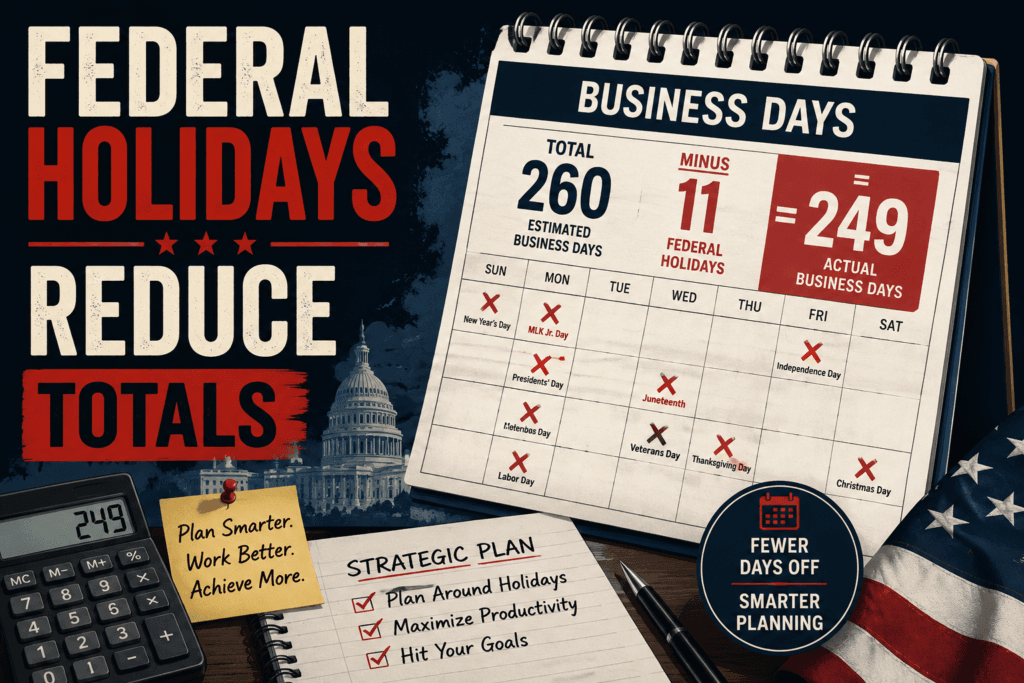
Federal holidays have a direct and measurable impact on how many business days in a year actually apply to most American workers. The eleven recognized federal holidays include New Year’s Day, Martin Luther King Jr. Day, Presidents’ Day, Memorial Day, Juneteenth National Independence Day, Independence Day, Labor Day, Columbus Day, Veterans Day, Thanksgiving Day, and Christmas Day. Each of these removes one business day from the working calendar, though the actual number removed from any individual employee’s schedule depends entirely on whether their employer observes each holiday.
Private sector companies are not legally required to follow the federal holiday calendar, which means the actual number of non-working days varies widely from one organization to another. Some companies observe all eleven federal holidays, some observe only six or seven, and others substitute certain federal holidays for days more relevant to their workforce or industry. This variability means that the question of how many business days in a year does not have a single universal answer for private employees. It depends on the employer, the industry, the employment contract, and sometimes even the state in which the work takes place. For anyone trying to calculate accurate working days, the federal holiday list is the first adjustment to make but rarely the last.
Leap Years Change Things
Most people know that leap years add an extra day to February every four years, but fewer stop to consider how that extra day affects the business day count. In a leap year, the calendar contains 366 days instead of 365. Depending on how that extra day falls relative to weekends, it may or may not add a business day to the annual total. When February 29 falls on a weekday, which happens roughly half the time it appears, it adds one additional business day to the year. When it falls on a Saturday or Sunday, it has no effect on the weekday count whatsoever.
This distinction matters more than it might initially seem when answering how many business days in a year exist. For businesses that calculate daily billing rates, per diem compensation, or project timelines based on precise business day counts, a single additional day in a leap year can affect billing totals, staffing calculations, and budget projections. For salary calculations specifically, some organizations prorate compensation based on exact working days, meaning a leap year with an extra business day could technically alter daily rate calculations for hourly or daily workers. The leap year variable is small but real, and any truly accurate business day calculation must account for it.
Salary Calculations Need Precision

One of the most direct applications of knowing how many business days in a year exist is salary calculation. Salaried employees are typically paid an annual figure regardless of how many days they actually work, but the underlying math still depends on business day counts in ways that affect daily rates, overtime thresholds, and benefit accruals. When a human resources department or payroll system converts an annual salary into a daily rate for any purpose, such as calculating pay for partial months, prorating compensation during leaves of absence, or determining daily consulting fees, the number of business days in that specific year becomes critically important.
A simple example illustrates this clearly. An employee earning one hundred thousand dollars annually has a very different daily rate depending on whether the calculation uses 250 business days or 260 business days. Using 260 days produces a daily rate of approximately 384 dollars. Using 250 days produces a daily rate of 400 dollars. That sixteen dollar difference per day compounds significantly when applied over extended partial periods, leave calculations, or freelance contracts. Anyone negotiating day rates, calculating prorated pay, or reviewing compensation packages needs to know exactly how many business days in a year their employer or client is using as the basis for those figures.
Project Timelines Depend Heavily
Project managers live and breathe business day calculations because every deadline, milestone, and resource allocation depends on knowing exactly how many working days are available between two points on a calendar. When a project is scoped to require sixty business days of work, determining when it will be complete requires mapping those sixty days onto an actual calendar that accounts for weekends and holidays. Using calendar days instead of business days is one of the most common and costly mistakes in project planning, and it almost always results in timelines that are either too optimistic or too conservative.
The practical discipline of knowing how many business days in a year are available also helps project managers allocate resources more evenly. Many organizations experience natural productivity dips during holiday-heavy periods like late November, the weeks surrounding Christmas and New Year’s, and long weekend clusters in May and September. Building those reductions into project timelines from the start produces more realistic schedules and reduces the pressure that comes from discovering mid-project that fewer working days remain than originally assumed. Project management tools that automatically calculate business days are valuable precisely because the manual version of this calculation is tedious and highly prone to error when done across long project horizons.
Payroll Periods Vary Widely

Most employees receive their pay on a schedule, whether weekly, biweekly, semimonthly, or monthly, and each of those schedules interacts differently with the annual business day count. Biweekly payroll, one of the most common schedules in the United States, produces 26 pay periods in most years but occasionally generates 27 pay periods when the calendar alignment creates an extra pay cycle. This 27th paycheck year is a well-known phenomenon in payroll management, and it directly results from how many business days in a year fall relative to the payroll start date chosen by the employer.
When a 27-pay-period year occurs, it creates complications for both employers and employees. Salaried employees who receive fixed annual compensation divided equally among pay periods will receive a smaller check during each of the 27 periods compared to a 26-period year. Some employers choose to adjust their payroll distribution proactively to prevent confusion, while others let the math play out and deal with employee questions afterward. For hourly workers, a 27-period year may actually result in slightly different tax withholding patterns. Payroll professionals track business day counts and pay period alignments years in advance precisely to manage these situations before they become problems.
Freelancers Must Track Carefully
Independent contractors and freelance professionals have a uniquely important relationship with business day calculations because their income is often directly tied to the number of days or hours they work in a given period. Unlike salaried employees who receive a fixed annual amount, freelancers earn based on actual working time. This means that knowing how many business days in a year exist, and precisely how many of those days they intend to work, is fundamental to setting annual income targets, pricing daily or hourly rates, and managing cash flow across the year.
A freelancer who sets an income goal without accounting for holidays, vacation days, sick days, and other non-billable time will consistently fall short of their target. If someone assumes they will work 260 days but realistically works only 220 billable days after accounting for all non-working time, they need to set their daily rate significantly higher to hit the same annual income. Working backward from the question of how many business days in a year are truly available for billing is the most reliable way to set rates that actually support the lifestyle and income level a freelancer is working toward. Many experienced independent professionals treat this calculation as the cornerstone of their annual business planning.
Global Differences Affect Operations
For companies that operate across multiple countries, the question of how many business days in a year becomes considerably more complex. Different nations observe different public holidays, different standard workweeks, and in some cases different weekend structures entirely. Countries in the Middle East, for example, often observe Friday and Saturday as the weekend rather than Saturday and Sunday. Countries in Europe typically observe significantly more public holidays than the United States, with some nations recognizing fifteen or more official non-working days per year.
These international differences mean that a project running across teams in New York, London, Mumbai, and Dubai will have a different effective business day count for each location. Coordinating deadlines, scheduling meetings, and planning deliverables across those time zones and holiday calendars requires either dedicated planning tools or very careful manual tracking. Multinational companies that fail to account for these differences routinely run into situations where work grinds to a halt because a key team member is on a national holiday that other team members did not know about. Knowing how many business days in a year apply to each regional office is not just useful. It is operationally essential.
Banking Operates on Days
The financial services industry is perhaps the sector most rigidly governed by business day counts. Banks, investment firms, clearing houses, and regulatory bodies all operate according to strict business day rules that determine when transactions settle, when payments are due, and when regulatory deadlines expire. Standard financial contracts specify settlement in terms of business days, with most equity trades settling two business days after the transaction date and many bond transactions following similar conventions.
For individuals, understanding how many business days in a year affect banking operations is important for managing cash flow, timing large transfers, and avoiding late payment penalties. A payment initiated on a Friday afternoon will typically not settle until Tuesday of the following week because Saturday and Sunday are not business days and many financial institutions observe Mondays following holiday weekends as non-processing days. Missing a mortgage payment deadline or a credit card due date because of a failure to account for business day gaps can have real consequences on credit scores and financial standing. Business day awareness is not just a professional skill. It is a personal finance skill with direct monetary implications.
Productivity Benchmarks Use Days
Organizations that measure employee productivity often express their metrics in terms of output per business day, making the annual business day count a crucial denominator in performance calculations. Revenue per employee per day, cases processed per working day, units produced per shift, and customer contacts per business day are all measures that require an accurate business day baseline to be meaningful. If a company calculates that its sales team generates ten thousand dollars per business day and then sets annual targets based on an incorrect day count, every target in the system will be miscalibrated from the start.
Annual productivity benchmarking also depends on consistent definitions of what constitutes a business day across departments and reporting periods. Companies that allow remote work, flexible schedules, or compressed workweeks often find that their effective business day count differs from the standard 260-day figure in ways that require careful documentation and communication. Performance reviews that compare output across different years need to account for differences in available business days, particularly when one year has a 27-paycheck alignment or an unusually high number of holidays falling on weekdays. Precise answers to how many business days in a year your organization actually operates are the foundation of any productivity measurement system that aims to be fair and accurate.
Legal Deadlines Count Days
Courts, government agencies, and regulatory bodies frequently specify deadlines in terms of business days, and missing those deadlines can have severe legal and financial consequences. A response required within thirty business days of receiving a notice means something very specific and very different from thirty calendar days. The distinction matters enormously when those thirty days span a period that includes several holidays, a holiday weekend, or an administrative closure. Legal professionals routinely calculate business day deadlines with extreme precision because the cost of a miscalculation can be a dismissed case, a waived right, or a significant financial penalty.
Contract law similarly relies on business day definitions for provisions related to notice periods, cure periods, payment terms, and delivery obligations. When a contract states that a party has ten business days to remedy a breach, both sides need to agree on exactly which days count as business days for purposes of that calculation. Ambiguity in business day definitions has given rise to more than a few contract disputes over the years, and well-drafted agreements now typically include explicit definitions of what constitutes a business day within the context of that specific contract. Legal precision around business day counting is not bureaucratic excess. It is risk management at its most practical.
School Calendars Mirror Business
Academic institutions operate on calendars that closely mirror the business day structure of the broader economy, though with their own distinct patterns of breaks and closures. Most schools and universities define their academic year in terms of instructional days, which function similarly to business days in the sense that they are the days when meaningful work is expected to occur. Understanding how many business days in a year translate into available instructional days helps administrators plan curricula, schedule examinations, allocate professional development time, and budget for staffing costs.
For parents who depend on school schedules to align with their own work calendars, the overlap between school business days and professional business days is a practical daily reality. When school holidays do not align with employer holidays, working parents face childcare challenges that require planning well in advance. The growing movement toward year-round schooling in some districts further complicates this alignment, creating new patterns of business day distribution that affect both family logistics and local economies in ways that community planners are only beginning to fully measure and address.
Vacation Planning Requires Accuracy
Employees who receive paid time off measured in business days rather than calendar days need to understand the distinction clearly to make the most of their benefits. Ten business days of vacation represents two full calendar weeks if taken consecutively, but the value of those days in terms of rest and recovery depends entirely on when they are taken. Vacation days taken adjacent to holidays effectively extend the break without consuming additional PTO, a strategy that experienced employees use deliberately to maximize rest time relative to the number of business days spent.
Annual leave planning at the organizational level also depends on accurate business day calculations. Human resources departments that manage staffing levels, schedule coverage, and track leave balances across hundreds or thousands of employees need to know exactly how many business days in a year are available and how many will be affected by planned absences. Understaffing during critical business periods because of poorly managed vacation overlap is a preventable problem that good business day planning eliminates. The seemingly simple act of planning vacation time well is grounded in the same precise business day mathematics that governs payroll, project timelines, and financial settlements.
Contracted Hours Versus Days
Many employment contracts and service agreements specify obligations in terms of business days, which can create confusion when the actual hours worked on those days vary. A contract requiring delivery within fifteen business days assumes a certain pace of work per day, but if the working day is six hours rather than eight, the effective capacity within those fifteen days is substantially different. This distinction between contracted days and actual working hours is an area where misaligned expectations between clients and service providers frequently create friction.
When calculating how many business days in a year are productive versus simply present, organizations benefit from distinguishing between scheduled business days and days during which meaningful output is actually produced. Research on workplace productivity consistently shows that not all business days are created equal. Days before major holidays, days following extended breaks, and days disrupted by large organizational events tend to produce significantly less output than standard working days. Building these productivity variations into planning models produces timelines and budgets that are far more realistic than those built on the assumption that every business day delivers identical output.
Annual Planning Benefits Everyone
Whether you are a business owner setting revenue targets, a manager allocating resources across quarters, or an individual employee mapping out personal goals for the year, knowing exactly how many business days in a year are available is the starting point for any serious annual plan. Goals expressed in annual terms are only actionable when broken down into smaller units of time, and business days are the natural unit for most professional work. A revenue target divided by business days gives a daily target. A project broken into business day increments gives a workable schedule. A skill development goal measured in business days of practice gives a realistic timeline.
Annual planning that ignores business day realities tends to produce aspirational documents that look impressive in January and become sources of frustration by April. The discipline of building plans around actual available business days rather than idealized notions of how much time exists in a year is what separates effective planning from wishful thinking. Organizations that calculate their annual targets based on precise business day counts consistently show better goal attainment, more accurate forecasting, and higher employee satisfaction because the expectations embedded in their plans are grounded in reality rather than assumption.
Conclusion
The question of how many business days in a year is one that touches every professional domain in ways both large and small. The standard figure of 260 business days before holidays is a starting point, not a final answer. When federal holidays reduce that figure to around 250, when leap years add a day, when company-specific closures trim further, and when international operations introduce entirely different holiday calendars, the actual number of productive business days available in any given year is always a specific figure that deserves to be calculated rather than estimated. For individuals, organizations, legal systems, financial institutions, and academic institutions alike, getting that number right has real and measurable consequences.
Salaries calculated on incorrect business day assumptions produce compensation errors that affect employee trust and financial wellbeing. Project timelines built without precise business day counts produce delivery failures that damage client relationships and organizational reputation. Freelancers who do not account for the true number of billable business days in their year consistently undercharge for their work and fall short of their income goals. Payroll professionals who miss the 27-paycheck year create confusion and potential financial strain for both employers and employees. Legal deadlines missed because of imprecise business day counting can forfeit rights and trigger penalties with lasting consequences.
The good news is that this is a solvable problem. Business day calculation tools, payroll software, and project management platforms all exist specifically to take the guesswork out of this arithmetic. But the technology is only useful when the person using it understands why the calculation matters in the first place. Building a genuine appreciation for how many business days in a year affect the full range of professional activities is not a minor administrative skill. It is a form of professional literacy that pays dividends in every context where time, money, and planning intersect, which is to say in virtually every professional context that exists. Count your days carefully because they are the raw material from which all professional achievement is built.