

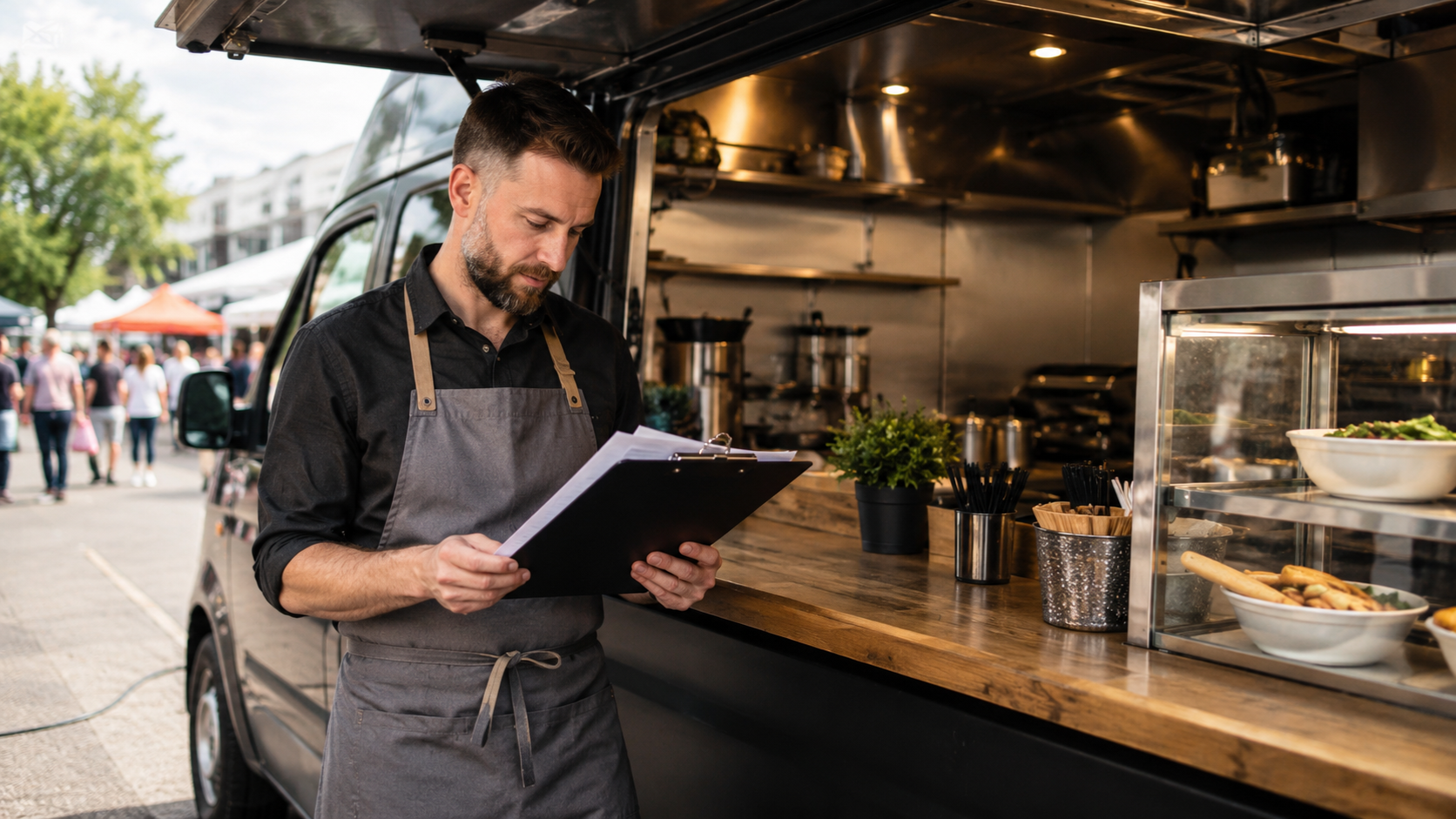
A practical food van business plan that covers costs, licences, pricing and funding — the real numbers, not vague theory, from someone who’s built one.
Why A Plan Matters
Most people who want to run a food van skip straight to picking a vehicle. That’s backwards. A food van business plan forces you to answer the boring questions before you spend a penny — what you’re selling, who’s buying it, and whether the numbers actually add up once fuel, insurance and stock are all accounted for.
I’ve seen this trip people up more than once: someone buys a converted trailer first, then tries to figure out the concept afterward. A food van business plan flips that order, and it’s the difference between a hobby that drains your savings and a business that pays your bills.
There’s also the investor angle. If you’re borrowing money from a bank, a government loan scheme, or even a family member, they’ll want to see that you’ve thought this through properly. A rushed plan scribbled on the back of an envelope doesn’t inspire confidence — a clear, numbers-backed food van business plan does.
And honestly, writing it forces you to be honest with yourself. It’s easy to fall in love with the idea of running your own van. It’s harder to sit down and admit the margins on a £4 coffee might not cover a £600-a-month pitch fee. Better to find that out on paper than three months into trading.
What The Plan Covers
A solid food van business plan isn’t a 40-page document nobody reads. It needs a concept summary, a market section, legal and licensing steps, a budget, a pricing model, and a rough financial forecast for the first year. That’s it — six parts, each doing real work.
Skip any one of these and you’ll feel it later. Miss the licensing section and you could be trading illegally without realising it. Miss the forecast and you won’t know if you’re actually making money until the bank balance tells you the hard way.
Keep it practical rather than polished. Investors and lenders care far more about whether your numbers hold up under questioning than whether the document has a nice cover page. A five-page food van business plan with honest figures beats a glossy thirty-page one full of guesswork.
Think of it as a working file, not a finished product. You’ll go back and adjust the pricing section after your first few markets, and the forecast after your first quarter of real trading. A food van business plan that never changes probably isn’t being used properly.
Know Your Local Market
Before you touch a menu, walk your target patch. Markets, festivals, business parks, breweries — go and watch what’s already selling, at what price, and how long the queues are. This is unglamorous work, but it’s the part of a food van business plan that actually predicts whether you’ll survive.
Talk to a few van owners if you can. Most are surprisingly open about which pitches work and which don’t. And don’t overlook smaller, community-facing spots — supporting local businesses has become a genuine selling point for shoppers who’d rather buy from an independent than a chain, and that loyalty is worth building into your plan from day one.
Write down what you actually observe, not what you assume. If a burger van two pitches over sells out by 1pm every Saturday, that’s a data point worth using in your own food van business plan — either as validation for your concept or as a warning that the market’s already saturated for that kind of food.
Consider seasonality of the location too, not just the food type. A pitch that’s packed at a summer festival could be dead in a business park car park in January. Map out roughly where you’ll trade across all twelve months before you commit to a single concept, because a van that only works from May to September isn’t really a full-time income.
Picking Your Food Concept
Your concept has to be narrow enough to execute fast under pressure. A van doing five things brilliantly beats one doing fifteen things adequately, especially when you’re cooking to order in a space the size of a small kitchen. Coffee, loaded fries, wood-fired pizza, burritos — pick one lane and own it.
So test the menu properly before you commit to it. Cook the full range twice at home under time pressure, not once for friends who’ll be polite about it. If a dish takes four minutes when you’re relaxed, it’ll take seven when there’s a queue of twelve people and the card reader’s playing up.
Think about dietary flexibility too, since it’s become a real factor in whether events book you at all. A vegan option and a gluten-free option, even a basic one, widens the pool of festivals and corporate bookings willing to take a chance on your food van business plan.
Price point matters here as well. A concept built around £3 items needs volume to work — you’re relying on footfall and quick turnover. A concept built around £9-£12 items can work on smaller crowds but needs a stronger brand and better presentation to justify the price. Decide which model suits your personality and your target pitches before locking in the menu.
Legal Steps You Need

You must register your food business with your local council at least 28 days before you start trading, and it’s free — there’s no excuse for skipping it. On top of that you’ll likely need a street trading licence, Level 2 Food Hygiene certification, a Gas Safe certificate if you’re cooking with gas, and a written fire risk assessment.
This is the part of a food van business plan people underestimate most. You can register your food business directly through the government portal, and it’s worth doing early since some councils are slower than others to process it. Insurance matters too — public liability of at least £5 million is standard, and product liability covers you if someone claims your food made them ill.
A HACCP food safety plan is also non-negotiable. It sounds intimidating, but it’s really just a written record of how you identify and control hazards — keeping raw meat separate, checking fridge temperatures, logging cleaning routines. Environmental health officers will ask for it during inspections, and not having one is an easy way to lose points you can’t afford to lose.
Don’t forget employer’s liability insurance if you’re bringing on any help, even casual weekend staff. It’s a legal requirement the moment someone else works alongside you, and skipping it because “it’s only for a few hours” is a mistake that shows up in almost every food van business plan post-mortem I’ve read.
Vehicle And Equipment Costs
A basic setup can come in under £5,000 if you’re buying second-hand and doing modest conversion work yourself. A mid-range van with proper equipment typically runs £10,000 to £20,000. Go custom-built with full branding and high-end kitchen fit-out, and costs can climb past £50,000 without much trouble.
The vehicle itself is usually your biggest single expense. Budget separately for conversion and wrap branding (£2,000 to £5,000), and don’t forget certified gas, electrical and plumbing systems, which can add another £1,000 to £3,000 per system depending on what you’re installing.
Equipment choice depends heavily on your concept. A coffee van needs a decent espresso machine, a grinder, and refrigeration — that alone can be £3,000 to £6,000 for equipment that won’t let you down mid-shift. A fryer-based menu needs commercial-grade fryers, extraction, and fire suppression, which pushes costs higher but also raises your margins per item sold.
Buying second-hand equipment is fine for most things, but be cautious with anything gas-related. It needs to pass inspection regardless of age, and a cheap second-hand system that fails its Gas Safe check can end up costing more in repairs than a new one would have in the first place.
Building Your Startup Budget

Your food van business plan needs a line-by-line budget, not a rough guess. List the van, equipment, conversion, licensing, insurance, first month’s stock, and a marketing buffer separately, then add 15% on top because something always costs more than expected.
One thing worth mentioning here — the US Chamber of Commerce’s Food Truck Index found that a typical operator spends around $28,000 a year on permits, licences and legal compliance alone. UK figures run lower, but the pattern holds everywhere: compliance costs eat a bigger chunk of the budget than most new owners plan for.
Break your budget into one-off costs and recurring costs, because they behave very differently. The van and equipment are one-off. Fuel, gas refills, stock, pitch fees and insurance renewals are recurring, and they’re the ones that quietly drain a bank account if you haven’t planned for them month by month.
Keep a separate contingency fund outside the main budget, even if it’s small. Vans break down. Generators fail during a Saturday rush. A food van business plan that assumes nothing will ever go wrong is setting you up for a stressful first year.
Funding Options To Consider
Self-funding keeps things simple, but not everyone has £15,000 sitting around. The UK’s government-backed start-up loans scheme offers up to £25,000 at a fixed rate, plus free mentoring, which is genuinely useful if you’ve never run a business before.
That £25,000 cap is worth planning around carefully, though. If your build costs more, you’ll need a hybrid approach — combining the loan with savings, a lease arrangement on the vehicle, or a smaller family investment. Don’t assume the loan alone will cover a high-spec build; it rarely does.
Leasing is worth a proper look too, especially if cash flow matters more to you than ownership in year one. Monthly lease payments are predictable, and it frees up capital for equipment and marketing instead of tying it all up in a depreciating vehicle.
Crowdfunding works for some concepts, particularly ones with a strong personal story or a local following already built through social media. It won’t suit every food van business plan, but for a concept people can get emotionally behind, it’s a route worth testing before ruling it out.
Pricing Your Menu Right
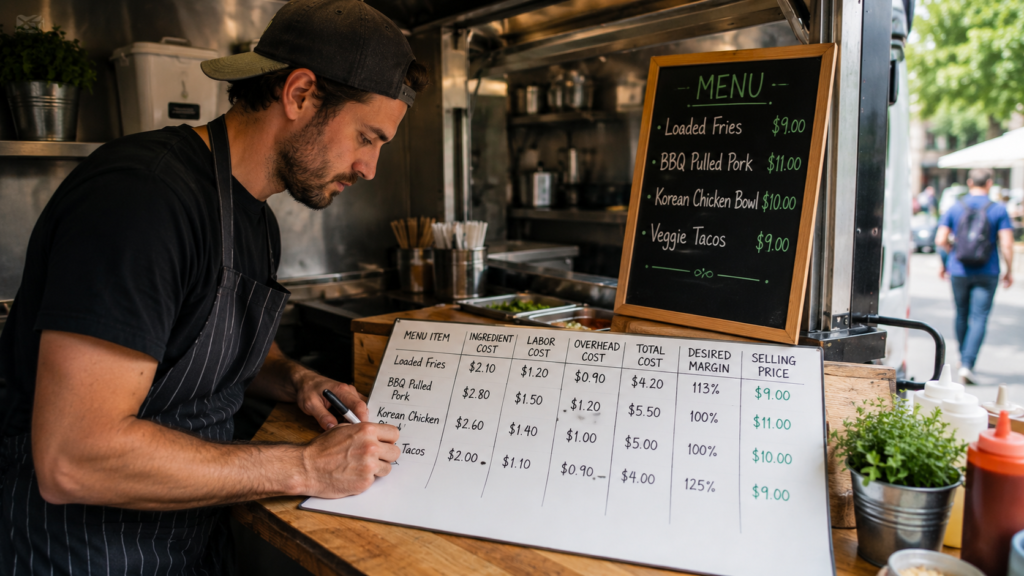
Price too low and you’ll never cover your running costs. Price too high and festival crowds will walk past you toward the van next door. A rough rule that works for most street food: your food cost should sit around 28-33% of the sale price, leaving room for wages, fuel, pitch fees and profit.
Test your prices at a couple of smaller events before committing at a big one. Watching real customers hesitate over a price tag tells you more than any spreadsheet ever will.
Factor pitch fees directly into your pricing rather than treating them as a separate cost you’ll absorb. If a festival charges 20% of takings, that needs to be baked into what you charge per item, or you’ll walk away from a busy weekend having barely broken even.
Round numbers help too, more than people expect. A £6 item sells faster at a crowded market than a £5.90 one — the extra ten pence in change slows the queue down and that matters when you’ve got ninety seconds per customer during a rush.
Finding Pitches And Bookings
Council street trading lists are the obvious starting point, and most local authorities publish them online. Market operators, event booking platforms and brewery residencies are all worth cold-emailing with photos and a short pitch — the first booking is genuinely the hardest one to land.
Beyond formal events, look at local businesses near you that draw steady foot traffic — office parks, sports clubs, large pubs without their own kitchen. A regular weekly slot at one reliable site can matter more to your income than three one-off festival bookings.
Corporate catering is worth chasing once you’ve got a few events under your belt. Companies booking lunch for a hundred staff pay reliably and often repeat the booking monthly, which gives your food van business plan a stable income line that festivals alone can’t offer.
Don’t underestimate word of mouth either. A good pitch at one wedding often leads directly to a booking for someone else’s engagement party. Keep a simple record of every event contact you make, because that list becomes one of your most valuable assets within the first year.
Writing Financial Projections
Investors and lenders will want to see twelve months of projected revenue, costs and cash flow, broken down monthly rather than as a single annual figure. Seasonality hits food vans hard — winter months can be half your summer takings — and your food van business plan needs to show you’ve accounted for that dip.
Build in a target, too. Many established vans aim for something around a £1,500 week once they’re fully booked; use that as a benchmark, then work backwards to figure out how many events per month gets you there realistically.
Show your break-even point clearly. That’s the number of trading days per month where revenue covers all fixed and variable costs — rent-free equivalent for a van is fuel, insurance, licensing renewals and stock. Once you know that figure, you know exactly how many bad-weather Saturdays you can absorb before it becomes a real problem.
Keep the projections conservative rather than optimistic. It’s tempting to assume every weekend will be a good one, but a food van business plan built on best-case numbers falls apart the first time it rains on a festival Saturday.
Mistakes That Sink Vans
The biggest one is underestimating running costs — fuel, gas, stock wastage and pitch fees add up faster than people expect. A close second is ignoring seasonality and assuming summer takings will hold steady through January, which they almost never do.
Weather kills more food van businesses than bad food ever does. Build flexibility into your menu — hot soups and stews for cold snaps, cold drinks and lighter dishes for heatwaves — so a rained-off Saturday doesn’t wipe out your week’s margin.
Another common mistake is chasing every event that says yes, regardless of fit. A high-fee festival pitch that only nets you fifty covers isn’t worth the diesel and the day’s labour, but new owners often say yes to everything early on out of anxiety about turning down income.
Poor record-keeping trips up more people than you’d think, too. If you’re not tracking sales by item and by location, you won’t know which pitches or menu items are actually profitable, and your next year’s food van business plan will just be a repeat of the same guesswork.
A Real Coffee Van Example
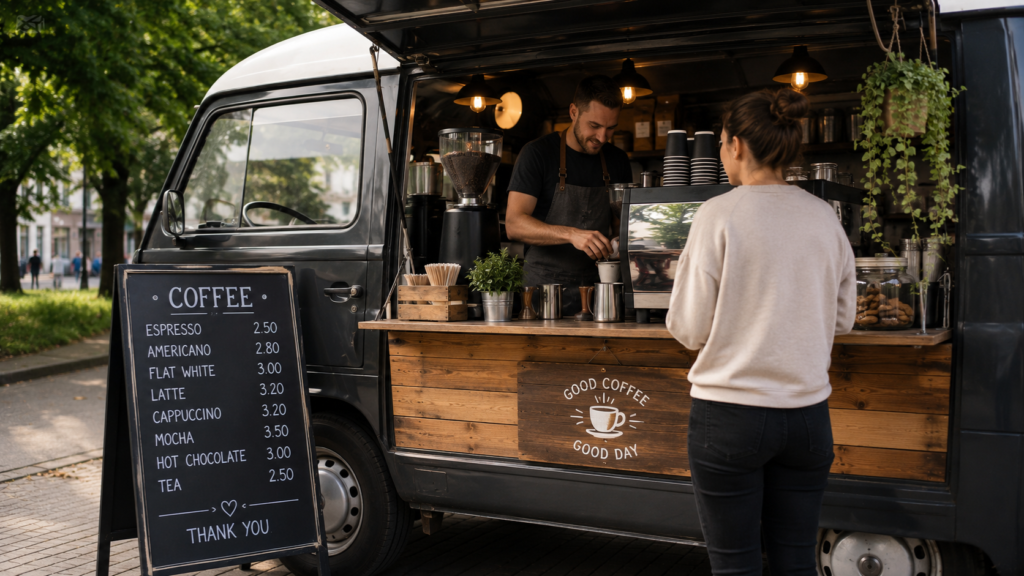
Picture a small coffee van operating from a private residence near a country park. The owner’s food van business plan started with market research showing a nearby café was the only real competitor, a kilometre’s walk away — close enough to matter, far enough to leave a gap.
Her financial plan built in £30,000 of total startup costs, split between the van, a specialist espresso setup, and a season’s worth of stock. She financed part of it through a bank loan, kept meticulous HMRC records from week one, and broke even by month five — roughly in line with what her original forecast predicted.
What made her food van business plan work wasn’t luck. She’d spoken to the café owner directly before launching, mapped out quiet times when the café was less busy, and positioned her van to catch the overflow rather than compete head-on for the same customers at the same hours.
By her second season, she’d added a second pitch at a nearby business park two mornings a week, using the same equipment and the same supplier relationships she’d already built. That’s the kind of steady, low-risk expansion a well-researched plan makes possible.
Tips From The Trade
Keep records obsessively. Every receipt, every transaction, every mile driven — HMRC self-assessment gets painful fast if you’ve been sloppy about it all year. A simple spreadsheet updated weekly beats a shoebox of receipts sorted in a panic every April.
Build relationships with other van owners rather than treating them purely as competition. They’ll tell you which pitches flood in the rain, which event organisers pay late, and which suppliers actually deliver on time. That kind of knowledge doesn’t show up in any food van business plan template you’ll find online.
Set aside 25-30% of your takings for tax and VAT before you touch the rest. It’s easy to spend what looks like profit in your account, only to find you owe HMRC a chunk of it come January. Treat that percentage as untouchable the moment it lands.
Also worth mentioning — invest in a decent card reader with reliable connectivity before your first big event. Cash-only vans lose a noticeable slice of impulse buyers, especially younger customers who genuinely don’t carry cash anymore.
Marketing That Actually Works
Instagram and a Google Business Profile do most of the heavy lifting for a food van — people search “food near me” constantly when they’re deciding where to eat at an event. Post photos of the food, not just the van, and tag your location every time.
A simple one-page website with your booking calendar helps too, especially once you’re pitching to wedding planners and corporate event organisers who want to check availability without a phone call. Keep it basic; nobody’s judging your food van business plan on web design.
Local Facebook groups still punch above their weight for food vans, particularly for weekly market announcements. A quick post the night before telling regulars where you’ll be tomorrow often drives more traffic than a paid ad ever would.
Consistency matters more than polish. A van that shows up at the same pitch every Thursday builds a habit in people’s minds, and habit is worth more to a food van business than any single viral post.
Frequently Asked Questions
How much does a food van business plan cost to put together?
Writing it yourself costs nothing but time. Paying a professional service typically runs £700 to £5,000 depending on depth and how much financial modelling you need.
Do I need a food van business plan if I’m self-funding?
Yes, still worth it. It’s the only way to know your real running costs before you’re committed, and it exposes gaps in your concept early.
What’s the biggest startup cost in a food van business plan?
The vehicle itself, usually. Expect £5,000 to £20,000 for a decent base van before equipment, conversion and branding are added on top.
How long before a food van business becomes profitable?
Most well-planned vans break even within four to six months of steady trading, though seasonality can stretch that if you launch heading into winter.
Conclusion
A food van business plan isn’t paperwork for its own sake — it’s the thing that stops you finding out the hard way that your margins don’t work. Get the market research, licensing and budget right first, and the van itself becomes the easy part.
Start small if you need to, test your concept properly, and keep your food van business plan as a living document you actually update once real numbers start coming in. That’s what separates the vans still trading in year three from the ones that quietly disappear.