

Introduction
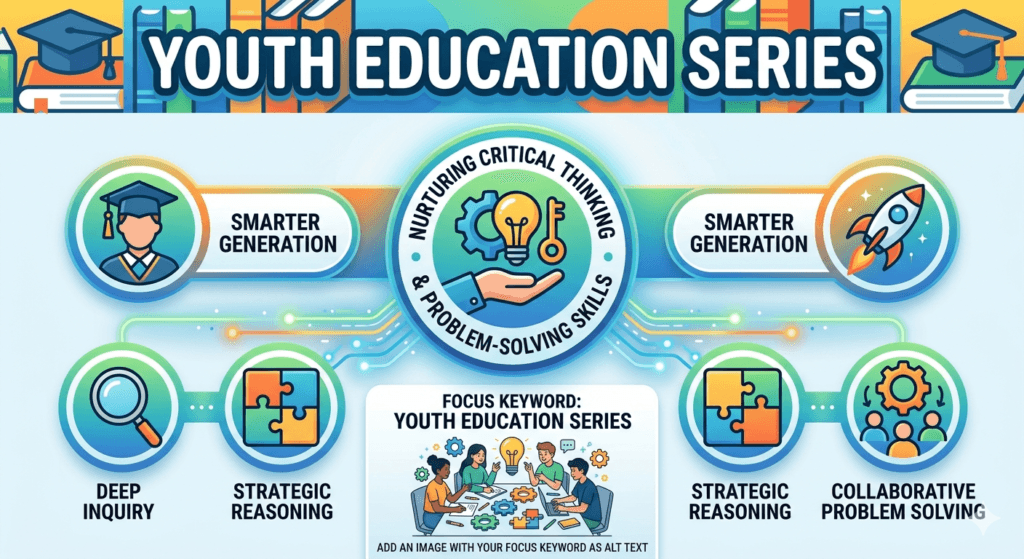
In a world that grows more complex with every passing year, the ability to think critically and solve problems effectively has become one of the most valuable skills a young person can possess. Traditional education systems have long focused on memorisation, standardised testing, and rote learning — approaches that, while useful in certain contexts, often fall short of preparing young minds for the nuanced challenges they will inevitably face in adult life. The Youth Education Series represents a bold and necessary shift in how we approach learning, placing critical thinking and problem solving at the very heart of the educational experience.
This series is not simply a collection of lessons or workshops. It is a comprehensive, structured journey designed to equip young learners with the intellectual tools they need to question assumptions, analyse information, evaluate evidence, and arrive at well-reasoned conclusions. In doing so, it prepares them not just for academic success, but for life — for careers, relationships, civic participation, and the countless decisions that define a meaningful human existence.
Why Critical Thinking Matters More Than Ever
We live in an age of information overload. Young people today are bombarded daily with news, opinions, advertisements, social media content, and peer influence. Without the ability to evaluate what they encounter with a discerning eye, they are left vulnerable to misinformation, manipulation, and poor decision-making. Critical thinking is the antidote — a mental discipline that allows individuals to separate fact from fiction, weigh competing arguments fairly, and form judgements based on reason rather than emotion alone.
Research consistently shows that students who develop strong critical thinking skills perform better academically across all subjects. More importantly, they carry those skills far beyond the classroom. They become better communicators, more empathetic listeners, more effective leaders, and more responsible members of society. They are less likely to be swayed by propaganda, less likely to make impulsive decisions, and more likely to approach disagreements with curiosity rather than defensiveness.
The Youth Education Series recognises that critical thinking is not a natural gift reserved for the intellectually elite. It is a learnable, teachable skill that flourishes when nurtured in the right environment — an environment that rewards questioning, celebrates mistakes as learning opportunities, and values the process of reasoning as much as the final answer.
The Role of Problem Solving in Youth Development
Problem solving and critical thinking are deeply intertwined, but they are not identical. While critical thinking is primarily about evaluation and analysis, problem solving is about action — about taking a situation that requires resolution and working systematically toward a solution. Together, they form the foundation of intellectual competence.
For young learners, problem solving is best developed through experience. When children and adolescents are given genuine challenges to wrestle with — challenges that have no obvious or single correct answer — they begin to develop cognitive flexibility, persistence, and creativity. They learn that failure is not a dead end but a detour, and that the most valuable lessons often emerge from the moments when things do not go according to plan.
The Youth Education Series incorporates problem solving at every stage of its curriculum, using real-world scenarios, collaborative group tasks, and reflective exercises that ask young people to think deeply about the choices they make and the reasoning behind them. Whether working through a logical puzzle, debating a complex ethical question, or designing a solution to a community challenge, students in this series are consistently pushed to think beyond the surface level.
Building a Culture of Inquiry in the Classroom
One of the most powerful insights behind the Youth Education Series is that critical thinking cannot be taught in isolation — it must be embedded in the culture of the learning environment itself. A classroom that punishes wrong answers, discourages questions, or prioritises speed over depth actively undermines the development of critical thinking, no matter how strong the curriculum may be.
Creating a genuine culture of inquiry requires educators to rethink their role. Rather than functioning as the sole authority and dispenser of knowledge, teachers in this model become facilitators and co-explorers. They ask open-ended questions rather than closed ones. They welcome dissent and disagreement as signs of intellectual engagement. They model the kind of humble, curious, evidence-based thinking they want their students to develop.
This shift does not happen overnight, and it requires ongoing professional development, institutional support, and a willingness among school leaders to prioritise depth over breadth in the curriculum. The Youth Education Series provides frameworks, training resources, and community support to help educators make this transition with confidence and clarity.
Practical Strategies That Work
Across the breadth of the Youth Education Series, several practical strategies have emerged as particularly effective in developing critical thinking and problem solving skills among young learners.
Socratic questioning is one of the most powerful tools available to educators. By asking students not just what they think but why they think it, and then probing their reasoning with follow-up questions, teachers can help students identify assumptions they did not know they were making and consider perspectives they had previously overlooked.
Collaborative learning, when structured thoughtfully, is another cornerstone of the series. When young people work together on a shared challenge, they are exposed to different ways of thinking and must learn to articulate, defend, and sometimes revise their own views in response to their peers. This social dimension of learning is irreplaceable — it mirrors the collaborative nature of most adult professional environments and builds the interpersonal skills that complement intellectual ability.
Reflective journaling encourages students to document their thinking processes, not just their conclusions. By writing about how they approached a problem, what they found difficult, and what they would do differently next time, students develop metacognitive awareness — the ability to think about their own thinking — which is one of the hallmarks of a truly critical thinker.
Project-based learning gives students the opportunity to apply their skills to extended, meaningful tasks that have genuine stakes. Rather than answering questions on a worksheet, students might design a proposal to address a local environmental issue, investigate a historical injustice, or create a media campaign around a cause they care about. These projects demand sustained effort, creativity, and the integration of multiple disciplines, all of which deepen the development of critical thinking.
The Family’s Role in Supporting Critical Thinking
Education does not begin and end at the school gate. Families play an irreplaceable role in shaping how young people think, and the Youth Education Series actively engages parents and caregivers as partners in the learning process. Simple habits practised at home — asking children to explain their reasoning, discussing current events over dinner, encouraging questions rather than demanding compliance — can have a profound cumulative impact on a young person’s intellectual development.
The series provides accessible resources for families, including discussion guides, activity suggestions, and advice on how to create a home environment that values curiosity and open-minded inquiry. When the messages young people receive at home align with those they receive at school, the results are significantly stronger and more lasting.
Frequently Asked Questions (FAQ)
Q1: At what age should children begin developing critical thinking skills?
Critical thinking development can and should begin from the earliest years of childhood. Even very young children benefit from being asked open-ended questions, being encouraged to explain their reasoning, and being given age-appropriate challenges that require them to think rather than simply recall. The Youth Education Series offers resources adapted for different developmental stages, from early childhood through adolescence.
Q2: How is the Youth Education Series different from standard school curricula?
While standard curricula often prioritise the acquisition of knowledge and the mastery of specific content areas, the Youth Education Series places equal emphasis on the processes of learning — how students think, reason, question, and collaborate. It is designed to complement and enrich existing curricula rather than replace them, providing the depth and experiential dimension that more traditional approaches sometimes lack.
Q3: Can critical thinking be taught to students who struggle academically?
Absolutely. Critical thinking is not correlated with academic performance in the traditional sense. Students who find conventional schoolwork challenging often demonstrate remarkable creative and analytical abilities when given the right kind of problem to engage with. The Youth Education Series is designed to be inclusive and accessible, meeting learners where they are and building from their existing strengths.
Q4: How do educators assess critical thinking skills?
Assessing critical thinking requires a different approach than assessing factual recall. The Youth Education Series uses portfolio-based assessment, reflective writing, observed discussions, and project evaluations to gauge how well students are developing their reasoning abilities. The focus is on growth over time rather than performance at a single point.
Q5: How can schools implement the Youth Education Series?
Schools can engage with the series at multiple levels — from individual teachers incorporating specific strategies into their existing practice, to whole-school adoption of the series’ frameworks and professional development programmes. The series team offers consultancy, training workshops, and ongoing support to schools at every stage of implementation.
Q6: What evidence supports the effectiveness of this approach?
A growing body of educational research supports the value of critical thinking instruction. Studies consistently show that students who receive explicit instruction in reasoning and problem solving outperform their peers in academic achievement, demonstrate greater resilience in the face of challenges, and report higher levels of engagement and motivation in their learning.
Conclusion
The Youth Education Series stands as a timely and transformative response to one of the most pressing needs in modern education — the need to develop young people who can think for themselves, reason with integrity, and engage with the world’s challenges with both confidence and humility. At its core, this series is built on a simple but profound belief: that every young person, regardless of background, ability, or circumstance, has the capacity to become a powerful and independent thinker. What they need is the right environment, the right guidance, and the right opportunities to develop that capacity fully.
The importance of this work cannot be overstated. We are preparing young people for a future that none of us can fully predict — a future in which the ability to adapt, to question, to collaborate, and to reason will matter far more than the ability to recall a fixed body of knowledge. The jobs that many of today’s students will hold in twenty years do not yet exist. The challenges they will face — environmental, social, political, economic — will demand levels of creativity and critical engagement that go far beyond what conventional education has typically been designed to produce.
By embedding critical thinking and problem solving at the heart of the educational experience, the Youth Education Series is not simply improving academic outcomes, as meaningful as those improvements are. It is contributing to the formation of a generation that is better equipped to participate in democratic life, to hold institutions accountable, to navigate disagreement with grace, and to pursue their own goals with clarity and determination. These are not small or peripheral ambitions — they are foundational to the kind of society we all want to live in.
For educators, the series offers not just a set of tools but a renewed sense of purpose. Teaching is one of the most consequential professions in existence, and when teachers are empowered to focus on depth, inquiry, and genuine intellectual development, they rediscover the aspects of their work that drew them to it in the first place. The enthusiasm that comes from watching a student truly wrestle with a difficult idea — and emerge from that struggle with greater understanding and confidence — is among the most rewarding experiences any educator can have.
For parents and caregivers, the series is an invitation to become more intentional participants in their children’s intellectual lives. The habits of mind that the series cultivates — curiosity, open-mindedness, persistence, reflective awareness — are habits that can be nurtured every day, in every kind of conversation and shared experience. When families and schools work together toward the same vision, young people receive a coherent and powerful message: that thinking well is not just something you do in a classroom, but a way of engaging with life itself.
For young people themselves, the series offers something that no amount of content knowledge alone can provide — a belief in their own capacity to understand, to question, and to contribute. When students discover that their reasoning matters, that their questions are valued, and that their ideas can make a real difference, something shifts in how they see themselves and their place in the world. That shift is the beginning of genuine empowerment, and it is the ultimate measure of what the Youth Education Series sets out to achieve.
In investing in critical thinking and problem solving skills today, we are making the most important investment of all — in the minds and futures of the young people who will shape the world of tomorrow.