

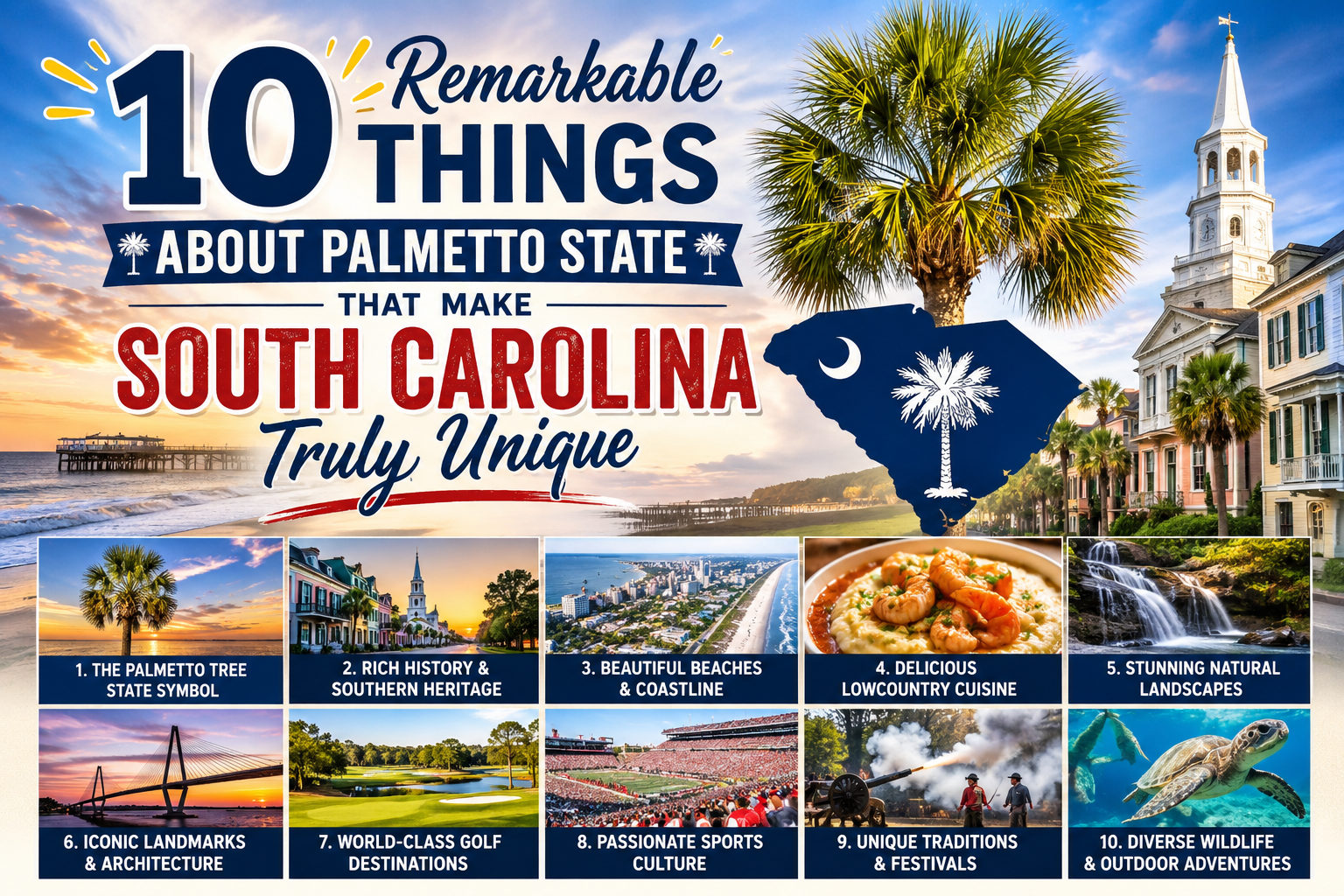
Palmetto state is the proud nickname of South Carolina, a place where history runs deep and culture tells a story unlike anywhere else in America. The name comes from the sabal palmetto tree, which played a decisive role in the American Revolution when its spongy wood absorbed British cannonballs during the Battle of Sullivan’s Island in 1776. That moment of unexpected strength became a defining symbol for the state and its people. Today the palmetto tree appears on the state flag and countless pieces of imagery that South Carolinians use to express their pride and identity every single day.
Palmetto State Geography and Landscape
The palmetto state stretches across a remarkably varied landscape, from the Blue Ridge Mountains in the northwest to the Atlantic Ocean coastline in the southeast. This geographic range gives South Carolina a diversity of terrain that surprises many visitors who expect only beaches and flatlands. The state is divided into three distinct regions known as the Upstate, the Midlands, and the Lowcountry, each with its own character and climate.
The Upstate region sits at higher elevations and offers cooler temperatures, waterfalls, and mountain scenery that draws outdoor enthusiasts throughout the year. The Midlands sit in the center of the state and include the capital city of Columbia along with rolling hills and pine forests. The Lowcountry stretches along the coast and into the Sea Islands, where Gullah Geechee culture, Spanish moss, and tidal marshes create an atmosphere found nowhere else in the country.
Rich Revolutionary War History
 The story of how South Carolina earned the palmetto state nickname is rooted in one of the most remarkable episodes of the Revolutionary War. In June 1776, British forces attacked a fort on Sullivan’s Island near Charleston that was built from palmetto logs. Instead of shattering under cannon fire, the soft fibrous wood absorbed the blows and kept the structure standing long enough for American defenders to repel the attack decisively and successfully.
That victory at Fort Moultrie was one of the earliest significant American successes of the Revolutionary War and gave colonial forces a major morale boost at a critical moment. The palmetto tree became a symbol of stubborn resistance and unexpected strength, qualities that South Carolinians have claimed as part of their identity ever since. According to Discover South Carolina, this history continues to draw thousands of heritage tourists to the state each year.
Charleston City and Its Legacy
No discussion of the palmetto state is complete without spending time on Charleston, the oldest and most historically layered city in South Carolina. Founded in 1670, Charleston served as one of the most important ports in colonial America and became a center of trade, culture, and the slave trade that shaped the entire American South. Its well-preserved historic district contains some of the finest examples of colonial and antebellum architecture found anywhere in the country today.
Walking through Charleston today means moving through centuries of American history in a remarkably compact area. Rainbow Row, with its brightly painted Georgian houses along East Bay Street, has become one of the most photographed streetscapes in the American South. The city’s food scene, its art galleries, and its deeply complicated relationship with history all combine to make Charleston one of the most discussed destinations in the palmetto state and in the entire nation.
Gullah Geechee Cultural Heritage
One of the most significant cultural contributions of the palmetto state to American life is the Gullah Geechee culture that developed among enslaved Africans and their descendants along the Sea Islands and coastal regions. Isolated on the islands and in the Lowcountry, these communities preserved African languages, traditions, crafts, foodways, and spiritual practices to a remarkable degree unusual in the American context and deeply valuable to world heritage.
The Gullah language blends English with elements of several West and Central African languages and has influenced the broader speech patterns of the entire region. Gullah Geechee cuisine, including dishes like red rice, shrimp and grits, and Hoppin John, has shaped the food culture of the entire palmetto state and beyond its borders. The Gullah Geechee Cultural Heritage Corridor, established by the federal government in 2006, recognizes and works to preserve this irreplaceable cultural legacy for future generations.
Myrtle Beach Tourism Economy
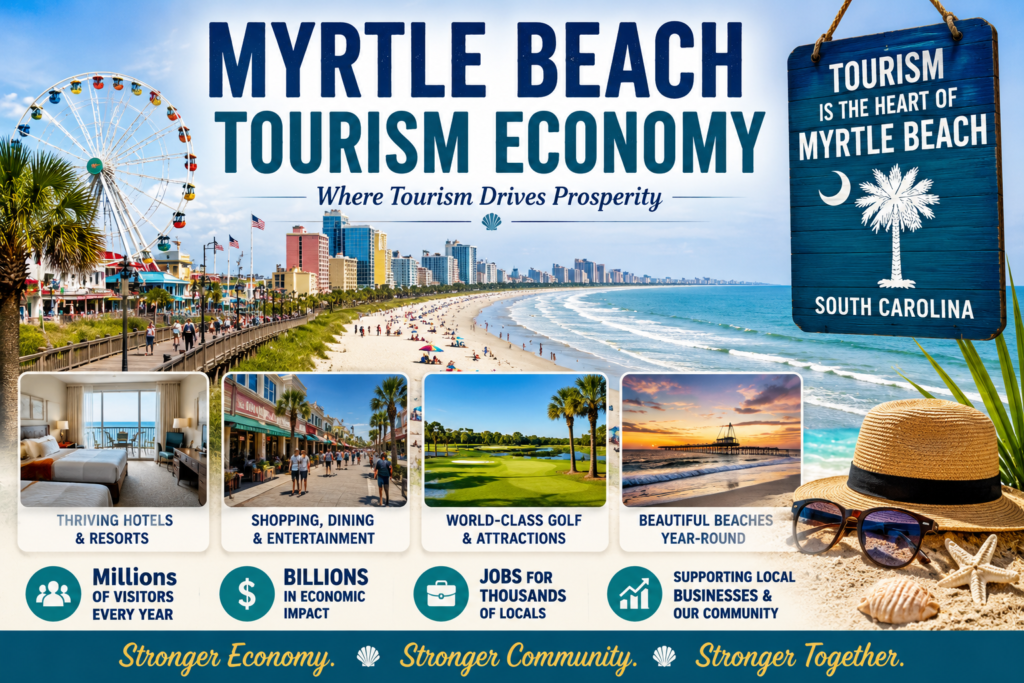
The Grand Strand, a stretch of coastline centered on Myrtle Beach, represents the palmetto state’s most visited tourist destination and one of the busiest beach resort areas on the entire East Coast. Roughly sixty miles of Atlantic coastline draw millions of visitors each year who come for warm water, wide sandy beaches, golf courses, and the sprawling entertainment infrastructure that has grown around the resort economy over recent decades.
Supporting local businesses near me in coastal communities like Myrtle Beach and Pawleys Island is something visitors can do meaningfully during their stays, as the tourism economy depends heavily on small and family-owned operations that give each community its distinct character. Beyond the commercial core, quieter communities like Litchfield Beach offer a more relaxed coastal experience that has attracted generations of South Carolina families seeking peaceful summer retreats away from the crowds.
Palmetto State Natural Wonders
The palmetto state maintains an extensive system of state parks that gives residents and visitors access to an impressive range of natural environments worth visiting throughout the year. Congaree National Park, the only national park in South Carolina, protects the largest intact expanse of old-growth bottomland hardwood forest in the southeastern United States. South Carolina State Parks offer additional access to mountains, rivers, beaches, and forests across the entire state.
Huntington Beach State Park near Murrells Inlet is consistently rated among the best state parks in the entire country, offering pristine beach access alongside salt marshes and the eccentric Atalaya Castle. The state’s rivers, including the Edisto, the Saluda, and the Santee, provide additional opportunities for fishing, kayaking, and wildlife observation that make the natural resources of the palmetto state a genuine asset for outdoor recreation lovers of all ages and experience levels.
Education and University System
Higher education in the palmetto state includes a diverse collection of institutions ranging from large research universities to historically Black colleges and universities that played a crucial role in educating generations of African Americans. Clemson University in the Upstate and the University of South Carolina in Columbia are the two flagship institutions whose athletic rivalry in football is one of the most passionate in the entire country each season.
Research into topics like are black women the most educated highlights how institutions like South Carolina State University, Claflin University, and Benedict College contributed enormously to educational advancement for Black Americans throughout the twentieth century under difficult conditions of enforced segregation. These historically Black colleges and universities educated community leaders, civil rights activists, and professionals whose contributions shaped the palmetto state and the broader American story in ways that deserve far greater recognition today.
Economic Growth and Business
 The economy of the palmetto state has transformed dramatically over the past half century, shifting from dependence on tobacco, cotton, and textile manufacturing toward a diversified base that includes automotive manufacturing, aerospace, tourism, and agriculture. The arrival of major international manufacturers including BMW, Volvo, and Boeing has made South Carolina an unlikely hub of advanced manufacturing and brought significant foreign investment into the state’s communities.
Careful market research has guided much of the economic development strategy that brought these major employers to the palmetto state, demonstrating how data-driven business decisions can transform regional economies over time. The port of Charleston has grown into one of the busiest container ports on the East Coast, handling enormous volumes of cargo that move through supply chains of manufacturers across the entire southeastern United States every single day.
Food Culture and Traditions
The palmetto state has one of the most distinctive and regionally varied food cultures in the American South that sets it apart from neighboring states. South Carolina is the only state in the country to claim four distinct styles of barbecue sauce, ranging from the mustard-based sauce of the Midlands, which reflects the German immigrant heritage of that region, to the vinegar-and-pepper sauces of the Pee Dee region in the northeast part of the state.
Lowcountry cuisine deserves particular attention for its depth and strong African influences that give it a character found nowhere else. Dishes like she-crab soup, frogmore stew, oyster roasts, and boiled peanuts are deeply embedded in the food identity of coastal South Carolina and have gained admirers far beyond the state’s borders in recent years. The farm-to-table movement has found fertile ground in the palmetto state, where agricultural diversity provides chefs with an unusually wide range of fresh local ingredients throughout the growing season each year.
Civil War Memory and Sites
 Few states carry the weight of Civil War memory as heavily as the palmetto state, which was the first state to secede from the Union in December 1860 and where the first shots of the war were fired at Fort Sumter in Charleston Harbor in April 1861. These facts are woven into the historical consciousness of the state in ways that continue to generate debate, reflection, and honest conversation about how history should be remembered and interpreted by future generations of Americans.
Fort Sumter National Monument, accessible by ferry from Charleston, remains one of the most visited Civil War sites in the country and offers a genuinely moving experience of standing where American history pivoted decisively. Battlefields, cemeteries, plantation sites, and museums across the palmetto state engage with different aspects of the Civil War and its aftermath, including the experience of enslaved people whose labor and suffering undergirded the society that chose to fight for its preservation at enormous human cost.
FAQ
Why is South Carolina called the Palmetto State?
The nickname comes from the palmetto tree whose wood helped defend a Revolutionary War fort by absorbing British cannonballs without shattering during the 1776 battle.
What is the most visited place in the Palmetto State?
Myrtle Beach draws the most visitors annually, followed closely by Charleston, which attracts tourists interested in history, food, and beautiful architecture.
What food is the Palmetto State known for?
South Carolina is famous for four styles of barbecue sauce, shrimp and grits, she-crab soup, boiled peanuts, and rich Gullah Geechee cuisine traditions.
Is the Palmetto State good for outdoor activities?
Yes, South Carolina offers mountains, beaches, rivers, and state parks including Congaree National Park, making it excellent for hiking, kayaking, and fishing.
Conclusion
The palmetto state is a place that rewards genuine attention and firmly resists easy summary or simple description. Its history is complicated and deeply significant, encompassing revolutionary courage, the brutal reality of slavery, the trauma of civil war, the long struggle for civil rights, and the ongoing effort to build a more equitable and prosperous society for all its residents across every region and community. Its geography moves from mountains to marshes across a relatively short distance, packing an unusual range of landscapes and ecosystems into a single state that continues to surprise first-time visitors.
What makes South Carolina genuinely compelling is the way its past and present exist in constant and meaningful conversation with each other every single day. A city like Charleston holds colonial grandeur and slavery’s legacy in the same city block. The Gullah Geechee communities of the Sea Islands preserve African cultural traditions that survived centuries of oppression and are now recognized as a national treasure worthy of protection and celebration. The Upstate city of Greenville demonstrates what thoughtful investment and civic ambition can accomplish in a post-industrial landscape when communities commit to genuine renewal and growth together.
The palmetto state is neither a simple celebration nor a simple condemnation but a full and complicated American place that has contributed enormously to the national story in ways both painful and deeply inspiring. Visitors who come looking only for beaches and golf will find those things in great abundance throughout the year. Those who look deeper will find a state grappling honestly with its history while building something new and meaningful on top of it, which is perhaps the most American story of all and one that the palmetto state tells with particular intensity, honesty, and authenticity that few other states can match.