

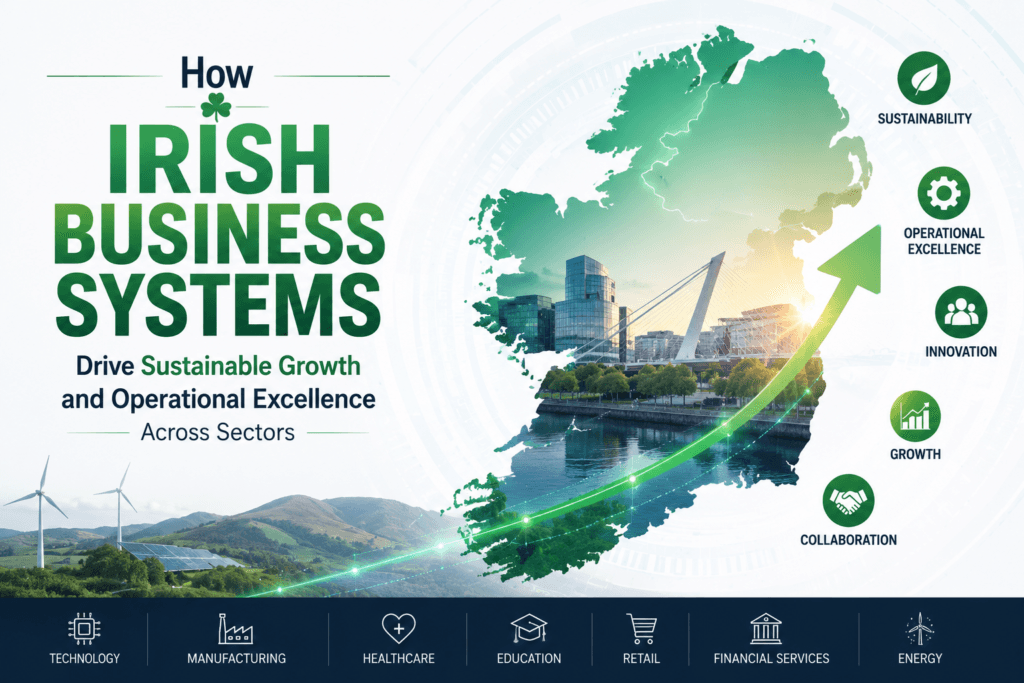
Ireland has developed one of the most structured and supportive business ecosystems in Europe, giving small enterprises access to frameworks that larger economies often reserve exclusively for corporations. Irish business systems combine government-backed enterprise support, a highly educated workforce, and a transparent regulatory environment that collectively reduce barriers for entrepreneurs entering competitive markets. Understanding how these systems function from the ground up allows business owners to leverage available resources strategically rather than navigating the commercial landscape without direction or institutional support.
Small enterprises in Ireland benefit enormously from organizations like Enterprise Ireland and the Local Enterprise Offices, which provide funding, mentorship, and market access programs specifically designed for emerging businesses. These institutional frameworks remove much of the guesswork from early-stage business development by offering structured pathways toward sustainable commercial viability. Entrepreneurs who engage actively with these systems from the outset build stronger operational foundations, access better financing options, and develop the strategic clarity needed to compete effectively in both domestic and international markets with greater confidence.
Understanding Irish Corporate Governance Frameworks for Responsible Business Operations
Corporate governance within Irish business systems follows a well-established framework that balances accountability, transparency, and operational flexibility for organizations operating across all sectors and sizes. The Companies Act 2014 provides the primary legislative foundation governing how Irish companies are structured, managed, and held accountable to shareholders, employees, and the broader public interest. Businesses operating within this framework benefit from clear guidelines on director responsibilities, financial reporting obligations, and compliance requirements that protect organizational integrity over the long term.
Responsible governance is not merely a regulatory obligation within the Irish business context but a genuine competitive advantage that builds trust with clients, investors, and institutional partners alike. Companies that demonstrate strong governance practices attract higher-quality investment, access better financing terms, and experience fewer operational disruptions caused by compliance failures or internal accountability breakdowns. Irish Business Systems that embed governance principles into their organizational culture from the earliest stages consistently outperform competitors who treat compliance as an afterthought rather than a foundational business system that supports every other operational function effectively.
How Irish Tax Structures Benefit Growing Businesses Seeking Competitive Advantage
Ireland’s corporate tax structure is one of the most strategically significant components of its broader business systems framework and a primary reason why multinational corporations establish European headquarters in the country. The 12.5 percent corporate tax rate on trading income has historically provided Irish-registered businesses with a meaningful cost advantage over competitors operating from higher-tax jurisdictions across continental Europe. This structure, combined with an extensive network of double taxation agreements with over seventy countries, creates a highly attractive environment for businesses with international trading ambitions and cross-border operational requirements.
Domestic Irish businesses benefit from this tax environment not only through reduced liability on profits but through the clustering effect created by multinational presence across technology, pharmaceutical, and financial services sectors. The concentration of global companies creates supply chain opportunities, talent pipeline benefits, and knowledge transfer effects that strengthen the broader commercial ecosystem for indigenous Irish enterprises. Understanding how to position your business within this tax-advantaged environment, with proper professional guidance, allows entrepreneurs and established operators alike to maximize retained earnings and reinvest more capital into growth-generating activities.
Leveraging Enterprise Ireland Funding Programs for Business Expansion Strategies
Enterprise Ireland operates as the primary government agency responsible for supporting the growth and internationalization of Irish-owned businesses across manufacturing, services, and technology sectors. Its funding programs range from competitive feasibility study grants for early-stage concepts to substantial research and development funding for established companies pursuing product innovation and market diversification. Engaging with Enterprise Ireland’s support ecosystem provides businesses with financial resources, strategic expertise, and international market connections that would otherwise require years and significant private capital to develop independently.
The application process for Enterprise Ireland funding rewards businesses that demonstrate clear commercial viability, realistic growth projections, and a coherent internationalization strategy supported by credible market research. Companies that invest time in developing thorough business plans before approaching the agency consistently secure more favorable funding outcomes than those who treat grant applications as administrative exercises rather than strategic business development opportunities. Building a relationship with your Enterprise Ireland development advisor early creates an ongoing support structure that evolves alongside your business needs as you progress through successive growth stages.
Building Operational Efficiency Through Irish Business Process Management Systems
Operational efficiency sits at the heart of every successful Irish business system, and process management frameworks provide the structural discipline needed to scale operations without proportionally increasing costs or administrative complexity. Lean management principles, adapted from manufacturing origins to service and knowledge-based industries, have been widely adopted by Irish businesses seeking to eliminate waste, reduce cycle times, and deliver more consistent quality outcomes for clients. These frameworks translate naturally into Irish enterprise contexts where resource constraints frequently demand creative solutions to operational challenges that larger competitors solve simply by deploying additional capital.
Implementing robust process management systems requires commitment from senior leadership and consistent communication across all organizational levels to succeed beyond initial implementation phases. Irish businesses that invest in process documentation, key performance indicator development, and regular operational review cycles build organizational resilience that sustains performance through market disruptions, personnel changes, and growth transitions. The discipline of systematic process management compounds in value over time, creating organizations that improve continuously rather than cycling through periodic efficiency initiatives that fade without institutional embedding.
Navigating Irish Regulatory Compliance Systems for Confident Business Leadership
Regulatory compliance in Ireland spans employment law, health and safety standards, data protection requirements under GDPR, environmental obligations, and sector-specific licensing frameworks that vary significantly across industries. Understanding which regulatory frameworks apply to your specific business activities is the essential first step toward building a compliance infrastructure that protects the organization from legal risk while enabling confident operational decision-making. Irish Business Systems that treat compliance proactively as a business system rather than reactively as a burden consistently experience fewer regulatory disruptions and build stronger reputations with institutional clients who conduct thorough due diligence.
The Central Bank of Ireland, the Competition and Consumer Protection Commission, and the Data Protection Commission each govern specific dimensions of Irish commercial activity with distinct enforcement approaches and compliance expectations. Working with qualified legal and compliance advisors to map your regulatory landscape before problems emerge costs significantly less than managing enforcement actions after compliance failures occur. Building compliance checkpoints into routine operational processes rather than treating them as separate annual exercises transforms regulatory management from a source of organizational anxiety into a structured system that supports rather than constrains business growth and development.
Developing Market Entry Strategies Using Irish Business Development Systems
Market development within Irish business systems is supported by a combination of institutional infrastructure, geographic positioning, and cultural advantages that create genuine competitive opportunities for well-prepared enterprises. Ireland’s membership in the European Union provides businesses registered here with full access to a single market of over four hundred and forty million consumers without the tariff and regulatory barriers that affect competitors operating from outside the bloc. This market access, combined with strong English-language capability and cultural alignment with both American and British commercial practices, positions Irish Business Systems uniquely within the global trading environment.
Effective market entry strategies begin with thorough research into target customer segments, competitive landscapes, and regulatory requirements specific to each market being pursued. Irish Business Systems entering continental European markets benefit from EU frameworks that standardize many commercial and legal dimensions of cross-border trading, reducing complexity compared to markets outside the bloc. Engaging with Bord Bia for food and beverage businesses, or Enterprise Ireland’s international office network for other sectors, provides market intelligence and introductory connections that accelerate credible market entry significantly beyond what individual research and cold outreach alone typically achieves.
Implementing Digital Transformation Systems for Modern Irish Business Competitiveness
Digital transformation has become a defining strategic priority for Irish businesses seeking to maintain competitiveness in rapidly evolving domestic and international markets. Enterprise-wide adoption of cloud computing platforms, customer relationship management systems, and data analytics tools enables Irish companies to operate with the speed, precision, and customer responsiveness that contemporary commercial environments demand. Businesses that delay digital transformation investment increasingly find themselves unable to compete effectively with digitally native competitors who operate at lower costs and faster response times across every customer-facing and internal operational dimension.
The Irish government supports digital transformation through programs like the Digital Transition Fund and IDA Ireland initiatives that assist both indigenous and foreign-owned businesses in upgrading their technological capabilities. Accessing these programs requires demonstrating a credible digital strategy with clear implementation milestones, measurable performance targets, and realistic resource allocation plans. Irish Business Systems that approach digital transformation as a comprehensive organizational change initiative rather than a series of isolated technology purchases achieve more sustainable competitive improvements and better return on the significant investment that genuine digital transformation consistently requires from committed leadership teams.
Strengthening Irish Supply Chain Systems for Resilient Business Performance
Supply chain resilience emerged as a critical strategic priority for Irish Business Systems following global disruptions that exposed the vulnerability of lean, single-source procurement models across multiple sectors simultaneously. Building diversified supplier networks, maintaining strategic inventory buffers for critical inputs, and developing alternative logistics pathways collectively reduce the operational risk that concentrated supply chains create in unpredictable global trading environments. Irish businesses with robust supply chain systems weathered recent disruptions more effectively than competitors whose procurement strategies prioritized cost minimization over operational continuity and risk distribution.
Developing strong supplier relationships within the Irish domestic supply base, where feasible, provides additional resilience benefits beyond cost and logistics considerations alone. Local procurement reduces exposure to international shipping disruptions, currency fluctuation risks, and geopolitical uncertainties that affect global supply chains with increasing frequency in the current commercial environment. Irish Business Systems that combine strategic domestic sourcing with carefully managed international procurement create supply architectures that balance cost efficiency with operational resilience in proportions appropriate to their specific industry risk profiles and customer service commitments.
Creating People Management Systems That Strengthen Irish Organizational Culture
People management represents one of the most consequential business systems any Irish organization operates, directly influencing productivity, innovation capacity, retention rates, and organizational reputation in competitive talent markets. Irish employment law establishes clear frameworks governing recruitment, contracts, working conditions, performance management, and termination processes that provide both employers and employees with structured rights and responsibilities. Building people management systems that meet legal requirements while genuinely supporting employee development creates organizations where talent chooses to remain and contribute at high performance levels over extended periods.
Progressive Irish employers are increasingly recognizing that talent retention in competitive sectors requires people management systems that extend well beyond legal compliance into genuine investment in employee wellbeing, career development, and workplace culture. Flexible working arrangements, transparent promotion pathways, regular feedback mechanisms, and meaningful recognition programs collectively create environments where skilled professionals feel valued and motivated to contribute their best work consistently. Organizations that build these systems deliberately attract higher-quality candidates, experience lower turnover costs, and develop the organizational capability needed to pursue ambitious growth strategies with confidence in their human capital foundations.
Using Financial Management Systems to Drive Irish Business Systems Profitability Growth
Sound financial management systems provide Irish businesses with the visibility, control, and analytical capability needed to make confident strategic decisions in dynamic and often unpredictable commercial environments. Implementing robust accounting software, developing monthly management accounts, and establishing clear financial performance metrics gives leadership teams the real-time insight needed to identify emerging problems and capitalize on developing opportunities before competitors recognize them. Irish businesses that operate with strong financial management disciplines consistently demonstrate better profitability, stronger cash flow management, and greater capacity to fund growth investments from retained earnings.
Working capital management deserves particular attention within Irish Business Systems financial systems, as cash flow constraints represent the most common cause of operational failure even among businesses that demonstrate strong underlying trading profitability. Implementing rigorous debtor management processes, negotiating favorable supplier payment terms, and maintaining appropriate credit facilities creates the financial buffer that sustains operations through seasonal demand variations and unexpected commercial disruptions. Engaging a qualified accountant or financial controller with specific Irish business experience ensures your financial management system meets both operational needs and the reporting obligations required by Revenue Commissioners and Companies Registration Office simultaneously.
Scaling Irish Business Systems Through Strategic Partnership and Collaboration Networks
Strategic partnerships and collaborative networks amplify the capabilities of Irish Business Systems beyond what internal resources alone can support, particularly for enterprises pursuing ambitious growth trajectories in competitive international markets. Joint ventures, strategic alliances, and formal consortium arrangements allow Irish companies to combine complementary capabilities, share market development costs, and present clients with more comprehensive service propositions than any single organization could credibly deliver independently. The Irish business culture, which tends toward relationship-driven commercial interaction, provides a naturally supportive environment for building the trust that effective strategic partnerships fundamentally require to function sustainably over time.
Industry associations, chamber networks, and sector-specific clusters create structured environments where Irish businesses develop the relationships that evolve into strategic partnerships and commercial collaboration opportunities. Engaging actively in these networks, contributing expertise and industry knowledge rather than simply attending events passively, builds the professional reputation that attracts partnership approaches from complementary organizations. Irish businesses that invest consistently in their professional networks over years rather than approaching networking transactionally develop rich relationship ecosystems that generate partnership opportunities, client referrals, and market intelligence with compounding value throughout their organizational development journey.
Optimizing Irish Business Innovation Systems for Sustained Competitive Market Advantage
Innovation capability represents one of the most strategically significant differentiators available to Irish Business Systems competing in domestic and international markets where product and service commoditization constantly erodes margin and competitive distinctiveness. Ireland’s research and development tax credit system, which provides a twenty-five percent tax credit on qualifying expenditure, creates a financially attractive environment for businesses investing systematically in innovation activities across product development, process improvement, and service design. Companies that build formal innovation systems rather than relying on occasional creative breakthroughs develop more consistent pipelines of commercially valuable improvements that sustain competitive advantage over extended periods.
Science Foundation Ireland, the Irish Research Council, and various industry-academic collaboration programs provide additional resources that Irish businesses can leverage to access cutting-edge research capabilities without building expensive internal research infrastructure from scratch. Establishing relationships with universities and institutes of technology through Knowledge Transfer Ireland connects businesses with specialized expertise, research facilities, and talented graduate researchers who bring fresh analytical perspectives to established commercial challenges. Irish Business Systems that integrate academic collaboration into their innovation systems consistently develop more technically sophisticated solutions and access intellectual property development pathways that create durable competitive advantages in knowledge-intensive markets.
Building Customer Experience Systems That Strengthen Irish Business Brand Loyalty
Customer experience has emerged as the primary competitive battleground for Irish businesses across retail, professional services, hospitality, and technology sectors where product and price differentiation alone no longer sustain long-term commercial relationships. Designing systematic customer journey frameworks that identify every touchpoint between your organization and your clients reveals improvement opportunities that are invisible to businesses managing customer relationships informally without structured analytical frameworks. Irish Business Systems that invest in customer experience systems consistently achieve higher retention rates, stronger referral generation, and premium pricing power compared to competitors who treat customer interaction as an operational function rather than a strategic capability.
Implementing customer feedback mechanisms, net promoter score tracking, and regular service quality audits creates the data infrastructure needed to manage customer experience as a genuine business system rather than a collection of individual relationship management efforts. Irish businesses benefit from cultural warmth and relationship orientation that creates naturally strong customer rapport, but systematic measurement and continuous improvement transforms this cultural advantage into a durable organizational capability. Training customer-facing teams in experience design principles and empowering them to resolve issues autonomously creates the responsive service culture that generates the loyalty and advocacy that drive sustainable revenue growth through positive word-of-mouth in closely networked Irish Business Systems communities.
Developing Leadership Capability Systems for Next-Generation Irish Business Growth
Leadership development represents a critical long-term investment within Irish business systems, as organizational growth ultimately depends on the quality and depth of leadership capability available to guide teams through increasingly complex commercial challenges. Irish Management Institute programs, executive education offerings from leading Irish universities, and peer learning networks like the Irish Institute of Directors provide structured development pathways for business leaders at every career stage. Organizations that invest systematically in leadership development create succession depth that protects operational continuity while simultaneously building the strategic thinking capacity needed to navigate evolving market conditions with confidence and clarity.
Mentoring programs that connect emerging Irish business leaders with experienced executives accelerate leadership development beyond what formal education alone consistently achieves in practical commercial contexts. The relatively compact nature of the Irish business community makes senior leader access more achievable than in larger economies, creating mentoring relationship opportunities that entrepreneurs in bigger markets rarely access at equivalent career stages. Building formal mentoring and leadership development programs into your organizational people strategy signals genuine commitment to employee growth that strengthens retention among high-potential individuals who represent the future leadership foundation of your growing Irish business.
Implementing Sustainability Systems That Future-Proof Irish Business Operations
Sustainability has transitioned from a reputational consideration to a fundamental operational and strategic requirement for Irish Business Systems responding to regulatory evolution, investor expectations, and shifting customer purchasing values across every sector. The Irish government’s Climate Action Plan establishes legally binding targets that will increasingly affect how businesses operate, procure, and report on their environmental impact over the coming decade. Companies that begin building environmental management systems now develop competitive advantages in green procurement processes, sustainable supply chain certification, and ESG reporting capability that less-prepared competitors will scramble to establish under regulatory and commercial pressure.
Beyond compliance, sustainability systems create genuine operational efficiencies through energy reduction, waste minimization, and circular economy practices that reduce input costs while simultaneously strengthening environmental credentials with clients and partners. Irish businesses pursuing export markets in continental Europe face increasingly rigorous sustainability requirements from procurement teams and regulatory frameworks that make environmental management capability a genuine commercial prerequisite rather than a differentiating bonus. Building sustainability into core business systems early, rather than appending it as a separate reporting exercise, creates organizations that operate more efficiently, attract purpose-driven talent, and access the growing universe of sustainable finance instruments available through Irish and European financial institutions.
Measuring Irish Business System Performance Through Strategic Analytics Frameworks
Performance measurement systems provide Irish businesses with the objective evidence needed to distinguish genuine organizational progress from activity-based busyness that consumes resources without generating proportionate commercial returns. Developing a balanced scorecard of financial, operational, customer, and organizational learning metrics creates a multi-dimensional view of business performance that single-measure tracking consistently fails to capture accurately. Irish businesses that implement structured performance measurement frameworks make faster, more confident strategic decisions because leadership teams operate from shared factual understanding rather than competing subjective interpretations of organizational health and directional momentum.
Key performance indicator selection requires careful alignment between measured metrics and genuine strategic priorities to avoid the common trap of measuring what is easily quantifiable rather than what is strategically meaningful. Monthly performance review disciplines that examine both leading and lagging indicators give Irish business leaders early warning of emerging challenges while celebrating genuine progress toward strategic objectives. Over time, consistent performance measurement creates an organizational culture of accountability and continuous improvement that compounds in value across every operational dimension, transforming data collection from an administrative burden into a genuine strategic advantage that separates high-performing Irish businesses from well-intentioned but directionless competitors.
Conclusion
The three-part exploration of Irish business systems presented throughout this series reveals a comprehensive landscape of frameworks, supports, and strategic disciplines that position well-prepared Irish enterprises for sustained commercial success in increasingly competitive domestic and international markets. From foundational governance and tax structures through operational efficiency and digital transformation to innovation systems and sustainability frameworks, each dimension examined contributes a distinct and essential layer to the organizational architecture that high-performing Irish businesses consistently demonstrate across sectors and scales.
Part One established that the structural foundations of Irish business systems, including corporate governance frameworks, enterprise support networks, tax advantages, and regulatory compliance disciplines, create the stable platform upon which all subsequent growth and development strategies depend. Businesses that invest in getting these foundations right before pursuing aggressive growth consistently outperform those that attempt to scale before establishing the organizational infrastructure needed to support expanded operations sustainably. The institutional ecosystem available to Irish businesses through Enterprise Ireland, Local Enterprise Offices, and industry associations provides levels of structured support that entrepreneurs in many competing economies simply do not have available at equivalent stages of business development.
Part Two demonstrated that strategic growth within Irish business systems requires deliberate investment across multiple simultaneous dimensions including market development, digital transformation, supply chain resilience, people management, financial discipline, and partnership network development. No single growth lever operates effectively in isolation, and Irish businesses that develop capability across all these dimensions simultaneously build more resilient and adaptable organizations than those who pursue excellence in one area while neglecting others. The interconnected nature of these systems means that strength in one area amplifies returns in adjacent systems, creating compounding organizational improvement that accelerates as capabilities mature and integrate more deeply across operational boundaries.
Part Three revealed that long-term excellence in Irish business systems ultimately depends on continuous investment in innovation, customer experience, leadership development, sustainability, and performance measurement capabilities that most organizations develop inadequately or inconsistently across their commercial lifespans. The businesses that dominate their sectors in Ireland over decades are those that treat organizational development as a permanent strategic commitment rather than a series of time-limited initiatives pursued in response to competitive pressure and abandoned when immediate urgency fades. Building these advanced capabilities requires patience, consistent resource allocation, and the leadership conviction that investing in organizational excellence today generates the competitive advantages that sustain commercial success through every future market evolution.
Together, these seven dimensions of Irish business systems create a complete strategic framework that any Irish enterprise, regardless of current size or sector, can use to assess their organizational strengths, identify development priorities, and build the comprehensive commercial capability needed to compete confidently and grow sustainably in the dynamic and opportunity-rich Irish Business Systems environment that continues to attract global attention and investment.