


Learn how to start an online business the smart way, sidestep the costly rookie mistakes, and get real steps, real costs, and honest timelines to follow.
Most people who ask me how to start an online business already have three tabs open comparing Shopify plans. That’s the wrong place to start, and I’ve watched it waste months of somebody’s life more than once.
I’ve spent years fixing what other people broke while starting theirs — half-built stores, abandoned dropshipping accounts, email lists nobody ever emailed, LLCs filed for businesses that never sold a single thing. The pattern is almost always the same: someone got excited about the idea of an online business before they figured out what problem they were actually solving for a customer. I’ve cleaned up that exact mess enough times now to know exactly where it starts. So let’s do this differently.
What Does It Actually Mean to Start an Online Business
An online business is just a business that sells something — a product, a service, or access to information — primarily through the internet instead of a physical storefront. That’s it. No mystique required.
But here’s the part people skip. Every online business still needs the same three things any business needs: a customer with a real problem, a way to reach that customer, and a way to get paid reliably. The “online” part changes the tools you use. It doesn’t change those fundamentals at all.
When someone asks me how to start an online business, I usually ask them one thing back first: who exactly is going to buy this, and why haven’t they already solved this problem another way? If they can’t answer that in two sentences, we’re not ready to talk platforms yet.
Why This Matters More Than People Think
There’s a reason so many online businesses quietly die in year one. It’s not lack of traffic. It’s not a bad logo. It’s that the founder built something before confirming anyone wanted it.
I’ve seen this trip people up constantly, and it’s the single most common fix I end up making. Someone spends six weeks on a beautiful website, launches, and hears crickets. Meanwhile, a competitor with an ugly Instagram page and clear messaging is already making sales. Looks don’t sell. Clarity does. Nine times out of ten, when someone calls me in after a launch flopped, this is the actual problem — not the website, not the ads, the offer itself was never tested on a real person first.
Getting how to start an online business right, from day one, saves you from rebuilding everything later — the offer, the pricing, sometimes the entire niche. Cheap mistakes early are fine. Expensive ones, the ones that cost months, usually come from skipping validation.
Common Types of Online Businesses Worth Considering
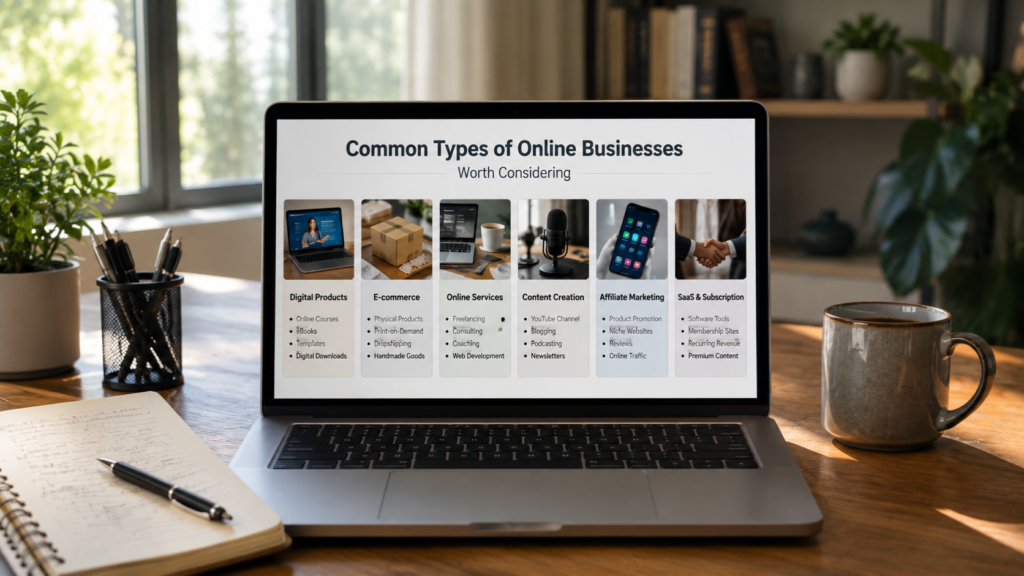
There isn’t one template here, and honestly, that’s a good thing. Anyone researching how to start an online business quickly discovers there are several very different paths, and the right one depends on your skills, savings, and patience, not just what’s trending.
- Service-based businesses — freelancing, consulting, coaching, done mostly over calls and email
- E-commerce — physical products, either made yourself, sourced wholesale, or dropshipped
- Digital products — courses, templates, software, ebooks, anything sold once and delivered infinitely
- Content and audience businesses — blogs, YouTube channels, newsletters monetized through ads, sponsors, or affiliate links
- Marketplace or agency models — connecting buyers and sellers, or managing a service for other businesses
Some of these need almost no money to test. Service businesses in particular can start with nothing but a laptop and a portfolio. E-commerce, by contrast, usually needs some capital tied up in inventory or ad spend before it proves itself.
I get asked constantly which of these is “best” for someone starting an online business with no experience. There’s no universal answer, but there’s a useful shortcut: match the model to what you already have. If you have a skill people already pay for offline — bookkeeping, writing, design, tutoring — a service business gets you paid within days. If you have a knack for sourcing or making physical goods, e-commerce fits better, even though it ties up cash longer. If you already have an audience somewhere, even a small one, a digital product or content business can monetize that faster than starting from zero.
What I’d steer most beginners away from, at first, is anything requiring heavy upfront inventory investment before a single sale has happened. It’s not that it can’t work. It’s that it removes your ability to change course cheaply, and changing course cheaply is exactly what you need in month one.
How Starting an Online Business Actually Works Step by Step

Here’s the sequence I’d walk a friend through, in order.
- Pick a problem, not a product. Talk to five to ten people who have the problem you think you’re solving. Ask what they’ve already tried. This alone kills half of bad ideas before any money is spent.
- Choose your business model and structure. Decide whether you’re selling a service, a product, or a mix. Then register the business properly — most people in the US will want an LLC or sole proprietorship, plus a federal tax ID. The SBA’s official startup guide walks through registration, licensing, and structure in more depth than I can cover here, and it’s worth reading before you file anything.
- Build the smallest version you can sell. Not a full catalog. Not a 12-module course. One offer, one price, one clear promise.
- Set up how you’ll get paid. Stripe, PayPal, or a platform’s built-in checkout — pick one and move on. Don’t spend three weeks comparing payment processors.
- Get in front of real people. Cold outreach, a small ad budget, posting in communities where your buyer already hangs out. Traffic isn’t the hard part early on; it’s usually the offer.
- Sell before you scale. Get five to ten actual paying customers before investing in a fancier website or automation. Real feedback beats assumptions every time.
Honestly, that whole sequence can happen in three to four weeks if you don’t overthink the branding.
A quick note on step two, because it’s the one people rush past or avoid entirely. Registering the business isn’t glamorous, but skipping it creates real problems later — you can’t open a proper business bank account, you can’t easily prove the business exists if a client asks, and you’re personally exposed if anything goes wrong. It’s an afternoon of paperwork now versus a legal headache later. Worth doing before you take your first payment, not after.
I’ll also say this: the order matters more than the tools. Two people can use the exact same website builder and payment processor, and one succeeds while the other doesn’t, purely because one validated demand first and the other built in isolation for two months. Anyone teaching how to start an online business who skips straight to “pick your platform” is skipping the part that actually determines whether the business survives.
The Real Benefits of Going Online First
Low overhead is the obvious one — no lease, no retail staff, no inventory sitting in a warehouse if you’re selling services or digital products. But there’s more to it.
You get to test fast. A physical store change takes weeks; an online offer can be tweaked in an afternoon based on what customers actually say. You also get reach a local shop never had — someone in another state or country can become a customer without ever meeting you.
And there’s flexibility most people undervalue until they have it. Running things from a laptop means the business can move with you, which matters more than it sounds like until you’ve actually lived it.
There’s also a data advantage that a lot of first-time founders don’t think about until later. Every click, every abandoned cart, every email open is trackable in a way a physical shop simply can’t match. That means you find out what’s not working within days instead of months, and you can fix pricing, messaging, or targeting long before you’ve spent serious money finding out the hard way.
Challenges Nobody Warns You About
I won’t pretend this is easy, because it isn’t.
Competition online is invisible until it isn’t — you’re not just competing with the shop down the street, you’re competing with everyone selling something similar anywhere in the world. Trust is harder to build too, since people can’t walk into your store and see you’re legitimate; reviews, testimonials, and a real presence have to do that work instead.
Cash flow can also get weird fast, especially with e-commerce, where you might pay for inventory or ads weeks before the sales revenue actually lands in your account. Budget for that gap. Plenty of otherwise-good businesses fold because of timing, not because the idea was bad.
There’s also a quieter challenge: isolation. Working alone from home, without coworkers or a boss checking in, sounds appealing until three months in when you realize you haven’t talked business strategy with another human in weeks. Find a community, a mastermind group, even just one other person doing something similar. It matters more for staying motivated than most people expect going in.
Platform dependency is another one worth naming. If your entire online business lives on one marketplace or one social platform’s algorithm, a policy change or account suspension can wipe out income overnight. Diversify where you can — your own website, your own email list, more than one traffic source — so no single company controls your livelihood.
A Realistic Example
A woman I worked with wanted to sell handmade candles. Instead of building a full store first, she posted five photos in three Facebook groups, priced three scents, and took orders through direct messages for two weeks straight.
She sold eleven candles before she ever had a website. Only then did she build a simple Shopify page, because by that point she knew what sizes people wanted, what price they’d pay, and which scent to feature first. That’s the order that actually works — sell, then build the storefront around what already sold.
Compare that to a different client, a man building a subscription meal-planning app. He spent four months building features nobody had asked for before he showed the product to a single potential user. When he finally did, the feedback forced him to cut two-thirds of what he’d built. Same ambition, same effort, wildly different outcome — because the sequence was backward from the start.
Expert Tips I Give Almost Everyone

Price higher than feels comfortable at first. Most new business owners underprice out of fear, then resent the business six months in because the margins can’t support anything.
Track where your first ten customers actually came from — write it down. It’s tempting to guess later, and guessing is usually wrong. Also worth mentioning: set up basic email capture from day one, even before you have much to send. An email list you actually maintain, following good deliverability practices, tends to outperform social media reach within the first year, since you’re not renting attention from an algorithm.
Get your EIN sorted early too — I can’t count how many times I’ve had to help someone retroactively fix a business bank account or a client contract because they were still operating under their own Social Security number six months in. It takes ten minutes through the official IRS EIN application, it’s free, and it saves you the exact headache I keep getting called in to untangle.
And don’t wait for permission. Nobody is going to tell you it’s the right time.
Build a simple weekly review habit early — twenty minutes, once a week, looking at what sold, what didn’t, and what people actually asked you about. Most founders who successfully start an online business and keep it running past year one aren’t smarter than the ones who quit. They just paid closer attention to small signals and adjusted faster.
One more thing: resist the urge to hire help too early. It’s tempting to outsource the parts you don’t enjoy, but doing the unglamorous work yourself for the first few months teaches you things about your own customers that you simply can’t learn secondhand from someone else’s summary.
Mistakes That Show Up Again and Again
These are the ones I get called in to fix, on repeat, year after year.
Skipping the business registration step is one I see constantly — people run for months under their own name, then scramble when a client wants an invoice from an actual registered entity. If you’re operating in North Carolina, for instance, checking the state’s business name records before you settle on a name saves you from picking one that’s already taken.
Building the “perfect” website before making a single sale is another one. So is choosing a niche so broad it means nothing — “health and wellness” tells a customer nothing about why they should pick you over the next result.
Ignoring taxes until year-end is a rough one too. Set aside a percentage of every sale from the start; don’t make future-you handle a surprise bill alone.
Another one: trying to be everywhere at once. New founders often try to post on five social platforms, run ads, write a blog, and build an email list simultaneously in week one. Pick one channel, get good at it, then add the next. Spreading thin early is how good ideas quietly die from neglect rather than failure.
And copying a competitor’s whole playbook without knowing why it worked for them. What worked for a business with three years of trust built up rarely works identically for someone in week one. Borrow the principle, not the exact execution.
What It Actually Costs to Get Started

People searching how to start an online business almost always want a number, so here’s an honest one instead of a vague “it depends” answer.
A service-based business can genuinely start for $50 to $200 — a domain name, a basic website or even just a well-built profile on a freelance platform, and maybe a simple invoicing tool. That’s often the entire bill for month one.
A digital product business — courses, templates, ebooks — usually lands between $100 and $500 once you factor in a platform to host and sell the product, some basic design tools, and a small amount for initial promotion. The main cost here is time, not money; building the actual product takes longer than setting up to sell it.
E-commerce sits at the higher end. Even a lean version, sourcing a small batch of product and running a modest ad budget to test demand, tends to run $500 to $2,000 before you know if it works. That’s not a reason to avoid it, but it is a reason to test demand with pre-orders or a waitlist before committing to a full inventory run.
None of these numbers include your time, and none of them account for the version of the business you’ll actually settle into after the first few months of adjusting. Budget a little more than you think you need, and treat the first thirty days as tuition, not proof of concept.
FAQs
Do I need a business license to start an online business?
It depends on your state and what you’re selling, but many online sellers do need at least a basic license or permit. Check your local requirements before your first sale, not after.
How much money do I need to start an online business?
Service-based businesses can start with under $100. E-commerce and inventory-based models usually need more, often several hundred to a few thousand dollars for initial stock and ads.
How long does it take to become profitable?
It varies widely, but many focused, service-based online businesses see their first profit within one to three months. Product-based businesses often take longer, closer to six months to a year.
Can I start an online business while working a full-time job?
Yes, and honestly it’s a smart way to test the idea with less financial pressure. Many successful online businesses started as evenings-and-weekends projects before going full-time.
What’s the biggest reason online businesses fail?
Usually it’s building something nobody was actively looking for, not lack of effort. Validating demand before investing heavily is the single biggest predictor of survival.
Do I need to be good with technology to start an online business?
No, basic comfort with a computer and a willingness to learn one or two tools is usually enough. Most modern platforms are built for non-technical users, so the harder skill to develop is actually marketing, not coding.
Wrapping This Up
If you take one thing from all this, let it be this: how to start an online business isn’t really a technical question. It’s a sequencing question. Talk to real people first. Sell something small before you build anything fancy. Register the business properly instead of hoping nobody asks. Track what’s working instead of guessing.
The tools — the website builder, the payment processor, the email platform — are the easy part, and they change every year anyway. What doesn’t change is that a business needs a real customer willing to pay before anything else matters. Get that right, and the rest is mostly logistics.
I’ve watched people spend a year “preparing” to launch and people who launched in a weekend with a rough offer and a DM list. The second group almost always ends up further ahead, simply because they started learning from real customers months earlier. That gap compounds. So if you’re still reading guides instead of talking to your first potential buyer, that’s probably the actual next step — not another guide, including this one.
I’ve fixed enough of these mistakes for other people at this point that I’d rather you just avoid them from the start. That’s really the whole point of this.