

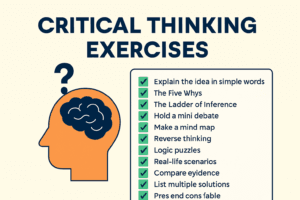
Description:
Nobody teaches this in school. These 12 critical thinking exercises build the reasoning habits that separate people who solve problems from people who just react to them.
School Taught Facts Not Thinking

Twelve years sitting in classrooms and most people graduate knowing plenty of information but having no reliable system for deciding what that information actually means or whether it should be trusted at all.
That is not an accident. Curricula prioritize content. The mental tools needed to evaluate content rarely make the syllabus. Critical thinking exercises exist because that gap does not close on its own — and the adults who discover them tend to feel a specific frustration that nobody introduced this earlier.
What This Actually Means In Practice
Not arguing. Not being the person who challenges everything in meetings to seem clever. Not contrarianism dressed up as intellectual rigor.
Real Critical Thinking Exercises is simpler and harder than any of those things. It is the habit of asking the right questions before deciding what to do with information. Where did this come from. What is it assuming. What would have to change for this conclusion to be wrong.
What this looks like in real situations:
- Noticing when a confident claim has no actual evidence behind it
- Catching your own bias before it finishes your reasoning for you
- Seeing the difference between two things happening together and one causing the other
- Recognizing when emotion is doing the work that logic should be doing
These are habits. Buildable ones. That is the entire premise of critical thinking exercises.
Exercise 1 — Strengthen What You Want To Dismiss

Take the position you most want to reject and spend five minutes building the strongest version of it you can manage. Not the version that is easy to dismiss. The version that genuinely challenges you.
This is called steel manning and it is uncomfortable enough that most people avoid it entirely — which is exactly why it works.
How to practice this:
- Pick one opinion you strongly disagree with today
- Write the three best arguments supporting it
- Only then write your counter arguments
- Notice which of yours actually survive the strongest version
Most people discover their position was held against a version nobody serious actually defends. That discovery alone justifies the five minutes.
Exercise 2 — Hunt The Hidden Assumptions
Every conclusion travels with assumptions. Most of those assumptions go unstated because the person making the argument considers them obvious. Obvious is not evidence.
Pick any decision you made this week. List every assumption that decision required to be true. Then ask honestly which ones you actually have evidence for.
Assumptions that quietly break conclusions:
- That past patterns will keep repeating
- That other people define success the way you do
- That the information available is complete
- That memory of what happened is accurate
- That two things happening together means one caused the other
Practicing this daily makes flawed reasoning visible before it produces consequences rather than after.
Exercise 3 — Ask What Would Make You Wrong
For any conclusion you reach spend two minutes asking what would need to be true for the opposite to be correct.
Uncomfortable? Good. That discomfort is doing something useful — forcing genuine engagement with contrary evidence instead of the reflexive dismissal that passes for reasoning in most conversations.
Real examples of how this works:
- You think a colleague is unmotivated — what if they are motivated but blocked by something invisible to you
- You think a project failed because of execution — what if the strategy itself was wrong from the start
- You think someone is avoiding you — what if they are dealing with something that has nothing to do with you at all
According to Harvard Business Review, leaders who regularly consider opposite conclusions make measurably better decisions under uncertainty than those who treat their first conclusion as the final one.
Exercise 4 — Evaluate The Source Before The Content
One piece of information. Five minutes. Do not evaluate what it says — evaluate who said it and why before you decide whether to believe it.
Questions worth asking about any source:
| Question | What It Actually Reveals |
| Who produced this? | Potential bias and agenda |
| What do they gain if you believe it? | Incentive structure |
| What evidence supports the claim? | Fact versus assertion |
| Who disagrees and what do they say? | Alternative perspectives |
| What would change this conclusion? | Whether it can be tested |
Once these questions become automatic the way news, research, and expert opinion land changes permanently.
Exercise 5 — Ask Why Five Times
Surface problems are almost never the actual problem. The five whys finds what is actually happening underneath the symptom that keeps getting treated without ever resolving.
A project keeps running late. Why? Scope expands unexpectedly. Why? Requirements are unclear at the start. Why? Stakeholders are not consulted during planning. Why? The planning process does not include a stakeholder review step. Why? Nobody ever defined who needed to be in the room before decisions got made.
Now there is something fixable. Critical thinking exercises that reach root causes instead of treating symptoms change how recurring problems get handled permanently. Check our project based inquiry science article for more on how structured questioning builds better thinking habits across all learning contexts.
Exercise 6 — Track Your Own Biases Daily
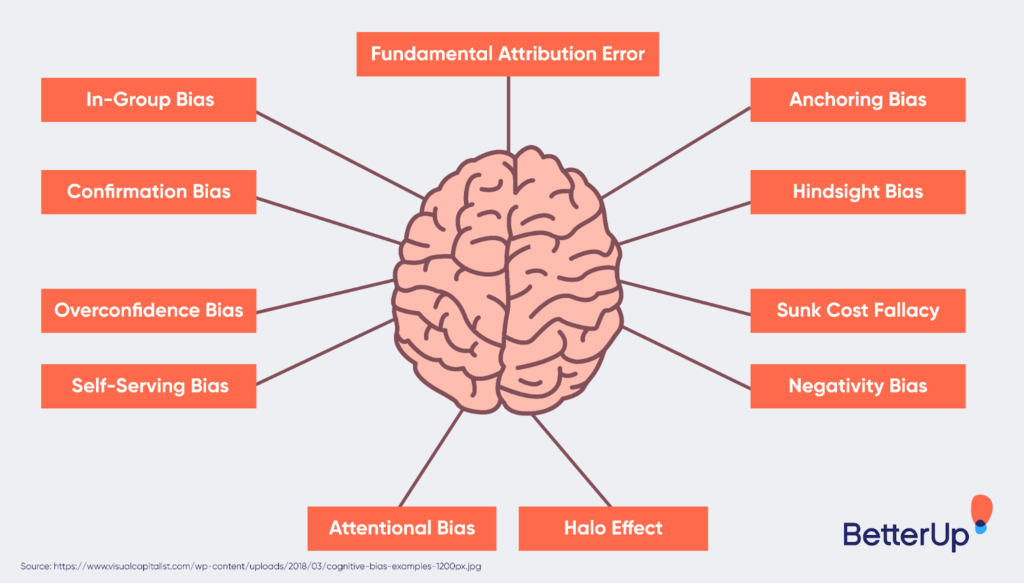
Everyone has them. The difference between clear thinkers and cloudy ones is not the absence of bias — it is awareness of which biases show up in which situations and catching them before they finish the reasoning on your behalf.
One decision per day. Write which cognitive bias might be influencing it.
Biases worth tracking most actively:
- Confirmation bias — only noticing evidence that agrees with existing beliefs
- Availability heuristic — overweighting recent or dramatic examples
- Anchoring — letting the first number heard dominate everything after
- Sunk cost fallacy — continuing something bad because stopping feels like waste
- Dunning-Kruger effect — most confident in areas of least actual knowledge
The goal is not eliminating bias. It is seeing it operating in real time rather than discovering it afterward when the damage is done.
Exercise 7 — Map The Argument Visually
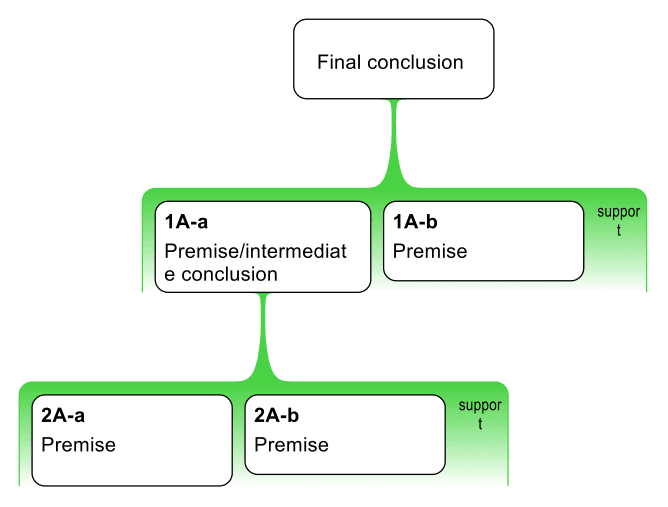
Take any complex argument and draw it out. Central claim in the middle. Supporting reasons as branches. Evidence for each reason noted alongside it. Objections written next to each supporting point.
What this reveals every time:
- Which parts actually have support behind them
- Which parts are assertions dressed as conclusions
- Where the reasoning is genuinely strong
- Where one challenge collapses the whole structure
- Whether the conclusion actually follows from the premises
Most arguments that seem airtight when heard quickly fall apart when the structure becomes visible. This is one of those critical thinking exercises that produces genuine surprise the first several times it gets used.
Exercise 8 — Write Predictions And Check Them
Every week write three explicit predictions. Specific ones — not “I think the project will go well” but “I think the client will request changes within two weeks.” Come back in a month and check.
Most people discover their predictions in specific domains are far less accurate than their confidence suggested.
The pattern to look for:
- Wrong more often about people or processes
- Wrong more often when optimistic or pessimistic
- Wrong more often in familiar situations or unfamiliar ones
According to Farnam Street, systematic prediction tracking identifies where reasoning feels reliable but consistently is not — more accurately than introspection alone ever manages.
Exercise 9 — Generate Perspectives That Are Not Yours
For any situation deliberately think through how three people significantly different from you would see it. Not what you would think if you were them. What they would actually think given their different experiences and incentives.
Perspectives worth regularly including:
- Someone with significantly less power in the situation
- Someone whose financial interests conflict with yours
- Someone who will experience consequences you will not feel
- Someone from a background where different assumptions are default
- Someone who started with the opposite conclusion
Critical thinking exercises that expand perspective range consistently produce better decisions than optimizing within a single viewpoint. Check our education achievement authority article for more on how perspective-taking develops stronger reasoning across educational and professional contexts.
Exercise 10 — Apply The Newspaper Test Both Ways
Most people apply the newspaper test in one direction only. Would a journalist write about this decision as harmful or wrong? That is the obvious check.
Apply it the other direction too. Would a journalist write about this decision as needlessly overcautious or paternalistic? Both tests together reveal decisions that hold up from multiple directions rather than just avoiding obvious criticism from one side.
What double-direction testing catches:
- Decisions defensible against harm accusations but embarrassingly timid
- Policies that protect the organization while failing the people it serves
- Conclusions that feel safe only because they have always been the conclusion
- Bold-looking decisions that are actually just undisclosed risk transfer
Exercise 11 — Rank Evidence Before Believing Anything
Personal anecdote and randomized controlled trial are not the same thing. Treating them as equivalent evidence is a reasoning error so common it has become invisible in most professional conversations.
Evidence quality from highest to lowest:
| Evidence Type | Weight It Deserves |
| Randomized controlled trials | Very high |
| Systematic reviews | Very high |
| Observational studies | Moderate |
| Expert opinion | Lower than assumed |
| Personal anecdote | Very low |
| Intuition | Not evidence |
The most confident claims in meetings are often backed by the lowest quality evidence. Once this ranking becomes automatic that pattern becomes impossible to unsee.
Exercise 12 — Assume Failure Before Starting
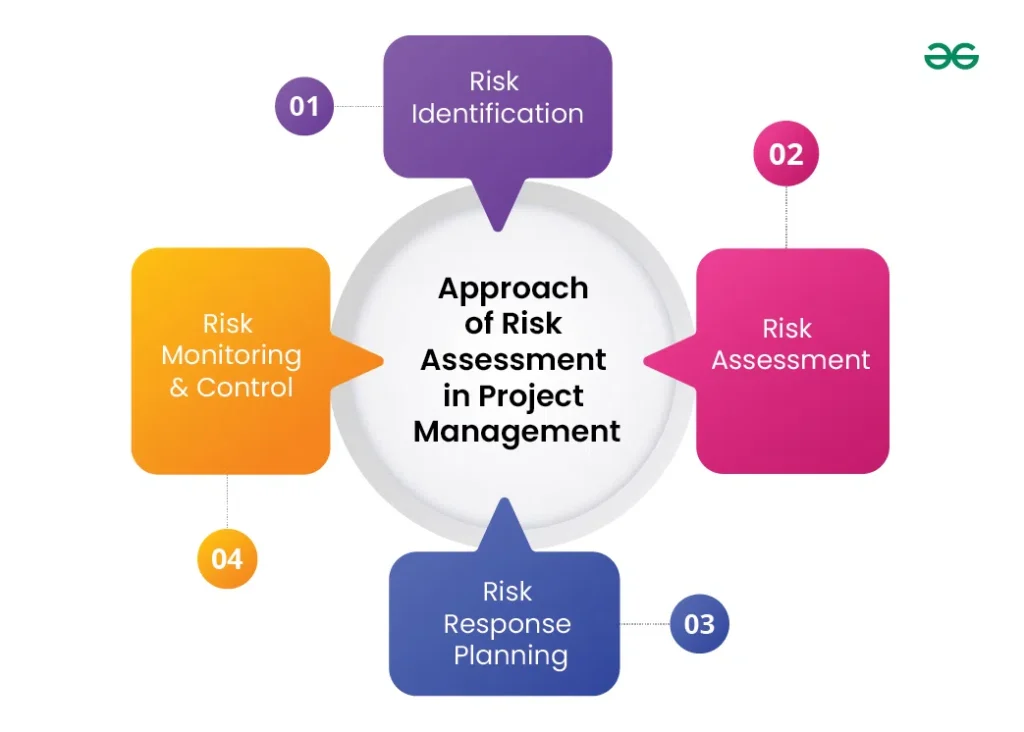
Before any significant project imagine it has already failed completely. Work backward from that failure to everything that could have caused it.
This bypasses the optimism bias that makes people systematically underestimate risks at the planning stage. Assuming failure rather than imagining it might happen surfaces risks that forward planning consistently misses.
How to run one properly:
- State the project clearly in one sentence
- Assume total failure twelve months from now
- List everything that could have caused it
- Rank causes by likelihood and impact
- Build mitigation for the top risks into the plan before starting
Military planners, surgeons, and serious investors use this because it works — not because it is comfortable to do.
Frequently Asked Questions
How long before critical thinking exercises produce visible improvement?
Most people notice clearer reasoning within four to six weeks of consistent daily practice. Habits become genuinely automatic within three to six months when practiced regularly.
Do these exercises work practiced alone or do they need other people?
Most work effectively solo. Steel manning and perspective multiplication benefit from discussion but produce genuine value practiced individually — the conversation with yourself is more useful than most people expect.
Are critical thinking exercises useful for students or mainly working professionals?
Research consistently shows the strongest long-term benefits come from starting early. Every exercise here scales naturally to different ages with minor complexity adjustments.
Which exercise produces the fastest noticeable improvement?
Assumption hunting and the five whys produce the most immediately visible results — often within hours of first use rather than weeks — because they apply directly to real situations already in front of you.
Conclusion

Critical thinking exercises are not content for people who enjoy reading about thinking. They are practical tools for anyone whose decisions and work would benefit from reasoning that holds up under pressure rather than collapsing the moment someone pushes back seriously.
The twelve exercises here cover everything — evaluating arguments, hunting assumptions, recognizing bias, ranking evidence, generating alternative perspectives, and stress-testing decisions before they produce consequences difficult to reverse.
None require special equipment or significant time. The steel man takes five minutes. Assumption hunting takes three. The pre-mortem takes thirty minutes and can prevent months of wasted effort on something headed toward predictable failure.
What they require is consistency. Done once these Critical Thinking Exercises produce interesting insights. Done daily they produce a fundamentally different quality of reasoning — visible to everyone around the person who developed it in how clearly they communicate, how quickly they spot problems, and how rarely they find themselves defending conclusions that collapse under the first serious question.
The people who think most clearly are not born that way. They practiced these habits long enough that the habits became invisible. That outcome is available to anyone willing to spend five minutes a day doing something slightly uncomfortable because it challenges conclusions they would prefer to leave alone.