

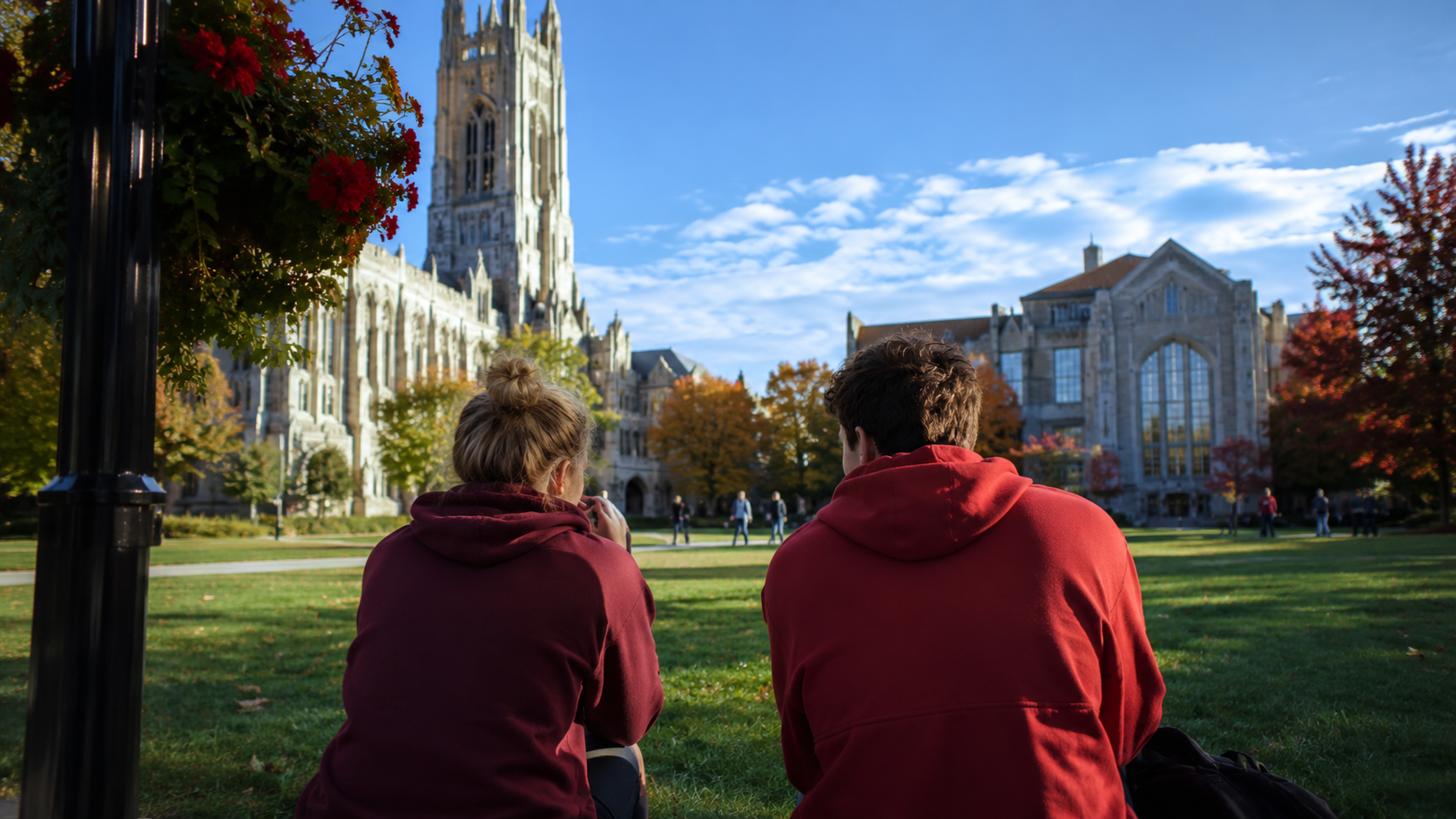
Boston College vs Boston University compared honestly: campus feel, cost, admissions odds, and academics, from someone who has watched families choose. Every fall, thousands of high schoolers sit at the kitchen table with two acceptance letters and no idea which one to pick. Boston College vs Boston University is one of those debates that sounds simple until you actually try to answer it.
Same city, similar price tag, both respected — and yet the experience of attending each school is nothing alike. I’ve sat across from families going back and forth on this exact question more times than I can count, and the same confusion shows up every single time.
Here’s the thing nobody says out loud: this isn’t really a fight over which school is “better.” It’s a fight over which environment fits a specific eighteen-year-old. Boston College vs Boston University comes down to religious versus secular identity, suburban campus versus urban sprawl, and a smaller academic footprint versus a research-heavy giant. Get those three things wrong and you’ll spend four years feeling like you picked the wrong seat on a long flight.
What Is the Boston College vs Boston University Comparison Really About?
At its core, Boston College vs Boston University is a comparison between two private research universities that sit about four miles apart, connected by the same Green Line trolley. Boston College, founded in 1863, is a Jesuit Catholic institution with roughly 9,400 undergraduates on a hilltop campus in Chestnut Hill. Boston University, founded in 1839, is a much larger, non-sectarian research university with about 17,000 undergraduates spread across Commonwealth Avenue in the heart of the city.
That size difference alone changes everything downstream. A smaller undergraduate population means smaller intro classes, more face time with professors, and a campus that actually feels like a campus — quads, dining halls clustered together, a defined edge where the school starts and stops. BU doesn’t really have that edge. It’s woven into Boston itself, with buildings scattered along Comm Ave next to apartment complexes, coffee shops, and city buses. Some students love that blur between campus and city. Others find it disorienting during their first semester.
I should mention here — the religious affiliation question trips people up constantly. Boston College is Jesuit, and yes, it does require students to take a couple of philosophy and theology courses regardless of major. That’s not the same as being a religious school in the way people sometimes imagine, though. Plenty of non-Catholic, even non-religious students attend BC and barely notice the affiliation outside of those core requirements and a chapel on the quad. Boston University has no religious affiliation at all and no theology requirement, which matters a lot to students choosing between the two on values alone.
Why This Decision Actually Matters
People treat Boston College vs Boston University like a coin flip, but the downstream effects are real. Your major availability, your class sizes, your social scene, even your commute to internships in the Financial District — all of it shifts depending on which side of Chestnut Hill you land on.
Take business. BU’s Questrom School of Business has a stronger reputation for finance and consulting recruiting specifically because of its proximity to downtown firms and its sheer size, which brings more recruiters to campus. BC’s Carroll School of Management punches above its weight too, particularly for students who want smaller class sizes and closer alumni mentorship — BC’s alumni network has a reputation for being unusually loyal and willing to help newer grads, something a lot of current students mention when asked what surprised them most.
Nursing, communications, and pre-med tracks tell a different story. BU’s nursing and public health programs benefit from its research infrastructure and hospital affiliations around the Medical Campus. BC doesn’t have a nursing school inside the main undergraduate college structure in the same way, though its Connell School of Nursing is respected in its own right. Pre-med students at both schools do fine getting into medical school, but BU’s larger research apparatus means more lab opportunities for students who go looking for them early.
Campus, Location, and the Feel of Each School
This is where Boston College vs Boston University stops being about numbers and starts being about how a Tuesday afternoon actually feels. BC sits up on a hill in Chestnut Hill, a quiet, leafy, mostly residential neighborhood about six miles from downtown Boston. You take the Green Line B branch (or drive, though parking is its own headache) to get anywhere else. The campus itself is gorgeous — Gothic stone buildings, a real quad, sports fields, dorms clustered together. It feels like a self-contained little world, and that’s intentional.
BU is the opposite experience entirely. The campus runs along Commonwealth Avenue for roughly a mile and a half, meaning your dorm might be a fifteen-minute walk from your classroom building, which sits next to a Trader Joe’s, which sits next to Fenway Park a few blocks further down. There’s no quad in the traditional sense. Students describe it as living inside the city rather than near it — and depending on the student, that’s either the best part of the whole experience or the thing they wish someone had warned them about.
Weather matters too, oddly enough. Both schools deal with brutal New England winters, but BC’s hilltop location means wind cuts harder in January, while BU’s street-level layout means more slush, more crowded sidewalks, and more foot traffic navigating around construction. Neither is dealbreaker material, but ask any junior which one they’d complain about first and you’ll get an instant answer.
Academics, Majors, and Class Sizes
Boston College runs a more traditional undergraduate structure organized around a core curriculum that touches philosophy, theology, literature, and the natural sciences regardless of major. Students sometimes grumble about the core early on, then admit years later it forced them into classes they never would’ve picked and ended up loving. Class sizes at BC skew smaller on average, and because the undergraduate population is roughly half of BU’s, you’re less likely to sit in a 300-person lecture hall for your entire first year.
Boston University runs on a different model entirely — students apply directly into one of its specific colleges (Questrom for business, COM for communication, CAS for arts and sciences, and so on), and requirements vary a lot depending on which one you land in. That structure gives BU students earlier access to specialized coursework, but it also means intro-level classes in popular majors can run large. If you’re the kind of student who wants to figure things out before committing to a track, this distinction alone should carry real weight in your college acceptance rate research as you compare admissions odds and program structures side by side.
Both schools send a healthy number of graduates on to competitive law schools and graduate programs, and this is one area where the comparison actually flattens out — a strong GPA and LSAT from either institution carries similar weight application-wise, since neither undergraduate brand outweighs the numbers once you’re applying to programs later on.
How Admissions and Selectivity Compare
Boston College vs Boston University gets genuinely close when you look at admissions numbers, and this is where a lot of families get surprised. BC’s acceptance rate has hovered in the high teens to low twenties in recent cycles, while BU’s has landed in a similar range, sometimes a few points lower depending on the year. Both schools have gotten significantly more competitive over the last decade — BC in particular used to be considered a safer bet for strong students a generation ago, and that’s just not true anymore.
According to data compiled through the U.S. Department of Education’s College Scorecard, both institutions report similarly strong six-year graduation rates, generally in the high 80s to low 90s percentage range, which tells you something important: once students get in, both schools do a solid job keeping them enrolled and moving toward a degree.
Test-optional policies, essay requirements, and interview expectations shift year to year at both schools, so anyone actively applying should check current admissions pages directly rather than relying on last year’s numbers. That said, demonstrated interest — campus visits, supplemental essays that actually reference the specific school — tends to matter more at BC than at BU, partly because of BC’s smaller applicant pool relative to total interest.
Cost, Financial Aid, and the Real Number You’ll Pay
Sticker price at both schools lands in a similar range, north of $80,000 a year once you add tuition, room, board, and fees together. That number scares a lot of families off before they even look closer, which is a mistake. Boston College meets full demonstrated financial need for admitted students without loans in most aid packages, a policy that’s genuinely rare among private universities. Boston University’s aid is generous too, but its no-loan policy is more selective, generally reserved for lower-income admits rather than the entire pool.
So here’s the blunt version: don’t cross either school off your list based on sticker price alone. Run the net price calculator on both official websites before making any decision. I’ve watched families assume BC was unaffordable and then get an aid package that made it cheaper than their in-state public option. It happens more than people expect.
Athletics, Student Life, and the Social Scene
BC plays in the ACC, and football Saturdays actually mean something on that campus — tailgates, a real student section, alumni flying back for home games. That kind of school spirit is baked into BC’s identity in a way that shapes weekends heavily during the fall semester. Hockey matters just as much, maybe more, given BC’s history producing NHL talent.
BU doesn’t chase football-driven school spirit the same way — it doesn’t field a football team at all, actually — but it makes up for it with hockey, which is a genuinely big deal on Comm Ave, plus a social scene that leans harder into the city itself. Students go to concerts, museums, and restaurants as a normal Tuesday rather than a special occasion, simply because everything is a ten-minute walk or one T stop away.
Greek life exists at both schools but plays a smaller social role than you’d find at a big state school. BC leans more toward a residential, dorm-and-quad social culture. BU leans toward off-campus apartments and city-based social circles once students hit sophomore or junior year. Neither is wrong, but if you’re picturing four years of dorm-centered college life, that expectation lines up better with BC than BU.
Common Mistakes People Make Comparing These Two Schools
The biggest one, hands down: picking based on name recognition alone. Both schools have strong reputations, but “which one sounds more prestigious” is a terrible reason to commit four years and six figures. A student who thrives in a tight-knit, hillside, traditionally structured environment will struggle at BU’s sprawling city campus, and the reverse is just as true.
Second mistake — assuming religious affiliation automatically means a stricter or less diverse environment at BC. It really doesn’t play out that way for most students day to day, and dismissing BC on that assumption alone means skipping a school that might otherwise fit perfectly.
Third, and this one’s sneaky: not accounting for how a school’s location affects internship access. BU’s downtown-adjacent position gives students an easier day-to-day commute into Boston’s business core, which matters enormously for finance, media, and consulting majors doing internships during the school year rather than just over summer.
And one more, worth mentioning because I’ve seen it wreck a few decisions — visiting campus on a beautiful sunny weekend in April and assuming that’s representative. Go in February if you can. That’s the real test.
Comparison at a Glance
| Category | Boston College | Boston University |
| Founded | 1863 | 1839 |
| Undergrad enrollment | ~9,400 | ~17,000 |
| Setting | Suburban hilltop, Chestnut Hill | Urban, along Commonwealth Ave |
| Affiliation | Jesuit Catholic | Non-sectarian, secular |
| Football | Yes (ACC) | No varsity football |
| Signature strength | Carroll School of Management, core curriculum | Questrom School of Business, research scale |
| Financial aid | Full need met, no-loan for most admits | Generous, no-loan more selective |
Practical Examples: Two Students, Two Outcomes
Picture a student who wants small discussion-based classes, a defined campus community, and a Saturday tradition built around football and tailgates. That student ends up genuinely happy choosing Boston College over Boston University, even turning down a slightly cheaper offer elsewhere because the fit mattered more than the price gap.
Now picture a different student — someone who wants to intern at a downtown consulting firm sophomore year, take the T to a museum on a random Thursday night, and study inside a business school with heavy corporate recruiting on campus. That student picks Boston University, and within a semester says it felt like exactly the right call, mostly because the size and location gave them access to things a smaller, quieter campus simply couldn’t.
Neither outcome makes the other student’s choice wrong. That’s the whole point of running Boston College vs Boston University as your own personal exercise instead of trusting a generic ranking list.
Expert Tips for Making the Final Call
Sit in on an actual class at both schools if you can — not just the tour, the real thing. Nothing settles the Boston College vs Boston University question faster than watching how professors and students interact in a real 50-minute period.
Talk to current sophomores, not just tour guides. Sophomores have survived the honeymoon phase and will tell you what actually annoys them about the school, which is more useful than anything in a brochure.
Compare the actual net price, not sticker price, side by side on paper before deciding anything based on cost. And be honest with yourself about whether you want a defined campus or a city-woven one — that single preference probably predicts your happiness more than any ranking, major offering, or football schedule ever will.
Career Outcomes and Alumni Networks
Ask any career services office at either school and you’ll get a similar pitch: strong outcomes, strong networks, strong recruiting relationships. But dig one layer deeper and the Boston College vs Boston University comparison shows real texture. BC’s alumni base is famously tight — Eagles tend to hire Eagles, especially in finance, consulting, and public sector roles concentrated in the Northeast. It’s not unusual for a BC junior to land an internship purely because an alum two decades removed from campus still checks the school’s career board looking for candidates.
BU’s alumni network is larger by sheer numbers, spread across media, health sciences, engineering, and international business given its size and global student population. That scale cuts both ways. You get more alumni in more industries and more cities, but the “instant loyalty” factor that BC grads talk about isn’t quite as concentrated at BU, simply because there are more of them and less of that small-school intimacy driving it.
Neither network guarantees anything on its own. What actually moves the needle is whether a student uses career services early, shows up to networking events freshman year instead of waiting until junior spring, and treats the alumni relationship as something to build rather than something to cash in later.
International Students and Campus Diversity
BU enrolls one of the largest international student populations of any private university in the country, and that shapes daily campus life in a noticeable way — more languages in the dining hall, more global student organizations, a genuinely international flavor that shows up in course discussions and dorm friendships alike. Boston College, by comparison, skews more domestic, with a smaller but still meaningful international cohort.
That difference matters if global exposure is high on your list. A student who wants to be surrounded by classmates from forty different countries will notice that BU delivers more of that experience day to day than BC does. It’s not a knock on BC — it’s just a different kind of community, one built more around shared regional and religious threads than international breadth.
Housing, Dining, and Daily Life Logistics
Housing at BC is largely guaranteed for four years, and most students live in dorms or campus-affiliated housing the entire time, which keeps that tight community feeling intact well into senior year. Meal plans are centralized, dining halls sit close together, and the whole rhythm of a day — class, gym, dining hall, dorm — happens inside a compact radius.
BU guarantees housing for the first two years typically, after which a large share of students move into off-campus apartments scattered around Allston, Brookline, or further down Comm Ave. That shift changes the social fabric noticeably. Junior and senior year at BU can feel more independent, more like early adult life in a real city, with less of the built-in dorm camaraderie that defines the later BC experience. Some students crave that independence. Others miss the built-in social structure once it’s gone.
Weighing Boston College vs Boston University for Graduate School Plans
Students eyeing law school, medical school, or an MBA down the line often ask which undergraduate choice sets them up better. Honestly, it matters less than people assume. Admissions committees for competitive graduate programs weigh GPA, test scores, and demonstrated experience far more heavily than which of these two Boston schools appears on a transcript. A 3.8 GPA from BC and a 3.8 from BU read almost identically to an admissions committee evaluating candidates for programs at the level of the nation’s most selective law schools.
Where the schools genuinely differ is in the on-ramp — how easy it is to find research opportunities, clinical hours, or pre-professional advising early in your undergraduate years. BU’s larger research infrastructure and hospital affiliations give pre-med and public health students more built-in opportunities to find lab placements without hunting as hard. BC’s smaller size means advisors often know students by name well before senior year, which some pre-law and pre-med students find genuinely useful once it’s time to apply somewhere like one of the top law school programs down the road.
A Quick Gut-Check Before You Decide
If you’re still stuck between Boston College vs Boston University after everything above, try this exercise: imagine a random Tuesday in February, not the pretty April open house. Are you walking across a quiet, snow-covered quad to a dining hall you know well, surrounded by the same three hundred faces you’ve seen all semester? Or are you catching a T stop, grabbing coffee at a shop wedged between two apartment buildings, and heading into a lecture hall inside a city block that never really slows down?
There’s no wrong answer here, and that’s worth repeating because so many families treat this like there has to be one. The right choice between Boston College vs Boston University is the one that matches the kind of daily rhythm you actually want for four years, not the one with the more familiar name on a sweatshirt.
Faculty Access and Class Format Differences
One thing that rarely comes up in glossy admissions brochures: how much face time you’ll actually get with the people teaching you. At BC, because the undergraduate population is roughly half of BU’s, intro-level courses in popular departments — economics, biology, communications — tend to cap out smaller, and professors are more likely to know your name by October rather than by graduation. Office hours feel less like a formality and more like an actual resource students use regularly.
BU’s scale changes that dynamic, especially in the first two years. Large intro lectures in Questrom, CAS, and COM can run into the hundreds of students, with teaching fellows handling discussion sections rather than the lead professor. That’s not automatically worse — some students genuinely prefer the anonymity and the chance to figure things out without feeling watched — but it is a different rhythm than what a BC freshman experiences in a 30-person seminar-style intro class.
By junior and senior year, this gap narrows considerably at both schools. Upper-level electives and major-specific seminars shrink at BU too, once students have moved past the general requirements and into specialized coursework where fewer students are enrolled to begin with.
Study Abroad and Global Programs
Both schools push study abroad hard, and it’s genuinely one of the stronger parts of each experience. BC sends a notably high percentage of its junior class abroad — often cited as one of the highest participation rates among comparable private universities — through programs built directly into most majors without derailing graduation timelines. BU runs one of the largest study abroad operations in the country by sheer volume, with dozens of its own BU-run campuses in cities like London, Sydney, and Madrid rather than relying entirely on third-party partner programs.
That distinction matters logistically. BU’s self-run campuses often mean credits transfer more smoothly and academic advising abroad stays consistent with what students get on Comm Ave. BC leans more on partner university relationships, which sometimes means a bit more paperwork translating credits back, though the experience itself gets consistently strong reviews from returning students at both schools.
Weather, Commute, and the Little Things Nobody Warns You About
Nobody puts this in a viewbook, but it matters more than people expect once winter actually hits. BC’s hilltop position means walking to class in January involves real wind chill, and the T ride into the city takes a solid 25 to 30 minutes each way, which adds up over a semester of internship interviews or weekend plans downtown. BU’s location means less commuting overall, but more crowded sidewalks, more construction detours, and a campus that never quite feels like it “closes” for the night the way BC’s quieter quad does after 11 p.m.
Ask upperclassmen at either school what surprised them most freshman year, and weather-and-commute logistics come up constantly — right alongside dining hall food and roommate stories. It’s a small thing until you’re the one trudging through slush twice a day for four months straight.
Final Thoughts Before You Commit
Whichever way this lands, remember that plenty of genuinely happy, successful graduates came out of both sides of this comparison. Boston College vs Boston University isn’t a test with a correct answer key — it’s closer to picking the right pair of shoes for how you actually walk, not how you think you should walk. Trust the details that matter to you personally over anything a ranking or a relative’s opinion tells you it should be.
FAQs
Is Boston College or Boston University harder to get into?
Both schools have grown more selective, with acceptance rates often landing within a few points of each other depending on the year. BC has occasionally run slightly more selective, but this shifts year to year, so check current cycle data before assuming either is a safer bet.
Is Boston College a religious school?
Yes, it’s Jesuit Catholic and requires a couple of philosophy and theology courses for all students. That said, day-to-day campus life doesn’t feel overtly religious to most students, including many who aren’t Catholic themselves.
Does Boston University have a football team?
No, BU dropped varsity football decades ago and doesn’t field a team today. Hockey fills much of that school-spirit role instead, and it draws a genuinely large, loud following on campus.
Which school is better for business majors?
Both have strong programs, but BU’s Questrom often edges ahead for finance and consulting recruiting due to its size and downtown proximity. BC’s Carroll School counters with smaller classes and a notably loyal alumni mentorship network.
Is Boston College or Boston University more expensive?
Sticker prices are similar, both north of $80,000 annually with room, board, and fees included. The real difference shows up in aid packages, so compare net price calculators directly rather than assuming either school is unaffordable.
Which campus is more walkable, Boston College or Boston University?
BU is far more walkable day to day since its buildings sit along a single avenue with the city built right in. BC’s hilltop campus is walkable within itself but requires a T ride for anything beyond Chestnut Hill.
One Last Word on Reputation and Rankings
It’s worth saying plainly: neither school “wins” the reputation game in any way that should sway a real decision. Boston College vs Boston University shows up in the same tier of national university rankings year after year, usually within a handful of spots of each other, and those small ranking shifts mean almost nothing to employers or graduate schools evaluating an individual candidate. What actually gets noticed is what a student did with their four years — internships landed, projects finished, relationships built with professors and mentors — not whether the diploma says Chestnut Hill or Commonwealth Avenue.
I’ve talked to hiring managers who couldn’t tell you the exact ranking difference between the two schools even if you asked directly, and I’ve talked to plenty who’ve hired strong candidates from both without a second thought about which one carried more prestige on paper. So if reputation is the only thing keeping you stuck on Boston College vs Boston University, it’s probably not the right tiebreaker to lean on. Look at the daily experience instead, because that’s what you’ll actually be living through for the next four years, not a number in a magazine.
Conclusion
Boston College vs Boston University isn’t a question with one right answer, and anyone who tells you otherwise is selling something. Both schools graduate confident, capable students who go on to do well — the difference is entirely about which environment gets a specific person there. Pick the hilltop, tight-knit, tradition-heavy campus, or pick the sprawling, city-woven, research-driven one. Visit both in bad weather, talk to real sophomores, run the actual numbers, and trust whichever gut reaction survives all three. That’s the only way Boston College vs Boston University actually gets answered correctly — not by a ranking, but by fit.
Give yourself permission to change your mind halfway through the process, too. Plenty of students start this search leaning one direction and end up somewhere completely different once they’ve actually toured both, sat in on classes, and talked honestly with current students about the parts nobody puts on a brochure. That’s not indecision — that’s the process working exactly the way it should.