

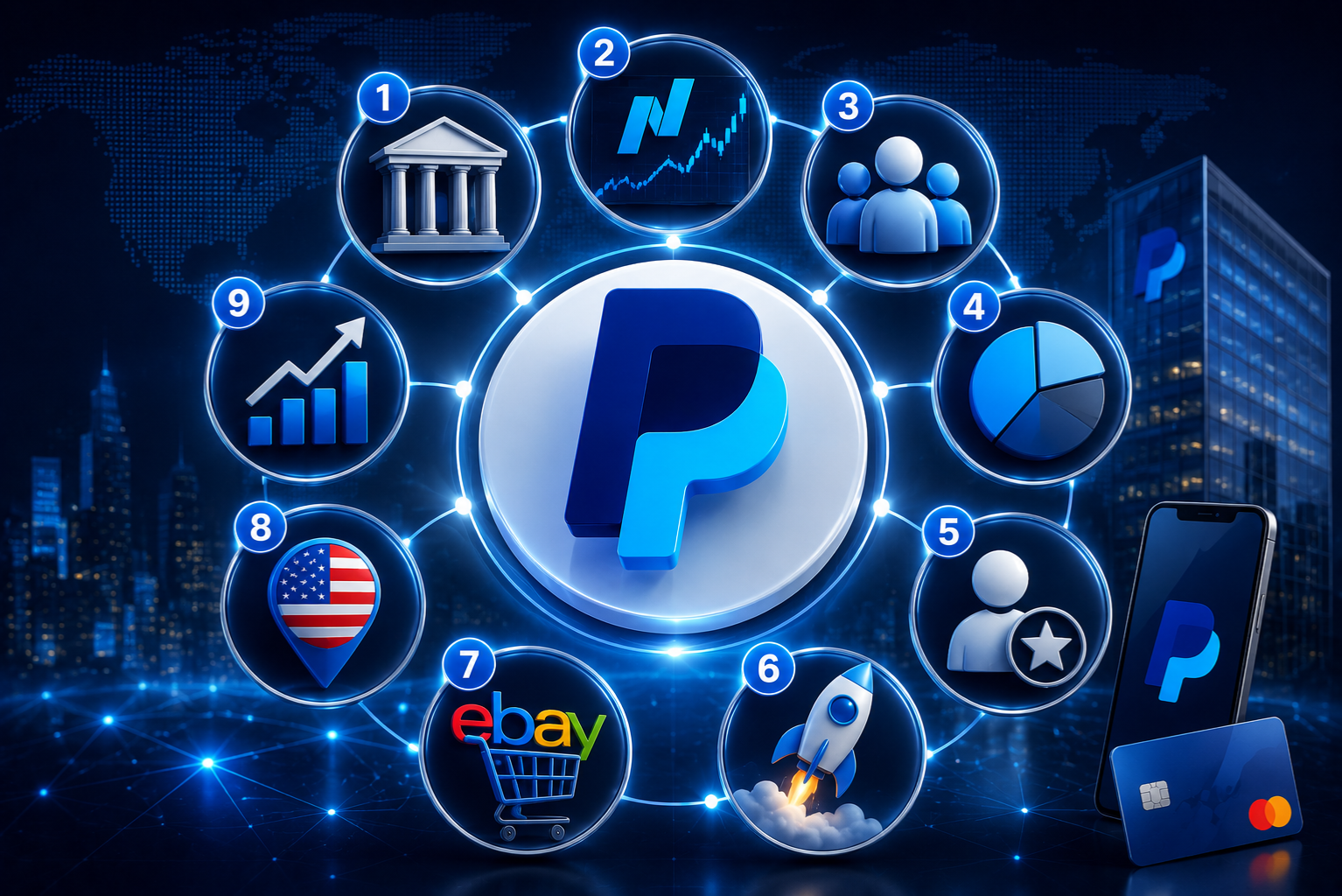
PayPal’s story begins in December 1998 when a group of visionary entrepreneurs came together with a bold idea — to make digital money transfers simple, fast, and secure. The company was co-founded by Max Levchin, Peter Thiel, and Luke Nosek, initially operating under the name Confinity. Ken Howery, Yu Pan, and Russel Simmons also played critical founding roles in those early days, each contributing technical and strategic expertise that helped shape the platform’s initial direction.
The question of who owns PayPal becomes interesting even from its founding days because the company quickly attracted top Silicon Valley talent. Elon Musk’s company X.com merged with Confinity in March 2000, creating what would eventually become the PayPal we recognize today. That merger brought significant momentum, new funding, and a broader vision for digital financial services that stretched far beyond simple peer-to-peer payments.
PayPal’s eBay Acquisition Years
eBay acquired PayPal in October 2002 for approximately $1.5 billion in stock, marking a major shift in who owns PayPal at an institutional level. At that point, eBay became the definitive owner, integrating PayPal as its primary payment processing arm. The partnership made logical sense — PayPal was already the preferred payment method for millions of eBay buyers and sellers, so bringing it under one corporate umbrella felt like a natural evolution.
During the eBay ownership era, PayPal grew exponentially. It expanded internationally, launched new merchant tools, and began positioning itself as more than just an auction payment solution. The years under eBay gave PayPal the resources, infrastructure, and brand recognition needed to compete with traditional banks and credit card networks. Despite operating within eBay’s ecosystem, PayPal maintained its own product identity and user base.
PayPal Becomes Independent Company
The next pivotal chapter in answering who owns PayPal came in July 2015, when eBay officially spun off PayPal into a fully independent publicly traded company. The separation, which had been pushed by activist investor Carl Icahn among others, listed PayPal on the NASDAQ stock exchange under the ticker symbol PYPL. This independence allowed PayPal to pursue its own strategic partnerships, acquisitions, and growth without being constrained by eBay’s priorities.
Going public transformed who owns PayPal from a single corporate parent into thousands of institutional and individual shareholders around the world. For anyone researching online services for business, PayPal’s independence marked a defining moment when digital payments matured into a standalone industry category. The spin-off gave management fresh flexibility to compete aggressively against rising fintech challengers and traditional banking institutions alike.
Major Institutional Shareholders Today
When asking who owns PayPal in the modern sense, the honest answer points to a diverse group of institutional investors who collectively hold the majority of outstanding shares. Vanguard Group consistently ranks as one of the largest shareholders, typically holding between 8% and 10% of total shares. BlackRock, Fidelity, and State Street Corporation also maintain significant positions, making PayPal a staple holding in countless mutual funds and retirement portfolios worldwide.
These institutional giants don’t just passively hold shares — they actively engage with corporate governance, vote on board decisions, and influence executive compensation structures. Their collective weight shapes how PayPal’s leadership team prioritizes long-term strategy over short-term earnings pressure. Individual retail investors, meanwhile, make up a meaningful but smaller slice of the overall ownership picture. The democratization of stock trading platforms has brought PayPal shares within reach of everyday investors who previously couldn’t participate in tech company ownership.
PayPal’s Current Leadership Structure
Understanding who owns PayPal also means examining the people at the executive level who make daily strategic decisions. Alex Chriss became PayPal’s President and Chief Executive Officer in September 2023, succeeding Dan Schulman who had led the company since its 2015 spin-off. Chriss came from Intuit, where he led the QuickBooks division, bringing deep expertise in small business financial tools and software-driven growth strategies.
The board of directors plays a crucial role in representing shareholder interests and setting the company’s long-term direction. PayPal’s board includes members with backgrounds in technology, financial services, retail, and governance — a diverse combination designed to provide balanced oversight. Executive Chairman John Donahoe has guided board-level strategy through multiple cycles of growth and challenge. Leadership decisions at this level directly impact every investor who holds shares, reinforcing the connection between governance and ownership value.
PayPal’s Key Acquisitions History
Who owns PayPal also connects to what PayPal itself owns, since the company has made numerous strategic acquisitions over the years that expanded its capabilities and market reach. Venmo, arguably PayPal’s most culturally influential acquisition, was purchased through the Braintree deal in 2013 for approximately $800 million. Venmo’s peer-to-peer social payment model captured a younger demographic and helped PayPal stay relevant as mobile-first behavior became the norm.
Other notable acquisitions include Honey, a browser extension and coupon platform acquired in 2020 for $4 billion, which represented PayPal’s push into commerce discovery and retail loyalty. According to PayPal’s official investor relations page, the company has consistently used acquisitions as a growth lever to diversify revenue streams beyond traditional payment processing fees. iZettle, Hyperwallet, and Simility also joined the PayPal family, each adding distinct capabilities in point-of-sale hardware, payout platforms, and fraud detection technology.
Retail Investors And Stock Ownership
Beyond institutions and executives, millions of ordinary people technically qualify as part of who owns PayPal by holding even a single share of PYPL stock. The rise of commission-free investing apps made it straightforward for people across income brackets to participate in PayPal’s ownership story. At various points in the company’s history, PYPL shares have attracted significant attention from retail trading communities, particularly during volatile fintech market cycles.
Retail investors often focus on PayPal’s growth metrics, including total payment volume, active account counts, and revenue per user. These figures directly influence share price and therefore determine whether individual investors see gains or losses on their holdings. The relationship between casual shareholders and the company is real — their trading activity, sentiment, and long-term holding behavior collectively shape market capitalization in ways that matter to every level of the ownership hierarchy.
PayPal’s Global Business Footprint
Any thorough exploration of who owns PayPal should acknowledge the sheer scale of the business those owners hold. PayPal operates in over 200 markets worldwide, supports more than 25 currencies, and serves hundreds of millions of active accounts. The platform processes billions of dollars in payment volume daily, making it one of the most systematically important financial technology companies in existence.
This global footprint means that ownership of PayPal represents a stake in digital commerce infrastructure that touches economies on every inhabited continent. Small business owners use PayPal to accept international payments. Freelancers rely on it for cross-border income. Consumers use Venmo for splitting restaurant bills. The breadth of use cases reinforces why institutional investors consistently include PayPal in diversified portfolios — it represents broad exposure to the ongoing digitization of money.
PayPal Versus Competitors Ownership
Comparing who owns PayPal to how competitors are structured reveals interesting contrasts in the payment technology space. Stripe, one of PayPal’s most significant rivals, remains privately held and is owned by its founders Patrick and John Collison along with various venture capital and private equity investors. Square, now rebranded as Block and led by Twitter co-founder Jack Dorsey, operates as a public company with a concentrated ownership structure that gives Dorsey significant voting influence.
Visa and Mastercard, though technically payment networks rather than digital wallets, operate as public companies with widely distributed institutional ownership similar to PayPal’s structure. Apple Pay and Google Pay function as features within larger corporate ecosystems rather than standalone entities, meaning their “ownership” sits entirely within Apple and Alphabet respectively. Understanding these structural differences helps put PayPal’s independent public company status in clearer context.
Regulatory Oversight Of PayPal
Who owns PayPal also raises the question of who watches over PayPal. As a financial institution operating globally, PayPal faces regulatory oversight from dozens of agencies across different jurisdictions. In the United States, PayPal operates under money transmission licenses in virtually every state and is subject to Consumer Financial Protection Bureau oversight for consumer financial products.
In Europe, PayPal Luxembourg S.A. operates under authorization from Luxembourg’s financial regulatory authority, which coordinates with regulators across EU member states under passporting arrangements. These regulatory relationships matter to owners because compliance failures carry significant financial penalties and reputational damage. The company dedicates substantial resources to regulatory affairs, legal compliance, and government relations — costs that sophisticated shareholders account for when evaluating long-term profitability.
PayPal’s Revenue And Profit Model
Shareholders who are part of who owns PayPal care deeply about how the company generates income and whether that model remains sustainable. PayPal earns revenue primarily through transaction fees, typically charging merchants a percentage of each sale plus a flat fee per transaction. For personal accounts sending money internationally, currency conversion fees add another revenue layer on top of base transaction charges.
Value-added services like PayPal Credit, Pay Later options, and working capital loans for merchants represent growing revenue segments that go beyond pure transaction processing. These credit products carry interest income that diversifies PayPal’s earnings away from pure payment volume dependency. Subscription-based tools for larger merchants, analytics services, and Braintree’s developer-focused payment infrastructure all contribute to a layered revenue model that investors evaluate when deciding how much PayPal is worth.
Who Owns PayPal Shares Breakdown
A precise snapshot of who owns PayPal at the share level breaks down into several distinct categories. Institutional investors collectively own roughly 70% to 75% of all outstanding shares, making them the dominant force in ownership terms. Company insiders — executives, directors, and early employees with vested equity — typically hold a much smaller percentage, often below 1% in aggregate for a company of PayPal’s size and maturity.
The remaining shares are distributed among retail investors, index funds that passively track market benchmarks, and exchange-traded funds that hold PayPal as a component. Activist investors have occasionally built positions to push for specific strategic changes, following the precedent set by Carl Icahn’s campaign that ultimately helped trigger the eBay separation. The ownership mix continues to shift constantly as institutional funds rebalance, executives sell shares, and new investors buy in.
PayPal In Emerging Markets Strategy
For investors considering who owns PayPal, the company’s emerging markets strategy represents both significant opportunity and meaningful risk. PayPal has expanded aggressively in markets across Southeast Asia, Latin America, and Africa, regions where smartphone adoption is outpacing traditional banking infrastructure. This expansion positions PayPal to capture first-mover advantages in populations that will conduct most of their financial lives through mobile devices.
However, operating in emerging markets introduces currency volatility, regulatory unpredictability, and intense competition from local payment providers who understand regional nuances more deeply. Companies like Mercado Pago in Latin America, Paytm in India, and M-Pesa in East Africa present formidable local competition that PayPal must navigate carefully. Owners who hold PayPal shares are therefore betting on the company’s ability to execute international expansion while managing these complex competitive and regulatory dynamics effectively.
PayPal’s Cryptocurrency And Innovation
Recent years have seen PayPal take meaningful steps into cryptocurrency, a development that shapes conversations about who owns PayPal and what strategic direction those owners are supporting. PayPal launched the ability for US users to buy, hold, and sell cryptocurrency directly through its platform in 2020, followed by enabling crypto payments at merchants in 2021. These moves represented a calculated attempt to stay ahead of emerging financial behavior patterns.
PayPal went further by launching its own stablecoin, PayPal USD (PYUSD), in partnership with Paxos in 2023. This was a genuinely bold move that put PayPal ahead of most traditional financial institutions in blockchain adoption. Whether cryptocurrency efforts ultimately generate substantial returns for shareholders remains debated, but the initiatives demonstrate that PayPal’s ownership structure supports calculated innovation rather than purely defensive strategies.
PayPal’s Environmental Social Governance
Modern institutional investors who represent the core of who owns PayPal increasingly evaluate companies through environmental, social, and governance frameworks. PayPal has made public commitments to carbon neutrality, diverse hiring practices, and equitable financial access — goals that resonate with ESG-focused fund managers who control enormous capital allocations. These commitments influence which funds include PayPal in their portfolios and how they engage with management on strategic priorities.
The company has also positioned financial inclusion as a core mission element, arguing that expanding payment access to underserved communities aligns profit motives with social purpose. Programs designed to help small businesses access capital, reduce transaction costs for low-income users, and expand services to the unbanked represent this philosophy in action. For owners who care about long-term brand value and regulatory goodwill, these ESG commitments carry real strategic weight.
Future Ownership Possibilities For PayPal
Speculation about who owns PayPal in the future inevitably involves merger and acquisition scenarios that industry analysts periodically raise. Various reports over the years have floated potential acquirers including major banks, technology companies, and retail giants who see value in owning a digital payments infrastructure of PayPal’s scale. Amazon, Apple, and even traditional financial players have been mentioned in speculative contexts, though no serious acquisition attempt has materialized.
The more likely scenario is that PayPal remains independent while gradually evolving its ownership mix as share buybacks reduce total outstanding shares and institutional positions continue shifting. Management has signaled commitment to independence as the preferred path, focusing on organic growth and targeted acquisitions rather than positioning the company for sale. Long-term shareholders who believe in that independent strategy continue holding shares despite pressure from market volatility and fintech competition.
Conclusion
The full answer to who owns PayPal is genuinely layered and fascinating. From its origins with visionary Silicon Valley founders to eBay’s decade-long stewardship, through its 2015 independence and current status as a widely held public company, PayPal’s ownership story mirrors the evolution of digital commerce itself. Today, institutional giants like Vanguard and BlackRock hold the largest positions, while millions of retail investors, company insiders, and index funds round out the ownership picture.
Who owns PayPal ultimately represents a broad coalition of shareholders united by belief in the company’s ability to remain essential infrastructure for global digital payments. The leadership team under Alex Chriss now carries the responsibility of delivering value to those owners while navigating competitive threats, regulatory pressures, and technological disruption. For anyone curious about who owns PayPal, the answer is both simple and complex: it belongs to the public, guided by institutions, and shaped by every strategic decision made in its Californian headquarters. Understanding who owns PayPal helps explain why decisions made in boardrooms affect millions of merchants, consumers, and investors around the world every single day.
FAQs
Who owns PayPal today in 2024?
PayPal is a publicly traded company listed on NASDAQ under PYPL. Institutional investors like Vanguard Group and BlackRock are among the largest shareholders, collectively owning the majority of outstanding shares alongside retail investors worldwide.
Did Elon Musk ever own PayPal?
Elon Musk co-founded X.com, which merged with Confinity to form PayPal. He served as CEO briefly before being replaced. When eBay acquired PayPal in 2002, Musk received significant proceeds from his equity stake but no longer holds ownership in the company.
Who owns PayPal’s Venmo service?
Venmo is owned by PayPal. PayPal acquired Venmo through its $800 million purchase of Braintree in 2013. Venmo operates as a semi-independent brand within the PayPal portfolio, maintaining its own distinct user experience and social payment features.
Is PayPal owned by a bank?
No, PayPal is not owned by a traditional bank. It operates as an independent financial technology company. While it holds banking licenses and money transmission authorizations in multiple jurisdictions, its ownership structure is that of a publicly traded technology company.
Who owns PayPal’s majority shares?
No single entity owns a majority of PayPal shares. Vanguard Group typically holds the largest single institutional position at roughly 8% to 10%, followed by BlackRock and Fidelity. The absence of a majority owner means no single shareholder controls corporate decisions outright.