

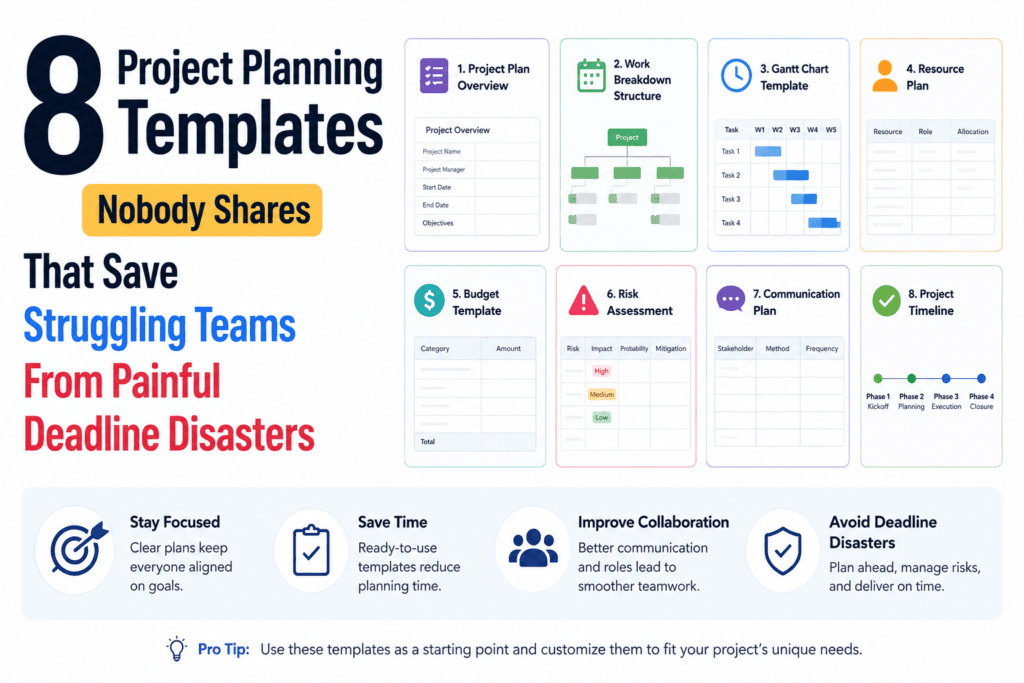
Discover 8 powerful project planning templates nobody shares that save struggling teams from missing deadlines, losing budgets, and experiencing painful project disasters that destroy careers.
Every team has missed a deadline they should not have.
Not because the team was lazy. Not because the project was impossible. Because nobody had a proper system for tracking what needed to happen, when it needed to happen, and who was responsible for making it happen.
That is the real reason most projects fail. Not talent problems. Not resource problems. Planning problems that compound quietly until the deadline arrives and everyone acts surprised.
Project planning templates exist to solve exactly this. Not the generic ones that look impressive in presentations and get abandoned by week two. The ones that actually get used because they fit how real teams work under real pressure with real consequences attached to missing dates.
Why Most Templates Get Abandoned
Here is something template collections never admit. Most project planning templates fail not because teams are undisciplined but because the templates were designed for how projects should work rather than how they actually work.
They assume complete information at the start. They assume stakeholders stay aligned. They assume scope does not change. They assume every dependency gets identified before work begins. None of that is true on most real projects and a template that cannot survive contact with reality gets abandoned fast.
What makes a template worth using is flexibility — it survives scope changes without breaking. Simplicity — updating it takes minutes not hours. Visibility — the whole team knows what is happening without asking. Honesty — it shows problems before they become disasters rather than after.
The Project Charter

Every project needs one document that answers the question nobody wants to ask out loud — what exactly are we building and why does it matter?
The project charter is that document. One page. Written before a single task gets assigned. Agreed on by everyone who has decision-making authority before the work begins.
It covers the project objective in one clear sentence — not a paragraph, one sentence. The business justification explaining why this project matters enough to spend time and money on. The scope defining what is included and — just as importantly — what is explicitly not included, because unclear scope boundaries are where most projects quietly fall apart.
It also captures who the key stakeholders are, how success gets measured when the project ends, the major milestones at a high level, and the overall budget envelope. Getting alignment on all of this at the start costs one meeting. Discovering misalignment three months in costs everything.
The Work Breakdown Structure
A project described as “build the new website” is not a plan. It is a wish. The work breakdown structure turns wishes into actual work by decomposing the project into every task that needs to happen for the project to be complete.
Not phases. Not milestones. Tasks. Specific enough that someone can pick one up and start working without asking what it means.
Start with the major deliverables. Break each deliverable into components. Break each component into tasks. Keep breaking until each task can be completed in one to five days, owned by one person, and verified as complete without ambiguity. Assign an owner and estimated duration to every single task.
Project planning templates built around proper work breakdown structures catch the missing tasks that cause projects to run over — not the ones everyone knew about but the ones nobody thought to include because they seemed obvious. Those obvious tasks are the ones that add two weeks to a project that was supposed to finish on time.
The RACI Matrix
Half of all project delays trace back to one root cause that nobody wants to say directly — nobody knew who was actually responsible for making a decision. Work waited for approval that nobody knew they needed to give. Tasks stalled because two people each assumed the other was handling it.
The RACI matrix eliminates that confusion by defining four roles for every task and decision in the project. Responsible is the person doing the work. Accountable is the person answerable for the outcome — only ever one person per item. Consulted are people whose input is needed before the work happens. Informed are people who need to know when it is done.
Every task in the project gets all four roles defined before work starts. The arguments that happen when building the RACI matrix are arguments worth having early — they reveal assumptions about ownership that would otherwise surface as conflict at the worst possible moment during execution. Project planning templates without a RACI component consistently produce the same accountability gaps that the RACI was designed to prevent.
The Project Timeline

A list of tasks without dates is a to-do list. Project planning templates built around proper timelines turn task lists into commitments by attaching dates, dependencies, and critical path visibility to everything that needs to happen.
The timeline template worth using shows not just when each task is scheduled but which tasks depend on other tasks completing first. That dependency mapping is what reveals the critical path — the sequence of tasks where any delay directly delays the project end date. Knowing the critical path tells a project manager where to focus attention and where schedule risk actually lives.
The most useful timeline templates also show buffer — planned slack time that absorbs the small delays that inevitably happen on every real project without cascading into missed milestones. Projects that plan with zero buffer assume perfect execution. No project executes perfectly. Buffer is not optimism padding — it is honest acknowledgment that reality will differ from the plan in ways that cannot be fully predicted. According to Project Management Institute, projects with realistic timeline templates and buffer planning complete on time at significantly higher rates than those built on optimistic schedules with no slack.
The Risk Register
Every project has risks. Most project teams know what the risks are. The ones that miss deadlines and blow budgets are usually the ones that knew the risks and never wrote them down — which means they never assigned owners, never defined responses, and never monitored whether those risks were materializing until they already had.
The risk register is a living document that captures every identified risk, estimates how likely it is to occur, assesses the impact if it does, assigns an owner responsible for monitoring it, and defines the response plan before the risk becomes reality.
The discipline of building a risk register forces conversations that teams would otherwise avoid. Nobody enjoys sitting in a room listing things that could go wrong. The discomfort of that conversation is considerably smaller than the cost of the risks it catches. Project planning templates that include risk registers produce teams that respond to problems rather than react to surprises — a distinction that determines whether a project recovers from setbacks or gets derailed by them. Check our online services for business article for more on the digital tools that make risk tracking and project management more efficient for modern teams.
The Status Report
Projects go off track for two reasons. Things go wrong. And nobody knows things went wrong until it is too late to fix them.
The status report template solves the second problem. A consistent, simple format that every stakeholder receives on a predictable schedule — weekly for most projects — that communicates what was completed, what is in progress, what is coming next, and what issues need attention or decisions from people above the project team.
The most effective status report templates use a simple traffic light system. Green means on track. Amber means at risk but manageable. Red means intervention needed. That visual simplicity makes the report scannable in thirty seconds for stakeholders who do not have time to read paragraphs. It also makes it harder for project managers to bury bad news in positive framing — a red item is a red item regardless of how it gets described.
Status reporting feels like administrative overhead until a project gets into trouble. At that point the team that has been sending consistent status reports has stakeholders who understand the context, have been watching the situation develop, and are positioned to help. The team that has not been reporting has stakeholders who are shocked, suspicious, and considerably less helpful.
The Budget Tracker
Projects run over budget for the same reason they miss deadlines — not because of single large unexpected costs but because of small untracked costs that accumulate until someone finally adds them up and the number is alarming.
The budget tracker template creates visibility before the accumulation becomes a problem. It tracks planned costs against actual costs for every budget category, captures variances as they happen rather than at month end, and flags categories where spending trajectory suggests the budget will be exceeded before the project ends.
The most important column in any budget tracker is not actual spend — it is forecast to complete. What has been spent is history. What will be spent by project end is what matters for decisions that can still be made. Project planning templates that capture only actuals without forecasting are looking backward at a problem that cannot be undone rather than forward at a problem that can still be managed. According to Harvard Business Review, projects with active budget tracking and regular forecast updates are significantly less likely to experience budget overruns than those reviewed only at scheduled checkpoints.
The Lessons Learned Log
Most project teams treat the end of a project as the finish line — a moment of relief rather than a moment of reflection. The knowledge accumulated over months of working through real problems on a real project disappears into individual memories where it becomes unavailable to the next project team facing similar challenges.
The lessons learned log captures what worked, what did not work, what would be done differently, and what should be done the same way on every future project. It gets maintained throughout the project — not just completed in a rushed retrospective meeting after everything is done and everyone wants to move on.
Project planning templates that include lessons learned create organizational memory. Teams stop reinventing solutions to problems that have already been solved. New project managers inherit the hard-won knowledge of experienced ones rather than learning the same lessons through the same painful mistakes. The value of this template compounds over time in ways that are invisible within a single project and obvious across an organization that builds it consistently.
How To Actually Use These Templates
Knowing eight project planning templates exist is not the same as using them well. The gap between having templates and getting value from them is smaller than it seems but it requires deliberate choices that most teams skip.
Start with the charter before anything else. Build the work breakdown structure before assigning tasks. Complete the RACI before anyone starts working. Build the timeline only after the work breakdown structure is complete because you cannot schedule what you have not identified. Set up the risk register in the first week. Establish the status report format before the first status report is due so the format does not get invented under pressure.
The sequence matters. Project planning templates used in the wrong order produce the same problems they were designed to prevent — dependencies missed because the timeline came before the work breakdown, accountability gaps because the RACI came after work started, budget surprises because tracking started after significant spending had already occurred.
Digital Tools Make Templates More Powerful
Project planning templates existed before software and worked reasonably well on paper and in spreadsheets. Digital tools make them significantly more powerful by adding real-time visibility, automated updates, and collaboration that paper cannot provide.
Asana, Monday.com, and Notion all support the templates in this article in formats that update automatically as work progresses. The work breakdown structure becomes a live task list rather than a static document. The timeline shows actual progress against planned dates without manual updates. The budget tracker connects to expense systems and updates without spreadsheet maintenance.
The choice of tool matters less than the discipline of using whichever tool gets chosen consistently. A simple spreadsheet used by everyone beats a sophisticated platform used by nobody. Project planning templates are only as valuable as the team commitment behind them.
What Happens When Teams Skip Templates
The pattern is consistent enough that it barely qualifies as a prediction. A project starts without a charter and scope arguments appear in week three. It starts without a work breakdown structure and tasks get missed until the deadline makes them visible. It runs without a RACI and accountability gaps produce delays nobody owns. It tracks no risks and gets blindsided by problems everyone knew were possible.
None of these outcomes are surprising. None of them are inevitable. Project planning templates do not guarantee project success — they remove the most common and most preventable causes of project failure. The projects that fail despite using good templates usually fail for reasons that could not have been predicted. The projects that fail without good templates usually fail for reasons that could have been.
Building A Template Culture In Your Team
Individual use of project planning templates helps. Team adoption of them as standard practice helps considerably more.
A team where every project starts with a charter, where work breakdown structures are expected rather than optional, and where status reports arrive on schedule regardless of whether the news is good creates a planning culture that compounds over time. New team members inherit the discipline. Stakeholders develop expectations that raise the standard. Problems get identified earlier because the systems for identifying them exist on every project rather than only the ones where someone happened to prioritize planning.
Building that culture starts with one project done right. Then another. Then the approach becomes the default rather than the exception — which is when project planning templates stop being tools individual managers use and become how the organization works.
Frequently Asked Questions
Do project planning templates work for small projects or only large ones?
They scale down effectively. A small project needs a lighter version of each template — a half-page charter, a simple task list instead of a full work breakdown structure — but the discipline of planning before executing applies regardless of project size.
How much time do project planning templates add to project startup?
A complete set of templates for a medium-sized project typically requires one to two days of upfront work. That investment returns multiple times over in reduced rework, fewer missed tasks, and faster recovery when problems arise.
What is the most important template if a team can only start with one?
The project charter. Alignment on what is being built and why prevents more downstream problems than any other single planning artifact. Everything else becomes easier when the foundation is clear.
How often should project planning templates be updated during execution?
The status report weekly. The risk register and budget tracker at least biweekly. The timeline whenever significant changes occur. The work breakdown structure when scope changes. The charter only when fundamental project direction changes — which should be rare if it was done well initially.
Conclusion
Project planning templates are not bureaucratic overhead that slows teams down. They are the infrastructure that allows teams to move fast without breaking things — to take on complex work confidently because the systems for managing that complexity are in place before the complexity arrives.
The eight templates in this article cover the full range of what project success requires. The charter aligns everyone before work begins. The work breakdown structure makes every task visible. The RACI eliminates accountability gaps. The timeline shows the critical path and where schedule risk lives. The risk register converts surprises into managed scenarios. The status report keeps stakeholders informed and intervention ready. The budget tracker prevents the accumulation of untracked costs. The lessons learned log converts project experience into organizational knowledge.
None of these require expensive software or specialized training. They require the discipline to build them before they are needed rather than after the problems they prevent have already arrived. That discipline — doing the planning work that feels like overhead when everything is fine and proves essential when things get hard — is what separates project teams that consistently deliver from project teams that consistently explain why this one was different.
It usually was not different. The problems were predictable. The project planning templates were just not there to catch them.