

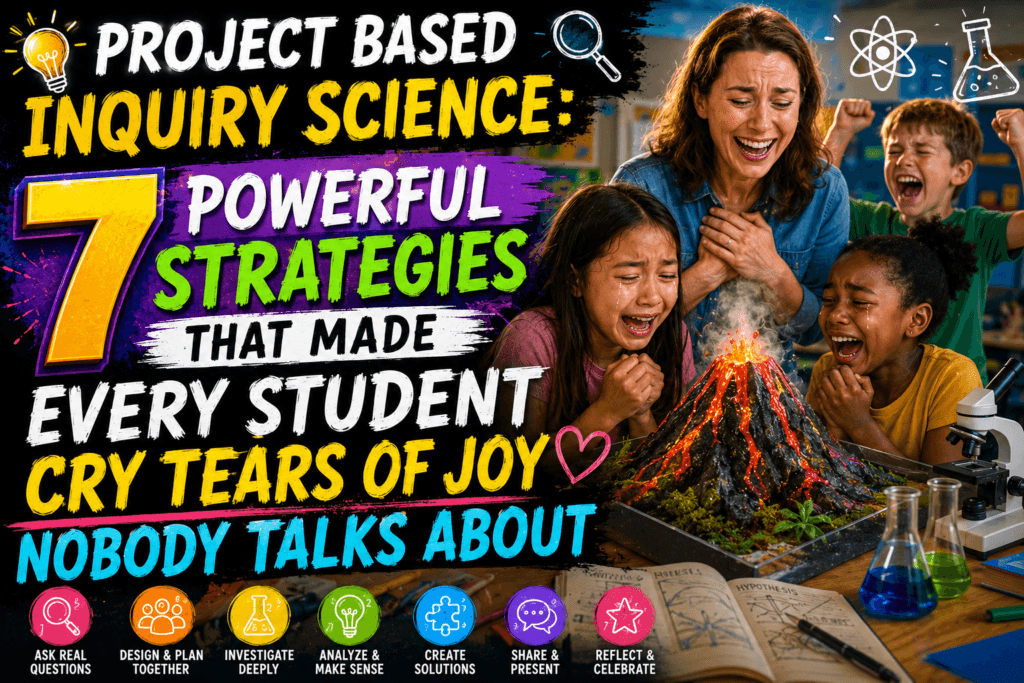
Discover how project based inquiry science transforms boring classrooms into joyful learning experiences where struggling students finally thrive and exhausted teachers rediscover their passion for teaching.
Science Class Felt Like Prison

Ask any student what their least favorite class is and science comes up more often than teachers want to admit. Not because science is boring — science is genuinely one of the most fascinating subjects a human brain can encounter. Because the way science gets taught in most classrooms strips every drop of wonder out of it and replaces that wonder with memorization, worksheets, and tests that measure nothing except how well a student can temporarily hold information before forgetting it entirely.
Project based inquiry science exists as a direct response to that failure. Not as a trendy add-on to existing curriculum but as a fundamental rethinking of what science class is actually supposed to accomplish in a child’s life.
What This Approach Actually Means
Project based inquiry science is not project work with a science label stuck on top. The distinction matters enormously and getting it wrong produces exactly the kind of surface-level activity that looks engaging from the hallway but produces no deeper understanding than the worksheet it replaced.
Genuine project based inquiry science puts a real question at the center of everything — a question without an obvious answer, a question the students actually care about, a question that requires genuine investigation rather than looking up the correct response in chapter four. The project emerges from that inquiry rather than being assigned before the inquiry begins.
Why Traditional Science Teaching Fails
Nobody prints this in any official teaching guide but the honest version of why traditional science classrooms produce disengaged students is straightforward. The whole system was built around a single measurable outcome — test performance — rather than the messier, harder-to-measure outcome of producing people who actually think like scientists when they encounter unfamiliar problems.
Those two goals pull in opposite directions more often than education policy admits. Project based inquiry science points toward the second goal deliberately. Forming a question nobody has answered yet, designing a way to test it, sitting with results that do not make immediate sense, rebuilding your understanding around what the evidence actually shows — that sequence is what science education was always supposed to produce and what traditional teaching almost never delivers.
Strategy One Starts With Real Questions
The first project based inquiry science strategy that changes everything is also the simplest and the most consistently skipped. Let the question come from the students rather than the curriculum document. Real questions — questions students actually want answered — produce engagement that no amount of teacher enthusiasm or colorful worksheet design ever manages to generate artificially.
This does not mean abandoning curriculum requirements. It means finding the genuine question hiding inside the curriculum requirement and surfacing that question for students rather than telling them the answer before they have had a chance to wonder about it. Every science standard contains a real question worth asking. Project based inquiry science finds that question and puts it in front of students before anything else happens.
Strategy Two Makes Failure Productive

Traditional science teaching treats wrong answers as problems. Project based inquiry science treats wrong answers as data. That shift in how failure gets framed changes the entire emotional experience of science class for students who have learned to associate being wrong with being stupid rather than being in the middle of a learning process.
Something unexpected landed in the results — good. Now the real thinking begins. A student trained in project based inquiry science sits with that unexpected outcome and asks what it is actually telling them rather than assuming they did something wrong. That instinct — treat surprise as information rather than failure — is one of the most transferable thinking habits any classroom can develop and one of the hardest to build through traditional instruction.
Strategy Three Connects To Real Life
Project based inquiry science lands differently when the investigation connects to something students can see, touch, or experience outside the classroom walls. Abstract science concepts taught in isolation from anything a student encounters in daily life produce abstract understanding that evaporates between Friday afternoon and Monday morning.
Water quality investigations using samples from local sources. Weather pattern analysis using data from the students’ own neighborhood. Structural engineering challenges using materials students can find at home. Project based inquiry science that connects curriculum content to the actual world students inhabit produces understanding that sticks because it has somewhere real to attach itself rather than floating in an abstract conceptual space that feels disconnected from everything that matters.
Strategy Four Uses Collaborative Teams
Science does not happen in isolation and science education should not either. Project based inquiry science organized around genuine collaborative teams rather than individual seat work produces something that individual assignments never can — the experience of thinking through a problem with other people who see it differently than you do.
Dropping students into groups and hoping productive thinking emerges is not collaboration — it is optimistic chaos. Real project based inquiry science teamwork needs defined roles where each person’s contribution actually changes what the group can accomplish, plus structured moments where teams reflect on how their collective thinking shifted through the investigation. That reflection on collaborative thinking is itself a form of scientific metacognition that individual work simply cannot replicate.
Strategy Five Presents To Real Audiences
Something shifts when students know their work will be seen by someone other than the teacher who assigned it. Project based inquiry science that culminates in presentations to genuine audiences — other classes, parents, community members, local scientists, or even filmed presentations for future students — produces a quality of effort and care that working toward a grade rarely generates on its own.
The audience does not need to be large or formally organized. A presentation to two other classroom teams is a real audience. A display in the school hallway is a real audience. What matters is that students understand their investigation produced something worth communicating to people who were not in the room when the work happened, because that is exactly what real scientific work produces.
Strategy Six Documents The Thinking Process
Most science assessments measure what students know at the end. Project based inquiry science documentation captures how students thought throughout — the initial hypotheses, the moments of confusion, the revised understanding, the questions that emerged from each investigation stage. That documentation is both a more accurate picture of scientific thinking and a more powerful learning tool than any end-point test.
Science notebooks, investigation journals, or digital documentation portfolios all serve this function when students are encouraged to record genuine thinking rather than cleaned-up final answers. The messy middle of an investigation — where understanding is incomplete and questions outnumber answers — is where the most important learning happens, and project based inquiry science documentation makes that messy middle visible and valuable rather than hiding it behind a polished final product.
Strategy Seven Connects Across Subjects
Project based inquiry science investigations rarely stay inside the boundaries of a single subject area when they are genuinely complex. A local ecosystem investigation pulls in reading, data analysis, written communication, and historical land use knowledge simultaneously. Treating that boundary-crossing as a scheduling opportunity rather than a logistical headache produces learning that travels across contexts in ways that single-subject instruction almost never manages.
Students who move through school experiencing knowledge as one connected web rather than separate containers labeled math, science, English, and history arrive at unfamiliar problems with a fundamentally different toolkit. Project based inquiry science builds that web deliberately by letting investigations go wherever genuine inquiry takes them rather than cutting them off at the subject boundary line.
Teachers Transform Alongside Students

Something unexpected happens to teachers who commit genuinely to project based inquiry science rather than dabbling in it occasionally between more traditional units. The role shifts from information deliverer to investigation facilitator and that shift turns out to be more professionally satisfying for most teachers than the traditional role ever was.
Teachers who have been in classrooms for fifteen years and thought they had lost their enthusiasm for the work describe project based inquiry science as the thing that brought them back. Not because it is easier — it is often harder, especially at first — but because it puts genuine intellectual engagement back at the center of what happens in a classroom and that engagement is contagious in both directions.
Assessment Looks Completely Different
Grading project based inquiry science means letting go of the single test score as the primary evidence of learning. The real evidence is scattered across the entire investigation — quality of initial questions, rigor of the testing approach, interpretation of what the results actually showed, clarity of communication, and the capacity to connect this investigation to questions that come next.
Rubrics built specifically for project based inquiry science capture that distributed evidence in ways that a multiple choice test never approaches. They measure whether a student thinks like a scientist rather than whether a student sounds like one, and that distinction matters most for the students at both ends of the traditional testing spectrum — those who think deeply but freeze on formal assessments and those who perform perfectly on tests while never having genuinely investigated anything.
Frequently Asked Questions
What makes project based inquiry science different from regular science projects?
Regular projects often start with known outcomes students work toward. Project based inquiry science starts with genuine open questions where students design the investigation and outcomes emerge from actual evidence.
How does project based inquiry science fit required curriculum standards?
Standards provide the content framework while the inquiry approach provides the learning methodology — investigations designed with standards in mind from the start satisfy both without either compromising the other.
Can project based inquiry science work without expensive equipment or laboratory resources?
Absolutely. The strongest investigations frequently draw on locally available materials and community connections rather than specialized equipment, making the approach accessible across very different school resource levels.
How much time does a project based inquiry science unit actually need?
Anywhere from one focused week to a full semester depending on investigation complexity, student age, and whether the teacher wants to develop inquiry process skills alongside the content itself.

Conclusion
Project based inquiry science is not a teaching strategy reserved for exceptional classrooms with unlimited time, perfect resources, and students who arrive already motivated. It is a teaching approach designed for the actual conditions most teachers face — mixed ability classrooms, constrained schedules, curriculum requirements that do not always feel inspiring, and students who have already learned to protect themselves from caring too much about school.
The seven strategies in this article work together rather than independently. Real questions create genuine investment. Productive failure builds scientific thinking habits. Real world connections create lasting understanding. Collaborative teams develop thinking that individual work cannot. Real audiences raise the quality of effort. Documentation captures the learning process. Cross-subject connections build knowledge that transfers.
Not one of these strategies demands a complete curriculum rebuild or a budget most schools will never see. Each one starts small — one unit, one investigation, one classroom — gets tested against what actually happens with real students, and grows from there based on evidence rather than assumption.
What project based inquiry science ultimately offers goes beyond better science content delivery. It gives students the actual experience of thinking scientifically from the inside — forming questions, testing ideas, changing their minds based on evidence, and communicating what they found to people who genuinely wanted to know. Students who have done that even once understand something about science that no amount of correct answers on a worksheet ever produces. And teachers who have watched it happen in their own classroom tend to spend the rest of their career figuring out how to make it happen again.