

Walk into any staffroom in England and ask teachers honestly whether they feel equipped to support autistic students properly. Most will pause before answering. Some will not answer at all. The silence says everything that the official statistics confirm — thousands of autistic children were sitting in classrooms designed around a version of learning that simply did not account for how their brains actually work.
The Autism Education Trust did not emerge from nowhere. It emerged from that specific failure — the gap between what schools were providing and what autistic children genuinely needed to access education without it costing them their wellbeing in the process.
What This Organization Actually Is
Two national autism charities — the National Autistic Society and Ambitious about Autism — joined hands to run a not-for-profit program that carries Department for Education backing behind everything it produces. That institutional support is not a small detail. It means the Autism Education Trust sits inside the system rather than knocking on its door from outside.
Across England, schools, local councils, and large academy networks tap into what the Autism Education Trust offers through a web of regionally based training partners working under license. The whole architecture was deliberately built for breadth rather than depth in any single location, which is exactly why the reach has quietly grown larger than most people tracking education policy ever noticed.
Teachers Were Left Without Tools
Here is something that does not get said loudly enough. Most teachers genuinely want to support autistic students well. The problem was never a lack of willingness — it was a lack of practical knowledge delivered in formats that busy classroom practitioners could actually absorb and apply by Monday morning.
The Autism Education Trust identified that gap early and built its training programs specifically around what education professionals need rather than what researchers find theoretically interesting. Training modules cover autism awareness, effective teaching strategies, and building inclusive environments in sequences that grow practical confidence rather than just theoretical knowledge sitting unused.
Early Years Work Changes Everything
Something happens in the first five years of a child’s educational life that sets a direction. Get the environment right during that window and the child builds a relationship with learning that carries forward. Get it wrong and the repair work takes years longer than the prevention would have. The Autism Education Trust understood that mathematics early and put serious resource into the early years phase of its program as a result.
Practitioners who go through Autism Education Trust early years training come out reading behavioral signals through a different lens, adjusting sensory conditions in their settings, and building communication methods that move toward how autistic children actually take in the world. That changed understanding at age three or four shows up in how the same child experiences school at age nine or fourteen.
School Programs Reach The Most Kids

The middle phase of the Autism Education Trust program — the years when children move through primary and secondary school — is where the numbers get largest because this is where autistic children are most publicly either finding their footing or visibly losing it inside mainstream settings that were not originally designed with them in mind.
A tool called the progression framework sits at the center of what makes the Autism Education Trust school program genuinely different from basic awareness training. Teachers get a structured method for working out exactly where an autistic student is and what targeted support would actually shift their learning forward. No guessing. No hoping something generic lands well. A framework that has spread into mainstream schools across England because it works in ordinary classrooms with ordinary class sizes.
Post Sixteen Support Often Gets Ignored
Somewhere around the time autistic young people turn sixteen the support conversation has a habit of going quiet. The Autism Education Trust noticed that pattern and built a specific program strand addressing the post-sixteen phase because quiet is exactly the wrong response to what is actually one of the most demanding transition periods autistic people face in their entire educational journey.
Sixth forms, colleges, and vocational training environments run on completely different social and structural rules from the school settings autistic students spent years learning to read. Autism Education Trust post-sixteen training gives practitioners in those environments the specific knowledge to understand that what looks like disengagement or difficulty is often a navigation problem rather than a motivation problem — and those two things require completely different responses.
The Progression Framework Changed Practice
Picture what assessment of autistic students looked like before any shared framework existed. One teacher with good instincts and genuine interest produced one outcome. A different teacher in the next classroom produced something entirely different. Students with identical needs landed in wildly different support situations depending on which adult happened to be responsible for them that year.
The Autism Education Trust progression framework replaced that lottery with something consistent. Support staff, classroom teachers, and school leadership can now look at the same student through the same structured lens and arrive at shared conclusions about what that child actually needs right now. A single training day does not produce that consistency. A framework embedded across a whole school does — and the difference in outcomes between those two approaches is not subtle.
Licensed Training Partners Spread Reach
Rather than trying to run everything from a central London operation, the Autism Education Trust built its delivery through a network of licensed training partners spread across the country. That structural decision sounds administrative but it produces something that centralized delivery almost never manages — training that lands in local contexts rather than feeling imported from somewhere with different schools, different communities, and different pressures.
Regional training partners carry the Autism Education Trust framework and quality standards into the specific local authority landscapes they understand from the inside. A school in a rural county and a school in an urban multi-academy trust both get access to the same evidence base through partners who understand the very different worlds those schools operate in daily.
Parents Can Access Resources Too

The Autism Education Trust was built around education professionals but it never locked the gate against parents trying to find their footing inside a school system that can feel impenetrable when you are trying to advocate for a child whose needs are not being met. Resources that help caregivers understand their child’s educational entitlements and build more productive conversations with schools have always been part of what the program offers.
That matters for a reason that goes beyond individual families. The most durable support for autistic children happens when the adults at home and the adults at school are working from shared understanding rather than spending energy on misalignment that leaves the child caught in the middle. Autism Education Trust resources reaching parents is not a side feature — it is part of how the core mission actually works in practice.
Evidence Base Drives Every Decision
The Autism Education Trust does not build its training programs around what sounds reasonable or what has been done traditionally. Every program strand connects back to current research into good autism practice — the 2023 Good Autism Practice Report shapes what gets taught rather than accumulated institutional habit that nobody has questioned recently.
That commitment to evidence means the training updates when the research updates. Autism understanding has shifted considerably over recent years in ways that matter practically for how autistic students experience classrooms. An organization whose training calcifies around decade-old approaches fails the children currently in schools right now. The Autism Education Trust structure was designed to prevent exactly that kind of institutional drift.
The AET Became NEN Recently
The organization that started as the Autism Education Trust has moved into a new chapter — now operating as the Neuroinclusive Education Network sitting within the National Autistic Society structure. Autism expertise did not get set aside in that transition. It got built upon, with the expanded framework reaching toward practitioners supporting students with ADHD, dyslexia, Tourette Syndrome, and other forms of neurodivergence that frequently appear alongside autism rather than in isolation from it.
What the Autism Education Trust embedded in schools across England over nearly two decades does not disappear with a name change. The training relationships, the progression framework, the licensed partner network — all of it continues under the neuroinclusive umbrella. The foundation holds. The scope widens. The children who needed this work before still need it and the expanded reach means more of them encounter professionals who understand what they are actually experiencing.
Collaboration Drives Better Outcomes
A training day that sends practitioners back into an unchanged school environment tends to produce an unchanged school. The Autism Education Trust figured that out and built collaboration into the program structure rather than treating a single training event as a complete solution to what is genuinely a whole-school challenge requiring sustained organizational change.
Something important sits in that gap between schools that transformed their autism practice and those that attended identical training and returned to identical behavior. It is almost never about the training content. It is about whether a school built the internal structures — action plans, self-assessment processes, accountability mechanisms — that give what was learned somewhere to actually land and grow. Autism Education Trust programs push schools toward building those structures rather than collecting certificates.
Global Reach Growing Steadily
England is where the Autism Education Trust program was built and the English education system is where it fits most naturally. The reach has not stayed contained within those boundaries. Conversations with organizations in other countries about evidence-based approaches and practical tools have been happening long enough that the model carries credibility in international contexts where different educational cultures have tested the same ideas against different conditions.
When an approach holds up across genuinely different national educational systems it means something different than when the evidence base comes entirely from one context with its own particular assumptions baked invisibly into everything. That cross-national credibility strengthens the case for what the Autism Education Trust built rather than simply restating it in new locations.
Frequently Asked Questions
What does the Autism Education Trust actually provide to schools?
Training programs, practical tools, and research-backed resources helping education professionals support autistic students across early years, school, and post-sixteen settings with real classroom strategies.
Is the Autism Education Trust only for specialist autism schools?
No. The program targets mainstream schools specifically because that is where most autistic children are educated and where ordinary teachers most need practical support strategies.
Can parents use Autism Education Trust resources directly?
Yes. Resources helping caregivers understand educational entitlements and communicate effectively with schools have always been available alongside the professional-facing program materials.
Has the Autism Education Trust changed its name recently?
Yes. It now operates as the Neuroinclusive Education Network under the National Autistic Society, widening beyond autism while keeping autism expertise firmly at the center.
Conclusion
The Autism Education Trust did not solve the problem of autistic children failing in mainstream schools — no single organization could make that claim honestly. What it did was build the infrastructure that makes solving that problem possible at scale, which is a genuinely different and more durable contribution than any individual intervention could produce.
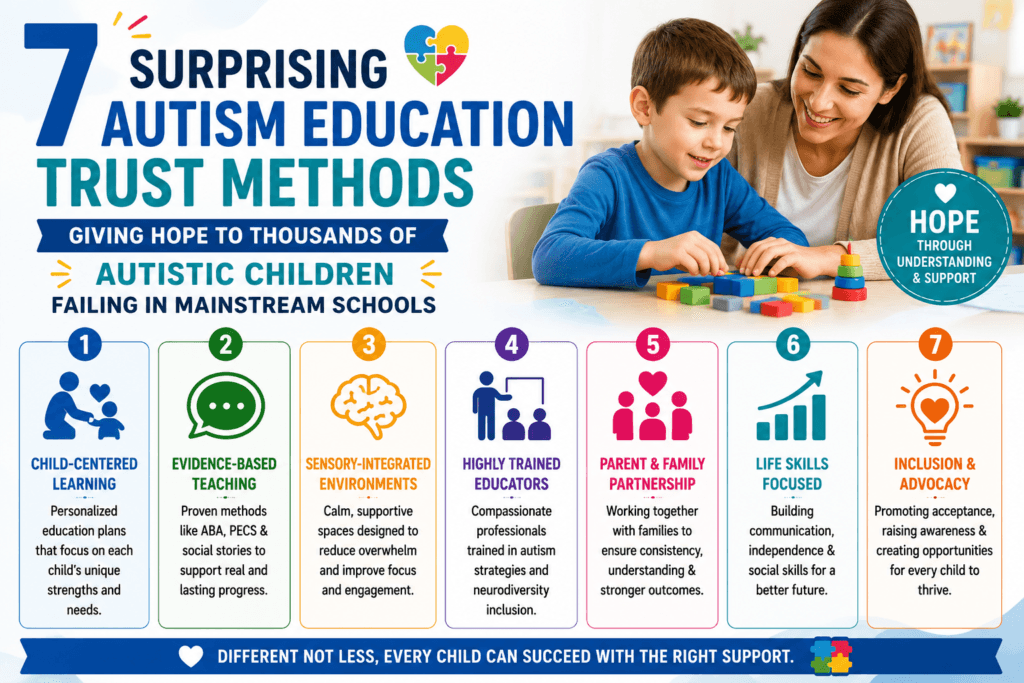
Seven methods, seven approaches, seven ways of thinking about how schools can do better for autistic students — they all trace back to the same foundational insight that the Autism Education Trust has been acting on since 2007. Autistic children do not fail in schools because something is wrong with them. They struggle because the schools were not built with them in mind and nobody gave the adults in those schools the knowledge to change that reality in practical terms.
The training programs address what teachers actually know. The progression framework addresses whether assessment is consistent or accidental. The licensed training partner model addresses whether good practice reaches rural counties or stays concentrated in well-resourced urban schools. The parent resources address whether home and school pull in the same direction. The evidence base commitment addresses whether the program stays current or drifts toward comfortable habit.
The post-sixteen focus addresses the age where support most commonly evaporates at exactly the moment young autistic people face their most demanding transitions. The shift toward a neuroinclusive model addresses the reality that neurodivergence rarely arrives in clean single-diagnosis packages that fit neatly into programs designed around one condition at a time.
Each piece addresses a different point where mainstream education has historically let autistic students down. Together they represent the most systematic and sustained attempt the English education system has produced to close the distance between what autistic children need and what the adults around them have been equipped to provide. The Autism Education Trust built that system piece by piece across nearly two decades and the children currently sitting in classrooms that work for them rather than against them are the only evidence that ever really mattered.