

Nobody working in technology genuinely expected this. The general assumption sitting comfortable in most boardrooms was that AI would expand the way social media did — freely, chaotically, and well ahead of any policy conversation that could realistically catch it. That assumption is now visibly, demonstrably wrong.
AI regulation news has been arriving in volumes and at speeds that leave even dedicated industry watchers perpetually behind. What felt like abstract policy theory eighteen months ago has hardened into active legislation, signed executive orders, and international frameworks carrying real financial penalties for organizations that ignore them.
Europe Wrote The First Rulebook
The EU AI Act did not tiptoe into existence. It arrived as the most structurally ambitious attempt any governing body had made to sort artificial intelligence into categories, assign risk levels to those categories, and attach genuine legal consequences to the highest risk applications.
Government-run citizen scoring systems, cameras that identify faces in crowded streets, and software quietly nudging human decisions without triggering conscious awareness — Brussels drew a hard line around all three and called it non-negotiable. Before any high-stakes system touches a real user, it now sits through documentation reviews, behavioral audits, and structural assessments that prove it behaves the way its creators claim it does.
America Chose Executive Action First
Washington’s approach landed differently than Brussels. Rather than comprehensive legislation moving through Congress, the United States went the executive order route — faster to implement, easier to adjust, and considerably more vulnerable to reversal when administrations change.
The Biden-era AI executive order established safety testing requirements for powerful models, called for watermarking of AI-generated content, and directed federal agencies to assess AI risks within their specific domains. AI regulation news watchers noted immediately that executive orders are not laws, which means the regulatory foundation built through them sits on ground that political transitions can shift considerably.
China Built Its Own Framework
Pull Beijing’s regulatory playbook next to Washington’s and Brussels’ versions and something immediately feels off — not wrong exactly, just built from a completely different starting assumption about what regulation is supposed to accomplish. The difference is worth sitting with rather than glossing over quickly.
Rather than sorting all AI into risk buckets first, China went straight after generative systems — every tool producing synthetic content now carries a mandatory origin label and clears a security review before any public user touches it. The result is a regulatory environment that is simultaneously more targeted in some areas and more opaque in others than its Western counterparts.
Algorithmic Transparency Demands Growing
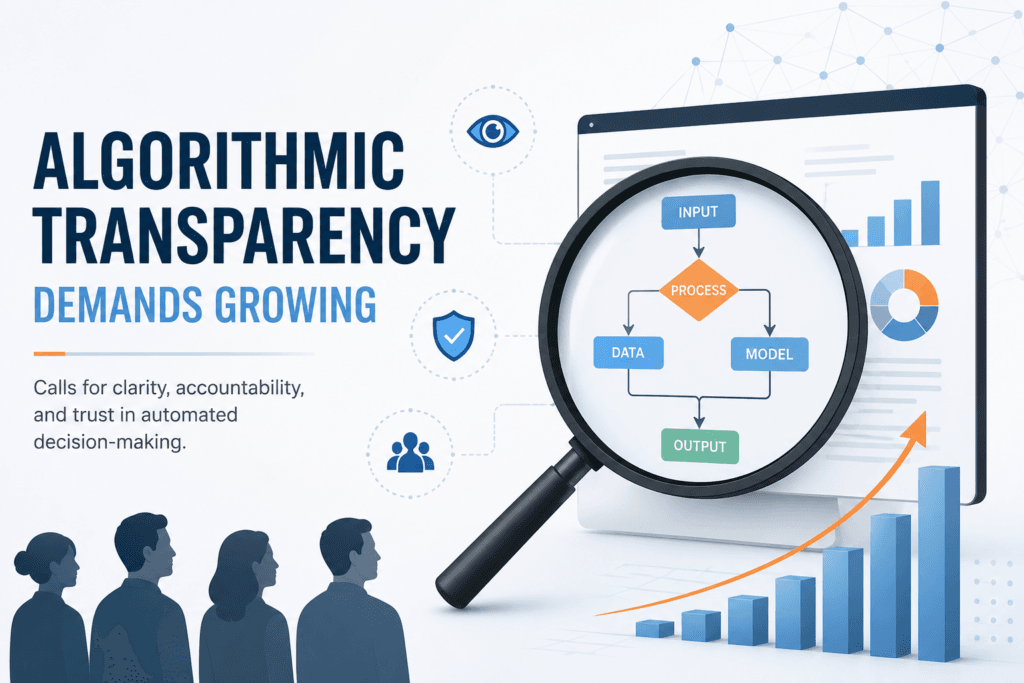
Governments across multiple jurisdictions have started pushing on a question that AI companies find genuinely uncomfortable. How does the system actually make its decisions — not the marketing version of that answer, but the technical, auditable, legally defensible version that a regulator can examine and a harmed individual can challenge in court.
Algorithmic transparency requirements appearing across AI regulation news coverage are forcing organizations to document model behavior in ways that most current development pipelines were never designed to produce. Retrofitting transparency into systems built without it is proving significantly more expensive and complicated than building it in from the start would have been.
Deepfake Laws Gaining Real Momentum
Synthetic media legislation has moved from fringe policy conversation to active lawmaking across multiple countries and several American states simultaneously. The triggers were predictable in retrospect — election interference concerns, non-consensual intimate imagery, financial fraud conducted through voice cloning and video manipulation.
AI regulation news on deepfake legislation has become its own substantial subcategory. Some jurisdictions are focusing on disclosure requirements — label it or face penalties. Others are moving toward outright prohibition of specific applications regardless of disclosure. The inconsistency across jurisdictions is creating compliance nightmares for platforms operating globally.
Liability Questions Remain Genuinely Unsettled
There is one corner of this whole regulatory conversation that keeps lawyers awake at genuinely unreasonable hours and somehow gets maybe three sentences in most mainstream coverage. It is the liability question and it does not have a clean answer yet.
A diagnostic tool flags the wrong condition. A hiring algorithm screens out a qualified candidate along demographic lines. A self-driving vehicle makes a fatal decision in a fraction of a second. The question nobody has cleanly answered yet — whose name goes on the lawsuit? Every legal structure governing accountability was assembled with a human at the center of the decision. Autonomous systems dissolved that center and nobody has rebuilt the framework around what replaced it.
Biometric Data Rules Tightening
Facial recognition specifically has attracted regulatory attention that goes beyond the AI Act’s public surveillance restrictions. Several cities banned municipal use of facial recognition technology before any national framework addressed it. Insurance companies, landlords, and employers using biometric systems are facing increasing scrutiny across multiple regulatory fronts simultaneously.
Three separate regulatory traditions — one continental, one Californian, several state-level — are all reaching toward the same category of AI system from different directions with different requirements and different enforcement mechanisms behind them. What satisfies a Brussels auditor and what satisfies a California regulator are turning out to be genuinely different things, and companies discovering that gap mid-deployment are paying for the surprise in ways they did not budget for.
Healthcare AI Faces Stricter Oversight
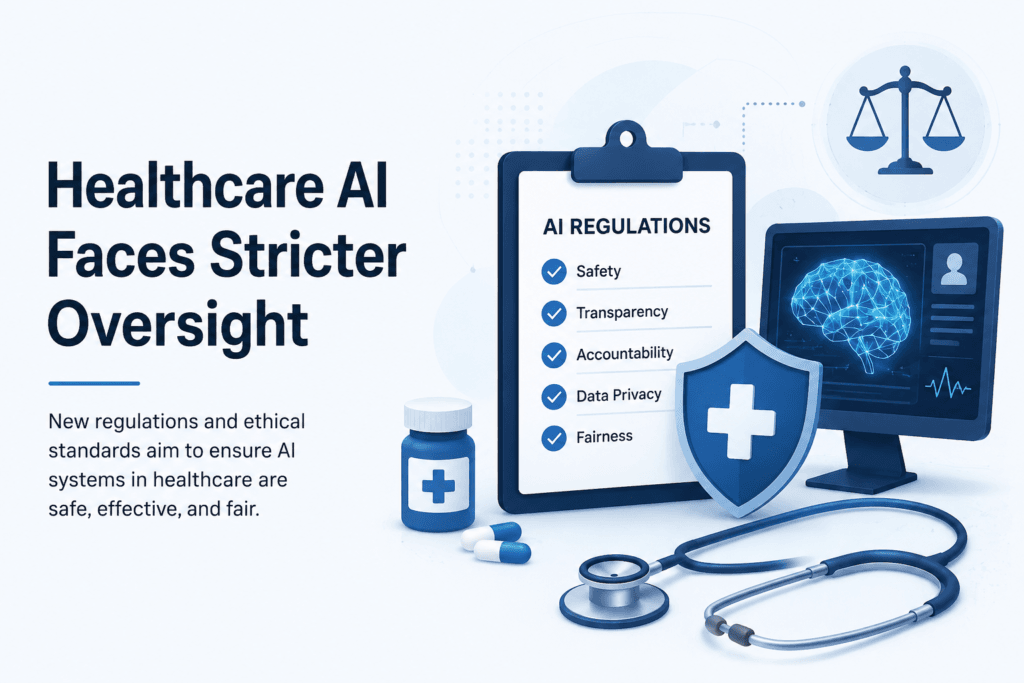
Medical AI applications are attracting regulatory attention proportional to the consequences of their failure, which are significant. Diagnostic support systems, drug interaction checkers, treatment recommendation engines — all of these are moving into regulatory territory that requires clinical validation, post-market surveillance, and in some jurisdictions explicit physician oversight requirements.
AI regulation news from healthcare regulators has been particularly active. The FDA has issued guidance on AI-based medical devices. European medical device regulations are being interpreted to cover software-based diagnostic tools. The core concern driving all of this is straightforward — a system that influences medical decisions needs accountability structures that match the severity of what happens when it is wrong.
Hiring Algorithm Scrutiny Intensifies
Employment decisions made or influenced by algorithmic systems have attracted regulatory attention in ways that caught many HR technology vendors genuinely unprepared. New York City passed local law requiring bias audits of automated employment decision tools. Colorado, Illinois, and Maryland have moved on various aspects of algorithmic hiring oversight.
The concern underneath all this AI regulation news about hiring is not abstract. Automated resume screening, predictive performance scoring, and interview analysis tools have demonstrated documented bias patterns across race, gender, and age in independent testing. Regulators are responding to evidence rather than theory, which makes this particular regulatory wave harder for industry to dismiss as uninformed overreach.
Small Companies Feel Compliance Weight
Large technology organizations have legal and compliance teams that can absorb new regulatory requirements, adjust development pipelines, and produce the documentation frameworks demand. Smaller companies building AI products do not have those resources and are discovering that compliance costs can represent a meaningful percentage of their operating budget.
The rules sit on paper the same way for every organization regardless of size, but the weight of actually meeting them lands hardest on teams without a dedicated compliance function and a legal budget that can absorb the additional overhead. This dynamic is functioning as unintentional market consolidation — raising barriers that well-resourced incumbents clear comfortably while smaller competitors struggle to follow.
International Coordination Remains Incomplete
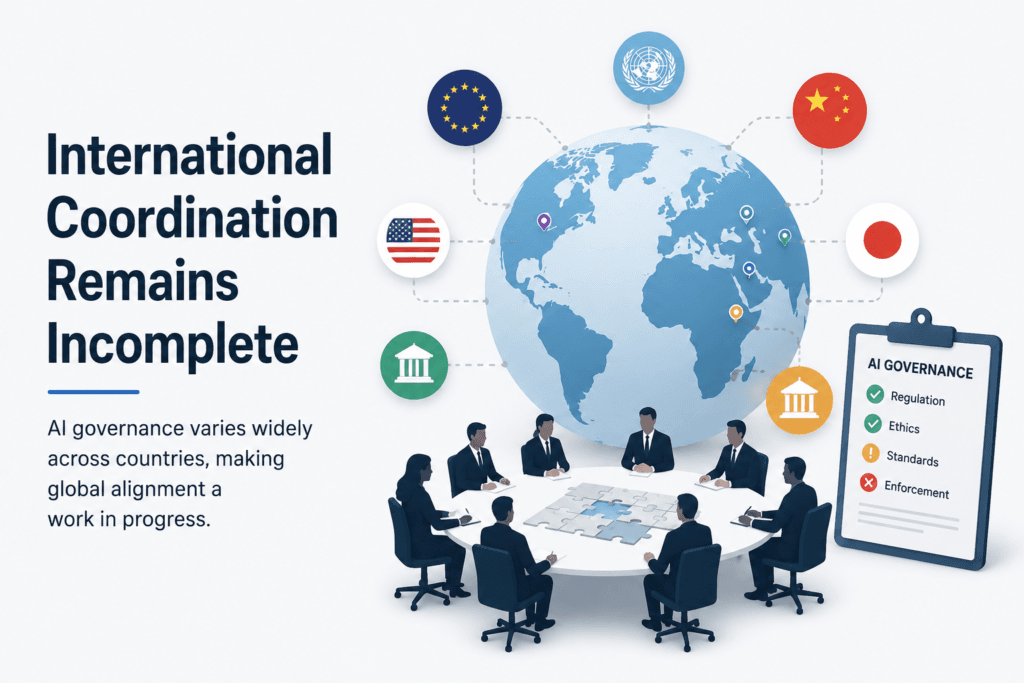
Different jurisdictions are producing different requirements on overlapping timelines with inconsistent definitions of fundamental terms. What constitutes high risk AI under the EU framework does not map cleanly onto how American executive guidance categorizes similar systems. Chinese requirements differ further still.
The AI regulation news picture at an international level is one of genuine fragmentation rather than coordinated global governance. Organizations operating across borders are building compliance programs that satisfy multiple frameworks simultaneously, which is expensive, complicated, and in some cases produces requirements that actively conflict with each other in ways that make full simultaneous compliance technically impossible.
Open Source Models Complicate Everything
Regulation designed around commercial AI deployments runs into a specific wall when applied to open source models that anyone can download, modify, and deploy without organizational accountability. The EU AI Act contains provisions attempting to address open source, but the practical enforcement questions remain genuinely unresolved.
AI regulation news covering open source has highlighted a fundamental tension. Regulatory frameworks assume identifiable responsible parties — a company that trained the model, deployed the system, and can be held accountable for its behavior. Open source distributions scatter that accountability across a global developer community in ways that existing legal concepts were not built to handle.
Frequently Asked Questions
What is driving the sudden acceleration in AI regulation news globally?
Real damage from live systems, documented electoral interference, and governments watching each other move first produced a legislative pace nobody inside the industry had modeled into their planning.
Does AI regulation apply differently to small businesses versus large corporations?
The rules apply equally on paper but compliance costs land hardest on smaller teams without dedicated legal functions and budgets built to absorb regulatory overhead comfortably.
How does AI regulation news in Europe affect companies based outside the EU?
Any organization deploying AI systems to EU residents falls under EU AI Act requirements regardless of where the organization itself is headquartered or incorporated globally.
Are there areas where AI regulation experts broadly agree on approach?
Ask regulators where they agree and two answers surface consistently — systems need to be explainable and highest-stakes applications need pre-deployment oversight. Implementation details dissolve the consensus immediately after.
Conclusion
AI regulation news is not slowing down. Every signal from every major jurisdiction points toward more requirements, stricter enforcement, higher penalties, and broader scope as governments gain confidence in their frameworks and as AI applications become more consequential across more domains of daily life.
The seven changes examined throughout this article represent the leading edge of a much larger regulatory transformation still in early stages despite moving faster than almost anyone predicted. Europe wrote comprehensive rules. America moved through executive action. China targeted generative systems specifically. Deepfake legislation gained teeth. Liability questions landed in courtrooms before legislatures answered them. Biometric restrictions multiplied. Healthcare oversight tightened significantly.
What makes this moment genuinely complicated for technology organizations is not any single regulatory requirement. It is the combination of multiple overlapping frameworks, inconsistent international coordination, unresolved liability questions, and the fundamental challenge of writing rules for systems whose capabilities are still changing faster than legislative processes can track.
What comes out the other side is regulation that lands precisely where it needs to in some places and completely misreads the technical situation in others — and untangling which is which will occupy courts and legal scholars for the better part of a decade. Strip away the legal complexity and one thing sits clearly underneath it for anyone with money or development hours inside an AI system. The question is no longer whether compliance matters but how far behind you already are.
For anyone building, deploying, or investing in AI systems, start treating compliance as a development requirement rather than a legal afterthought. The organizations building accountability and transparency into their processes now will navigate whatever the next wave of AI regulation news brings considerably better than those still waiting for final clarity before taking the question seriously.