
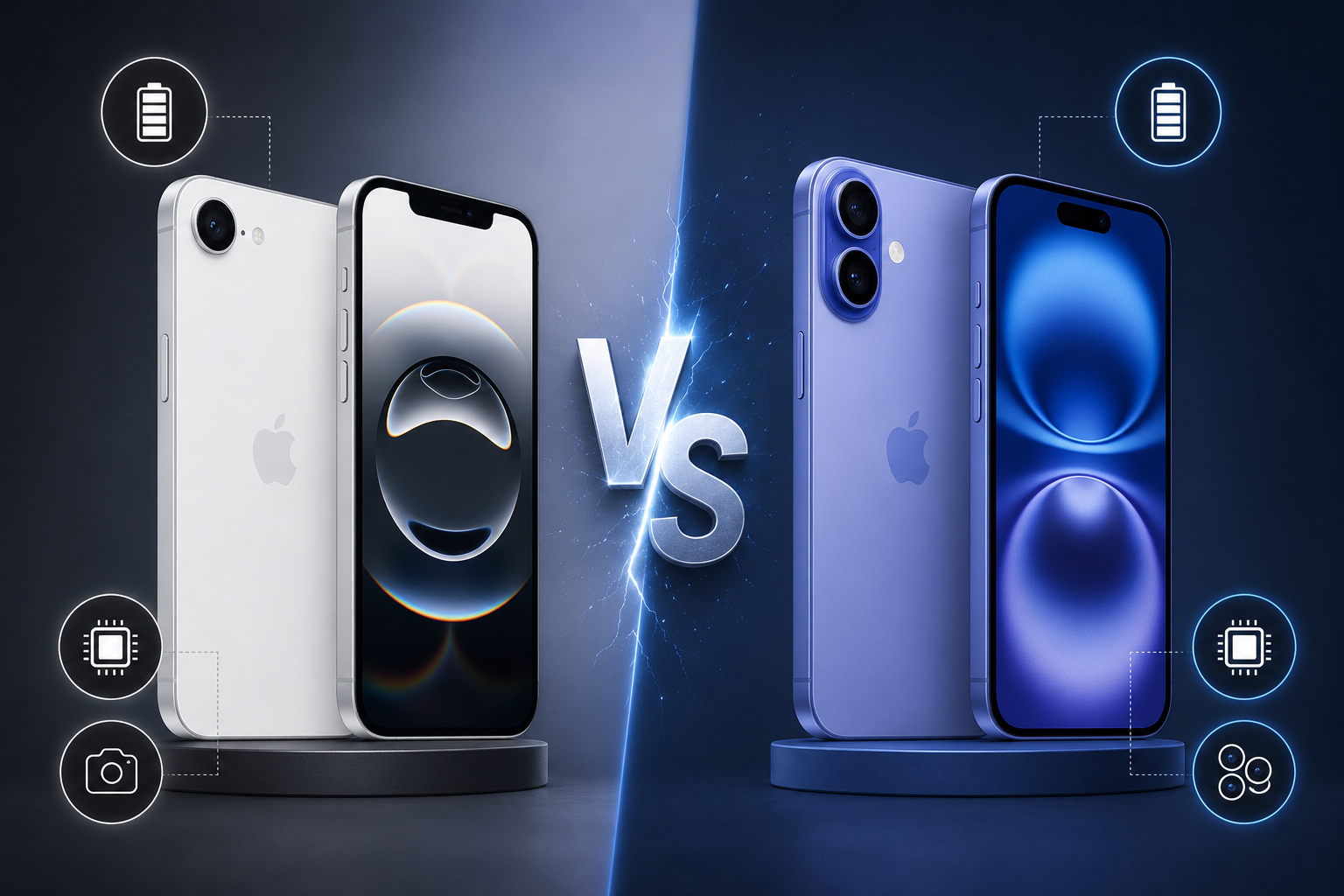
Confused between iPhone 16e vs iPhone 16? Discover the shocking differences in price, camera, design, and performance that will help you choose the right one.
Apple has a long history of offering multiple iPhone models at different price points, but the iPhone 16e changes the equation in ways that are genuinely worth paying attention to. For years, the budget-friendly iPhone option was the SE line — a small phone with an old design and a strong chip. The iPhone 16e is something different. It carries Apple Intelligence, a modern processor, and a fresh identity that blurs the line between budget and mainstream in ways that create real confusion for buyers trying to figure out which phone is actually worth their money.
The iPhone 16e vs iPhone 16 comparison is not as straightforward as most people assume going in. On paper the price difference looks like the obvious deciding factor — the 16e starts at $599 while the iPhone 16 starts at $799, a $200 gap that feels significant. But the differences between these two phones go beyond price in both directions. Some of the gaps favor the 16e in surprising ways, and some of the compromises in the 16e are more impactful than they first appear. This guide breaks down every meaningful difference so you can make a decision you will actually feel good about.
Design Differences That Matter
The physical design gap between the iPhone 16e vs iPhone 16 is more significant than most comparison articles acknowledge. The iPhone 16 uses Apple’s current design language with the Dynamic Island — the pill-shaped cutout at the top of the screen that houses Face ID sensors and displays notifications, timers, and activity indicators in an animated, interactive way. The iPhone 16e drops Dynamic Island entirely and returns to the older notch design, which feels like a step backward in everyday use once you have experienced Dynamic Island’s utility.
The iPhone 16 also introduces the Action Button — a customizable physical button on the left side of the phone that can be programmed to launch the camera, toggle silent mode, activate a shortcut, or trigger any number of custom actions. The iPhone 16e does not have an Action Button. It uses the traditional silent switch that has been on iPhones for over a decade. Neither design is broken, but the Action Button is genuinely useful once you set it up for your most frequent action, and its absence on the 16e is a real omission rather than just a spec sheet difference.
Screen Size and Display Quality
Screen size is one of the most noticeable daily differences in the iPhone 16e vs iPhone 16 comparison. The iPhone 16e has a 6.1-inch Super Retina XDR OLED display — the same screen size as the iPhone 16 — but the similarities largely end there. The iPhone 16e display runs at 60Hz, meaning the screen refreshes 60 times per second. The iPhone 16 also runs at 60Hz on its standard display, which means both phones share this specification and neither offers the 120Hz ProMotion technology found in the Pro models.
You can check out this iPhone Android VPN guide for additional context on how iPhone models differ in their privacy and connectivity features across generations. The iPhone 16e and iPhone 16 both use OLED panels with similar peak brightness levels around 2000 nits, good color accuracy, and True Tone technology that adjusts the white balance to match ambient lighting. The displays are genuinely comparable in everyday use, which makes screen quality one of the less dramatic differences in the iPhone 16e vs iPhone 16 debate and shifts attention toward the more impactful gaps elsewhere.
Camera Systems Compared
Camera capability is where the iPhone 16e vs iPhone 16 comparison gets genuinely interesting and the differences become most practically significant for most buyers. The iPhone 16 has a dual camera system on the back — a 48-megapixel main camera and a 12-megapixel ultrawide camera. The ultrawide adds a completely different field of view that is useful for landscape photography, architecture, group photos in tight spaces, and macro photography using Apple’s macro mode. It opens up creative options that a single camera simply cannot replicate.
The iPhone 16e has a single 48-megapixel main camera with no ultrawide. That single camera is capable and produces excellent images in good light with strong dynamic range and accurate color reproduction. But the absence of an ultrawide is a daily limitation for anyone who takes varied photos rather than just portraits and standard scenes. The iPhone 16 also includes a dedicated Camera Control button — a physical control on the right side of the phone that lets you quickly launch the camera and adjust settings like zoom and exposure with a touch-sensitive surface. The iPhone 16e does not have Camera Control, which is another hardware omission that affects how you interact with the camera experience.
Chip Performance Side by Side
The processor story in the iPhone 16e vs iPhone 16 comparison is one of the more surprising aspects of how Apple positioned these phones. The iPhone 16 uses the A18 chip. The iPhone 16e uses the A16 Bionic chip — the same chip found in the iPhone 14 Pro from 2022. That is a two-generation gap, and it matters in specific ways. The A18 in the iPhone 16 is built on a 3-nanometer process and delivers noticeably better CPU and GPU performance alongside the Neural Engine improvements that power Apple Intelligence features.
Both phones support Apple Intelligence, which is the key AI feature set Apple introduced with the iPhone 16 generation. However, the A16 in the iPhone 16e handles some Apple Intelligence tasks more slowly and may face limitations with future AI features that require the more powerful neural processing in the A18. For everyday tasks — app launching, web browsing, social media, messaging, streaming — the A16 is completely adequate and most users will not feel a meaningful performance difference. For demanding applications, gaming, and future-proofing over a five-year ownership period, the A18 in the iPhone 16 has a clear advantage.
Battery Life and Charging
Battery life is an area where the iPhone 16e vs iPhone 16 comparison delivers a genuine surprise in the 16e’s favor. Apple rates the iPhone 16e for up to 26 hours of video playback, compared to 22 hours for the standard iPhone 16. Real-world testing from multiple technology publications has confirmed that the iPhone 16e tends to outlast the iPhone 16 by one to two hours under typical mixed usage conditions. The reason is partly the less powerful chip consuming less energy and partly battery capacity optimization in the 16e’s design.
Charging speed tells a different story. The iPhone 16e supports up to 25W wired charging, the same as the iPhone 16. Both phones support MagSafe wireless charging, but the iPhone 16e supports MagSafe at up to 25W while the iPhone 16 supports it at up to 25W as well — matching on paper. The iPhone 16, however, also supports the new MagSafe accessory ecosystem more fully through its integration with the Action Button and Camera Control hardware. Neither phone ships with a charger in the box, which remains a frustrating Apple decision regardless of which model you choose.
iPhone 16e vs iPhone 16 Connectivity
Connectivity differences between the iPhone 16e vs iPhone 16 are subtle but worth knowing before purchasing. Both phones support 5G, Wi-Fi 6, Bluetooth 5.3, and USB-C with USB 3 speeds. The iPhone 16 adds a second generation Ultra Wideband chip that improves spatial awareness for features like Precision Finding in the Find My network and spatial audio handoff between devices. The iPhone 16e uses an older Ultra Wideband implementation that handles the core features but with less precision in range estimation.
Both phones include eSIM support and work without a physical SIM card in markets where carriers support eSIM activation. The iPhone 16 supports satellite connectivity for Emergency SOS and roadside assistance in supported regions, and so does the iPhone 16e — one area where Apple made no compromises on safety features regardless of price tier. Thread networking support, which enables smarter HomeKit device communication, is present on the iPhone 16 but absent on the iPhone 16e, which matters for users with a sophisticated Apple smart home setup but is irrelevant for most buyers.
Apple Intelligence Features Available
Apple Intelligence is the marketing name for Apple’s on-device AI feature set, and the iPhone 16e vs iPhone 16 comparison in this area requires careful attention. According to Forbes, Apple Intelligence features on the iPhone 16e are available but run through a combination of on-device processing and Private Cloud Compute — Apple’s secure server-side AI processing — more heavily than on the iPhone 16 due to the A16 chip’s less capable Neural Engine compared to the A18.
Practical Apple Intelligence features available on both phones include Writing Tools for proofreading and rewriting text across apps, Image Playground for generating images, Genmoji for creating custom emoji, and the enhanced Siri that can take actions across apps and answer questions about your personal context. Priority notification summaries, Clean Up in Photos, and the Visual Intelligence feature that uses the camera to identify objects and answer questions about them are also available on both models. The iPhone 16e delivers the full Apple Intelligence feature set as Apple has defined it at launch, though future features may demand more from the Neural Engine than the A16 provides.
Storage Options Available
Storage configuration choices differ between the iPhone 16e vs iPhone 16 in ways that affect value calculation at different price points. The iPhone 16e is available in 128GB and 256GB configurations. The iPhone 16 is available in 128GB, 256GB, and 512GB configurations. For most users, 128GB is sufficient for apps, photos, and a reasonable music and podcast library. For heavy camera users who shoot a lot of 4K video, or users who download large games or keep extensive local media libraries, the 256GB option is worth the upgrade cost on either model.
The absence of a 512GB option on the iPhone 16e eliminates the highest storage tier for buyers who genuinely need it and were hoping to save money on the base model while upgrading storage. On the iPhone 16, choosing 512GB currently costs $1,099 — well above the base price and well above the iPhone 16e’s price point entirely. iCloud storage is the practical alternative for most users who find local storage limiting, but it requires an ongoing subscription cost that should factor into the total cost of ownership comparison between the two models.
Price Value Breakdown
The $200 price difference between the iPhone 16e and iPhone 16 at their respective base configurations is the starting point for the value comparison, but the full picture requires factoring in what each phone actually delivers for that price. At $599, the iPhone 16e gives you a capable single camera, Apple Intelligence, MagSafe, USB-C, 5G, an OLED display, and excellent battery life in a package that covers the core smartphone experience well. At $799, the iPhone 16 adds a second ultrawide camera, Camera Control, Action Button, Dynamic Island, and the A18 chip.
For buyers who primarily use their phone for calling, messaging, social media, and occasional photos in standard situations, the iPhone 16e delivers roughly 85% of the iPhone 16 experience at 75% of the price. For buyers who care about photography versatility, want the newest chip for longevity, or use Dynamic Island and the Action Button regularly, the $200 premium for the iPhone 16 buys genuinely meaningful upgrades rather than marginal improvements. The right answer depends entirely on which features matter in your actual daily use rather than which phone wins a specification comparison on paper.
Who Should Buy iPhone 16e
The iPhone 16e makes the most sense for a specific type of buyer, and being honest about that helps more people make better decisions. First-time iPhone buyers switching from Android who want to enter the Apple ecosystem without paying flagship prices get excellent value from the 16e. Users replacing an iPhone 12 or 13 who want a meaningful upgrade — better chip, USB-C, Apple Intelligence, MagSafe — without paying current flagship prices will find the 16e covers every meaningful improvement they are looking for.
Budget-conscious buyers who primarily use their phone for social media, messaging, streaming, and standard photography rather than creative camera work will likely never feel the absence of the ultrawide camera or Camera Control in daily use. The 16e also makes sense as a secondary phone, a phone for younger family members entering the Apple ecosystem, or a work phone where the priority is reliability and software longevity over camera versatility. For these use cases, spending an extra $200 on the iPhone 16 would not produce a meaningfully better experience most days.
Who Should Buy iPhone 16
The iPhone 16 earns its $200 premium for buyers whose use cases align with what it adds over the 16e. Photography enthusiasts who regularly use an ultrawide lens — for travel, architecture, food, group shots, or video — will feel the single-camera limitation of the 16e frequently. The ultrawide is not a luxury feature for these users; it is a tool they reach for regularly, and its absence shapes every photo-taking decision throughout the day.
Buyers who want the most future-proof iPhone at a non-Pro price should lean toward the iPhone 16. The A18 chip’s advantage over the A16 in the 16e will become more apparent over a five-year ownership period as iOS updates and app requirements push hardware harder. The Camera Control button, while not essential, adds a genuinely useful way to interact with the camera that many users report missing on phones that lack it after a few weeks of use. The Dynamic Island’s utility for live activities, timers, and quick information access is also something users notice consistently once they have lived with it.
Software and iOS Updates
Software support longevity is one of the most practically important factors in an iPhone purchase and one that the iPhone 16e vs iPhone 16 comparison resolves similarly for both phones — but with a caveat. Apple typically supports iPhones with iOS updates for five to seven years after release. The iPhone 16e launched in 2025 with iOS 18 and can reasonably be expected to receive updates through iOS 23 or 24, giving it a comfortable software support runway regardless of its older chip.
The caveat is that as iOS evolves, features requiring more advanced hardware may arrive on the iPhone 16 before or instead of the iPhone 16e. Apple Intelligence is already partly constrained by the A16 chip in the 16e, and that pattern is likely to continue as future AI features demand more from the Neural Engine. The iPhone 16’s A18 chip gives it a cleaner path to supporting whatever Apple introduces over the next several iOS generations without hardware-based limitations becoming a factor sooner than expected.
Camera Quality in Real Conditions
Real-world camera performance between the iPhone 16e vs iPhone 16 in everyday shooting conditions is closer than the specification gap suggests for standard photography. The 48-megapixel main camera on both phones uses similar sensor technology and Apple’s computational photography pipeline, which means portraits, landscapes, and standard scenes look comparable when shot on the main lens in good light. The Photonic Engine processes both cameras’ output with the same fundamental approach, and the results at normal social media and printing sizes are difficult to distinguish.
Low-light performance is where the iPhone 16’s more powerful chip begins to show advantages in processing complex night mode shots faster and with slightly more detail retention in challenging conditions. Video capabilities are strong on both phones — both support 4K at 60fps on the main camera, Dolby Vision recording, and cinematic mode for video with rack focus effects. The iPhone 16e’s single camera limitation shows most clearly in video when you want to switch between standard and wide perspectives mid-shot, a workflow that requires a second camera to execute smoothly.
MagSafe and Accessories
MagSafe ecosystem compatibility is an area where both phones offer strong support, but with minor differences worth knowing. Both the iPhone 16e and iPhone 16 have the MagSafe magnet array built into their designs, which means compatible cases, wallets, chargers, and mounts attach with the same magnetic strength and alignment. The MagSafe ecosystem has grown significantly since its introduction with the iPhone 12, and both phones benefit equally from the wide range of accessories available.
The iPhone 16e supports MagSafe charging at up to 25W with a compatible MagSafe charger, matching the iPhone 16. Both phones also support Qi2 wireless charging at up to 15W with compatible chargers from third-party manufacturers, which expands the affordable wireless charging options beyond Apple’s own accessories. The practical accessory experience is nearly identical between the two models, which means case choices, wallet attachments, car mounts, and charging solutions work the same way regardless of which phone you choose.
iPhone 16e vs iPhone 16 Verdict
The iPhone 16e vs iPhone 16 decision ultimately comes down to two questions: How much do you care about camera versatility, and how much does a $200 difference matter to your budget right now? If both answers point the same direction — camera matters a lot and budget is flexible, or camera matters less and saving $200 is meaningful — the decision is easy. The harder case is when you care about the camera but the price difference is genuinely significant for your situation.
In that middle ground, the honest recommendation leans toward the iPhone 16 for most people who can stretch the budget. The ultrawide camera and Camera Control add practical value to daily photography in ways that the spec sheet does not fully capture. The A18 chip’s longevity advantage over the A16 becomes increasingly real over a four or five year ownership period. And Dynamic Island’s utility for live activities is something that genuinely improves the experience in ways that are hard to quantify until you have used it daily. The iPhone 16e is not a compromise phone — it is a genuinely good phone — but for buyers who can reach the iPhone 16’s price, it is usually the better long-term investment.
Frequently Asked Questions
What are the biggest differences in the iPhone 16e vs iPhone 16 comparison?
The most significant differences between the iPhone 16e vs iPhone 16 are the camera system, chip generation, and design features. The iPhone 16 has a dual camera with ultrawide, the newer A18 chip, Camera Control button, Action Button, and Dynamic Island. The iPhone 16e has a single main camera, the A16 Bionic chip, and the traditional notch design without Dynamic Island or Camera Control.
Is the iPhone 16e worth buying over the iPhone 16?
The iPhone 16e is worth buying if you primarily use your phone for messaging, social media, streaming, and standard photography, and the $200 savings is meaningful to your budget. It delivers Apple Intelligence, MagSafe, USB-C, and excellent battery life at a lower price. The iPhone 16 is worth the premium if camera versatility, the newest chip, and Dynamic Island matter to your daily use.
Does the iPhone 16e support Apple Intelligence like the iPhone 16?
Yes, both the iPhone 16e and iPhone 16 support Apple Intelligence. The iPhone 16e uses the A16 Bionic chip rather than the A18, which means some AI processing relies more heavily on Private Cloud Compute for complex tasks. All current Apple Intelligence features are available on the iPhone 16e, though future features may favor the A18’s more powerful Neural Engine.
How much cheaper is the iPhone 16e compared to the iPhone 16?
The iPhone 16e starts at $599 for the 128GB model, while the iPhone 16 starts at $799 for the 128GB model — a $200 difference at the base configuration. The iPhone 16 also offers a 512GB option at $1,099 that the iPhone 16e does not match, making the gap larger at higher storage tiers.
Conclusion
The iPhone 16e vs iPhone 16 comparison is more nuanced than a simple budget versus mainstream framing suggests. The iPhone 16e is a genuinely capable phone that delivers the core Apple experience — Apple Intelligence, MagSafe, USB-C, OLED display, and strong battery life — at a price point that makes it the most accessible modern iPhone Apple has ever offered. It is not a phone full of painful compromises. It is a phone with specific, deliberate omissions that matter more for some users than others.
The iPhone 16 justifies its $200 premium through the ultrawide camera, Camera Control, Action Button, Dynamic Island, and the A18 chip’s performance and longevity advantage. These are not trivial additions for users whose daily habits involve varied photography, frequent camera use, and a desire for hardware that feels current across a long ownership period.
Choosing between the iPhone 16e vs iPhone 16 well means being honest about which features you actually use rather than which specifications look better in a comparison table. The iPhone 16e wins on value and battery life. The iPhone 16 wins on camera versatility, design features, and chip performance. Both phones run the same iOS, receive the same updates for the foreseeable future, and deliver the Apple software experience that millions of users choose every year. Pick the one that fits your real habits and your real budget, and either way you are getting a phone worth owning.