
Ready to shoot like a pro? Discover the best beginner level DSLR cameras, key features to look for, and 3 top picks that deliver outstanding results fast.
Photography has a way of pulling people in slowly and then completely. One decent shot at a family event, one sunset that actually came out the way you saw it, and suddenly you are researching cameras at midnight wondering whether your phone is really holding you back. For most people who reach that point, the beginner level DSLR is the natural next step — a real camera with interchangeable lenses, manual controls, and a sensor large enough to produce images that genuinely look different from smartphone photos in ways you can feel immediately.
The market for entry-level DSLR cameras is both generous and slightly overwhelming. Canon and Nikon have dominated this space for decades, and both brands offer multiple models aimed directly at first-time buyers. Sony, Pentax, and others compete as well, though with smaller market shares at the entry level. Knowing which beginner level DSLR to choose — and more importantly, knowing what to look for before spending money — makes the difference between a camera that grows with you for years and one that ends up unused in a drawer six months later.
Why DSLR Still Makes Sense
Mirrorless cameras have been getting most of the photography industry attention for the past several years, and there are real reasons for that. But the beginner level DSLR still makes a compelling case in 2026, particularly for first-time buyers who are working with a limited budget. Entry-level DSLRs are significantly cheaper than comparable mirrorless options, both for the body itself and for the lenses that work with them. The used market for DSLR equipment is deep, which means your money goes further when building a kit.
Battery life is another practical advantage that rarely gets enough attention in camera comparisons. A beginner level DSLR typically delivers 500 to 800 shots per charge, compared to 200 to 400 for most mirrorless cameras. For someone spending a full day shooting travel, events, or family gatherings, that difference is genuinely meaningful. The optical viewfinder on a DSLR shows you the actual scene through the lens rather than an electronic representation of it, which many photographers prefer for its clarity and zero lag.
Beginner Level DSLR Buying Basics
Before jumping to specific camera recommendations, spending a few minutes on what actually matters at the beginner level saves a lot of confusion later. Megapixel count is the spec most new buyers fixate on, and it matters the least of all the major specifications for most photography use cases. A 24-megapixel sensor and a 45-megapixel sensor produce images that are indistinguishable at normal viewing sizes. What matters far more is sensor size, autofocus performance, low-light capability, and how the camera feels in your hands during a long shooting session.
If you want a broader view of how technology buying decisions work across different product categories, this technology news today resource provides useful context on evaluating specs versus real-world performance. For a beginner level DSLR specifically, the kit lens that comes bundled with the camera body deserves attention too. The standard 18-55mm kit lens included with most entry-level Canon and Nikon DSLRs is a genuinely capable optic for learning composition and technique, and it covers a useful focal range for portraits, landscapes, and everyday shooting without requiring an immediate additional lens purchase.
Canon Rebel SL3 Review
The Canon EOS Rebel SL3 is the best argument for why the beginner level DSLR market is not dead despite mirrorless competition. It is the smallest and lightest DSLR Canon has ever made, which matters more than most camera reviews acknowledge. A camera you actually carry with you produces better photos than a technically superior camera left at home because it felt too heavy. The SL3 weighs just 449 grams with its kit lens, which puts it in comfortable all-day carry territory for most people.
The image quality from the SL3’s 24.1-megapixel APS-C sensor is excellent for the price point, with clean results up to ISO 3200 and usable images at ISO 6400 in good conditions. The autofocus system uses Canon’s Dual Pixel CMOS AF for live view and video shooting, which tracks subjects smoothly and reliably — a feature that was previously found only in much more expensive cameras. The vari-angle touchscreen makes shooting from awkward angles genuinely easy, and the 4K video capability puts it ahead of older entry-level Canon models that topped out at 1080p.
Nikon D3500 Still Impressive
The Nikon D3500 is technically a previous-generation model, but it remains one of the most recommended beginner level DSLR cameras available and for reasons that hold up completely in 2026. Its 24.2-megapixel APS-C sensor produces images with outstanding dynamic range and color accuracy for the price, and the EXPEED 4 image processor handles noise control well enough that ISO 1600 images look clean and usable in most lighting situations. Nikon’s color science at this price point is genuinely appealing — skin tones in particular have a warmth and naturalness that Canon’s cheaper models sometimes lack.
The D3500 shoots 5 frames per second in continuous mode, which is adequate for casual sports and action photography at the beginner level. Battery life is exceptional — Nikon rates the D3500 at 1500 shots per charge, which is among the best figures for any DSLR at any price point and means you will rarely think about charging on a normal shooting day. The body is slightly larger than the Canon SL3 but still comfortable for extended use, and the control layout is logical enough that most functions become intuitive within the first few shooting sessions.
Canon EOS 250D for Versatility
The Canon EOS 250D, known as the Rebel SL3 in North American markets, earns its place as the third top pick in the beginner level DSLR category specifically because of how well it balances still photography and video in a single compact body. For new photographers who want to shoot both photos and video content — for YouTube, social media, or personal documentation — the 250D handles both well enough that you do not immediately feel the need to buy a separate dedicated video camera.
The 250D offers full manual control in video mode, which allows a genuinely engaged beginner to learn video exposure and cinema-style shooting alongside their still photography development. The flip-out screen is particularly useful for video, letting you frame yourself when shooting self-directed content or angle the camera downward for product shots without lying on the floor. At roughly $650 to $750 new for the body and kit lens, the 250D represents a reasonable investment for someone who is serious about photography and wants a camera that will remain relevant through several years of skill development.
Beginner Level DSLR Sensor Basics
The sensor is the most important component inside any camera, and getting comfortable with a few basic sensor concepts makes every camera buying decision cleaner. All three cameras recommended in this guide use APS-C sensors, which is the standard sensor size for beginner level DSLR cameras. APS-C sensors are significantly larger than the sensors in smartphones — roughly 25 times larger in surface area — which is the primary reason DSLR images look distinctly different from phone photos in terms of depth of field, low-light performance, and overall image quality.
The crop factor associated with APS-C sensors means that focal lengths work differently than they do on full-frame cameras. A 50mm lens on an APS-C DSLR behaves like an 80mm lens on a full-frame body, which affects how you think about lens selection as your kit grows. For beginners, this is a technical detail rather than a practical problem — the kit lens covers the useful range regardless, and the crop factor becomes a consideration worth thinking about more carefully only when you start building a lens collection beyond the initial kit.
Autofocus Systems Explained Simply
Autofocus is one of those specifications that gets described in technical language that obscures what actually matters in everyday shooting. For a beginner level DSLR, the practical autofocus questions are: Does it lock focus quickly in good light? Does it handle moving subjects reasonably well? Does it struggle in dim conditions where you actually want to take photos? All three cameras recommended in this guide answer the first two questions positively. Low-light autofocus is where entry-level DSLRs show their limitations most clearly.
According to Popular Photography, entry-level DSLR autofocus systems perform best in phase-detection mode through the optical viewfinder rather than in live view mode through the screen, which uses the slower contrast-detection method on most models. Shooting through the viewfinder gives you noticeably faster and more reliable autofocus than shooting with the screen at arm’s length — a practical tip that makes a real difference when you are just starting out. The Canon SL3 is the exception here because its Dual Pixel AF performs well in live view, which is one reason it edges slightly ahead of the Nikon D3500 for video work specifically.
Best Lenses for Beginners
The kit lens that ships with your beginner level DSLR is a fine starting point but rarely a permanent solution for photographers who get serious about their craft. The standard 18-55mm kit lens covers everyday shooting well but has real limitations in low light, at longer focal lengths, and for subjects requiring fast autofocus like children or sports. Knowing which lens to add first — before buying anything else — makes a meaningful difference in what kinds of photos you can take.
The 50mm f/1.8 prime lens is the near-universal first upgrade recommendation for beginner level DSLR owners, regardless of brand. Canon’s version costs around $125, Nikon’s around $215, and both deliver image quality that dramatically outperforms the kit lens in low-light situations and for portrait photography. The wide f/1.8 aperture allows shooting in dim indoor environments without flash, creates the blurred background effect that most beginners are trying to achieve, and forces you to think more carefully about composition because you cannot zoom — you have to move your feet to frame the shot, which is genuinely good for developing photographic instincts.
Manual Mode Made Simple
Manual mode is where most beginners feel intimidated, and it is also where most of the meaningful improvement in photography skill actually happens. The three settings that control exposure — shutter speed, aperture, and ISO — interact with each other in a relationship called the exposure triangle. Changing one requires adjusting another to maintain the same overall brightness, and getting comfortable with those adjustments in real time is the core skill that separates a photographer who gets lucky shots from one who gets consistent results.
Start with aperture priority mode rather than jumping straight to full manual. In aperture priority, you set the aperture and the camera handles shutter speed automatically, which removes one variable while still giving you control over depth of field. Once you feel confident choosing apertures intuitively, switch to shutter priority to learn how shutter speed affects motion in your images. Full manual mode makes sense once you understand what each setting does individually — trying to learn all three simultaneously on your first shooting day tends to produce frustration rather than education.
Beginner Level DSLR for Portraits
Portrait photography is one of the first things new DSLR owners want to try, and a beginner level DSLR handles it well with the right approach. The APS-C sensor and a wide-aperture lens produce the shallow depth of field — the sharp subject against a blurred background — that defines the portrait photography look most beginners are going for. The 50mm f/1.8 lens mentioned earlier is the practical tool for this, but even the kit lens at its widest aperture produces noticeably more background blur than any smartphone at similar focal lengths.
Lighting matters more than almost any camera setting for portrait quality. Natural window light from the side produces flattering, dimensioned light that works well for most face shapes without any additional equipment. Placing your subject near a large window with indirect sunlight — not direct sunlight streaming through — gives you soft, even illumination that reduces harsh shadows and produces skin tones that look natural rather than clinical. A beginner level DSLR captures that light beautifully once you get the exposure settings roughly right, and the results will genuinely surprise you compared to what your phone produces in the same conditions.
Wildlife and Sports Photography Tips
Action photography with a beginner level DSLR requires working with the camera’s limitations rather than fighting against them. Entry-level DSLRs shoot at 3 to 5 frames per second in continuous mode, which is enough to capture decisive moments in many action scenarios but not fast enough for professional sports photography. The autofocus tracking on these cameras is adequate for moderately fast subjects but struggles with erratic or very high-speed movement.
The practical approach for beginners shooting action is to use shutter priority mode and set a shutter speed of at least 1/500 second for most sports and wildlife subjects — faster for birds in flight or fast-moving vehicles. Switch the autofocus mode to continuous rather than single shot, which keeps the camera tracking a moving subject as long as you half-press the shutter. Burst mode captures multiple frames during a sequence, increasing the probability that one frame catches the peak moment of the action. These techniques work with any beginner level DSLR and produce far better results than trying to time a single shot precisely.
Memory Cards and Accessories Needed
Buying a beginner level DSLR and forgetting to budget for accessories is a mistake that delays your first shooting session. The camera body and kit lens are just the starting point. A fast memory card — at minimum a Class 10 or UHS-I rated SD card with write speeds above 45 MB/s — prevents the camera’s buffer from filling up during burst shooting and keeps video recording running smoothly without interruption. Buying the cheapest available SD card is a common beginner mistake that produces frustrating performance limitations regardless of which camera body you own.
A spare battery is the other accessory worth buying immediately. Both Canon and Nikon sell affordable third-party compatible batteries that work as well as the originals at a fraction of the cost. Running out of battery halfway through a shooting session is an easily avoidable problem, and carrying one charged spare eliminates it entirely. A basic camera bag, lens cleaning cloth, and UV filter for the kit lens round out the starter kit without adding significant cost — the UV filter protects the front element of the lens from scratches and dust, which matters when you are still developing the habits of careful equipment handling.
Shooting RAW vs JPEG Explained
Every beginner level DSLR can capture images in RAW format as well as JPEG, and the difference matters enough to understand early in your photography education. JPEG files are processed in-camera — the camera applies sharpening, noise reduction, and color corrections automatically and delivers a finished image ready to share immediately. RAW files contain all the unprocessed sensor data without any in-camera processing, which gives you complete control over how the final image looks during editing but requires processing software to produce a viewable result.
Shooting RAW produces significantly more editing flexibility, particularly for recovering detail in overexposed highlights or underexposed shadows — situations that are common while you are still learning exposure. A RAW file that is one to two stops underexposed can often be rescued entirely in editing software, while a JPEG in the same situation frequently cannot. Adobe Lightroom and the free alternatives Darktable and RawTherapee all handle RAW files from Canon and Nikon DSLRs well. Starting with RAW from your first serious shooting sessions builds better habits and produces better results than relying on JPEG and working around its limitations.
Learning Composition Quickly
Technical camera skills and compositional awareness develop at different rates for most beginners, and composition is often the one that gets neglected because it feels less concrete than aperture settings or autofocus modes. But compositional decisions — where you place the subject in the frame, what you include and exclude at the edges, what angle you shoot from — have more impact on whether a photo looks interesting than the camera settings that produced it.
The rule of thirds is the starting point almost every photography teacher uses, and for good reason: placing your main subject at one of the intersecting points of a 3×3 grid over your frame produces more dynamically interesting images than centering the subject in most situations. Most beginner level DSLR cameras can display a grid overlay on the live view screen or in the viewfinder to help you apply this until it becomes intuitive. Beyond the rule of thirds, getting physically lower or higher than eye level — even by a small amount — changes the entire character of a shot in ways that immediately make your photos look more considered and deliberate.
Editing Software for New Photographers
Owning a beginner level DSLR without learning at least basic editing is leaving a significant portion of the camera’s capability unused. Raw files in particular need editing software to reach their full potential, but even JPEG images benefit from basic adjustments to exposure, contrast, and white balance that take less than two minutes per image once you know what you are doing. The editing stage is where technical competence and artistic vision come together, and developing comfort with it alongside your shooting skills produces much faster overall improvement.
Adobe Lightroom remains the industry standard for photo editing and organization, at around $10 per month as part of the Photography Plan that also includes Photoshop. For photographers who prefer not to pay a subscription, Darktable is a free and genuinely capable alternative that handles RAW processing, color grading, and image organization with a learning curve comparable to Lightroom. Capture One is a professional alternative favored by many commercial photographers for its color rendering, available in a perpetual license version that avoids ongoing subscription costs. Starting with any of these and sticking with it long enough to learn the interface produces far better results than switching between programs looking for the easiest option.
Beginner Level DSLR Budget Planning
The total cost of getting started with a beginner level DSLR is higher than the camera body price suggests, and building a realistic budget before buying prevents the frustration of feeling like you need to spend more money immediately after the initial purchase. A complete starter kit — body with kit lens, fast SD card, spare battery, basic camera bag, and lens cleaning supplies — typically runs $750 to $950 for a current Canon or Nikon entry-level model bought new.
Adding the 50mm f/1.8 prime lens as your first upgrade brings the total to roughly $900 to $1,200 depending on brand and where you buy. Buying refurbished bodies directly from Canon or Nikon, or buying used from reputable camera retailers, reduces the body cost by 20 to 40 percent without sacrificing reliability. Both Canon and Nikon have certified refurbished programs that sell manufacturer-inspected bodies with warranties, which is meaningfully safer than buying from random private sellers whose equipment history you cannot verify. Planning the full kit budget rather than just the camera body budget produces a more satisfying buying experience and gets you shooting with everything you need from day one.
Frequently Asked Questions
Which beginner level DSLR is best for someone with no camera experience?
The Canon EOS Rebel SL3 is the top recommendation for complete beginners with no prior camera experience. Its compact size makes it easy to carry consistently, the touchscreen interface is intuitive for anyone familiar with smartphones, and the Dual Pixel autofocus performs reliably in both photo and video modes. The guided shooting modes also help new photographers learn manual settings at their own pace.
Is a beginner level DSLR better than a mirrorless camera for new photographers?
For budget-conscious buyers, a beginner level DSLR offers better value than a comparable mirrorless camera. DSLRs have longer battery life, lower body and lens costs, a deeper used market, and optical viewfinders that many photographers prefer. Mirrorless cameras offer better video autofocus and more compact bodies at higher price points, but those advantages matter less at the entry level where budget is typically the primary constraint.
How long will a beginner level DSLR last before needing an upgrade?
A well-maintained beginner level DSLR realistically serves a developing photographer for three to five years before the camera body becomes a limiting factor. Most photographers find that lenses, lighting knowledge, and compositional awareness limit their results long before the camera body does. Investing in a good lens earlier rather than upgrading the camera body sooner is almost always the better use of a photography budget.
What memory card should I buy for my beginner level DSLR?
Choose a UHS-I rated SD card with at least 45 MB/s write speed for reliable performance with any beginner level DSLR. A 64GB card is sufficient for most shooting sessions — it holds approximately 1,800 RAW files from a 24-megapixel camera. Sandisk Extreme and Lexar Professional cards at this speed rating are reliable choices available at most electronics retailers at reasonable prices.
Conclusion
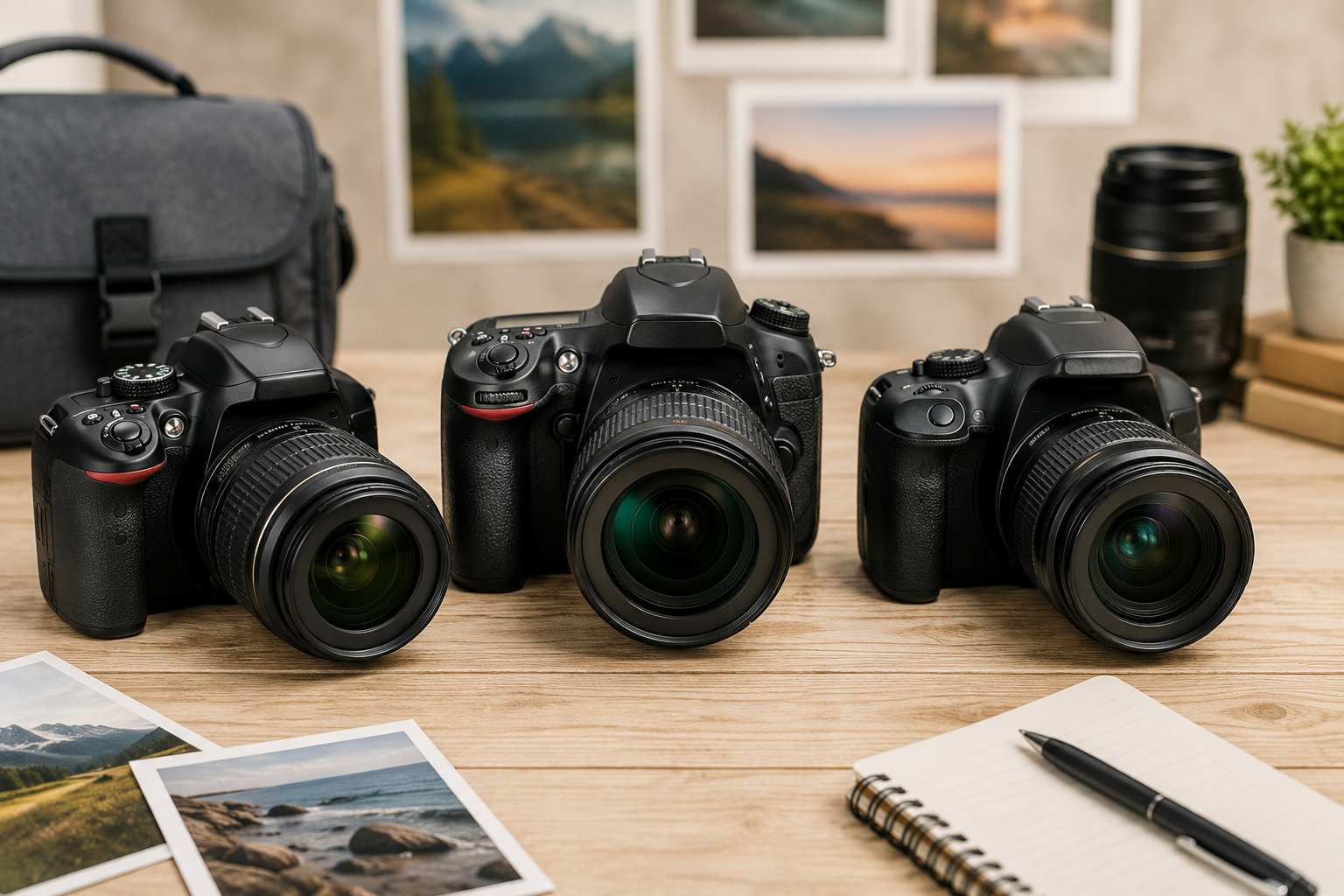
Getting your first beginner level DSLR is genuinely one of the more exciting purchases a photography enthusiast makes, and it deserves some careful thought rather than a rushed decision based on the first review you read. The three cameras covered in this guide — the Canon EOS Rebel SL3, the Nikon D3500, and the Canon EOS 250D — each represent a different set of priorities at the same general price point, and any of them will serve a new photographer well through years of learning and growth.
The Canon SL3 wins on compactness, video capability, and modern autofocus technology. The Nikon D3500 wins on battery life, image quality at the base ISO, and the exceptional value it represents given its current used market pricing. The Canon 250D sits between the two, balancing video and stills with a versatile flip screen that earns its keep in creative shooting situations.
Beyond the specific camera choice, the most important thing a new photographer can do with any beginner level DSLR is shoot consistently, edit regularly, and resist the urge to attribute limitations to the gear rather than the skill level behind it. The camera bodies recommended here are capable of producing portfolio-quality images in the hands of a photographer who understands light, composition, and exposure. Getting to that level takes time and repetition, and it starts with picking a beginner level DSLR and actually using it. Start there, and the rest follows naturally.